School of Public Health, Department of Preventive Medicine, Addis Ababa University, Addis Ababa, Ethiopia.
Faculty of Medicine, Palliative Care Unit, Hawassa University, Hawassa, Ethiopia.
BMC Health Serv Res. 2021 May 21;21(1):484. doi: 10.1186/s12913-021-06512-2.
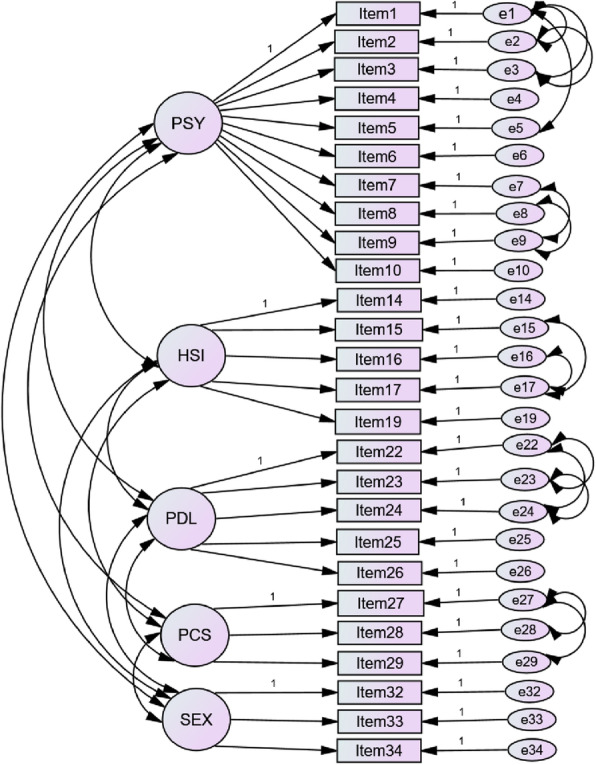
Supportive care needs survey short form has a total of 34 items that have 5 domains that measure the unmet needs of cancer patients. It is important to validate this tool since there are differences in culture, geographic areas, and clinical care service which influence patients' needs. Therefore, this study aimed to assess the construct validity and reliability of the tool.
The study was conducted among 170 cancer patients from April 1st to 30th 2019 in Hawassa hospital, South Ethiopia. Confirmatory factor analysis was done using fit indices. Convergent and discriminant validity was evaluated using average variance extracted and maximum shared variance respectively. Known group validity was checked using the Mann-Whitney U test. The reliability of the instrument was examined using Cronbach's alpha.
Domains except for health system and information, and patient care and support maintained convergent and divergent validity. The remaining validity was maintained after removing items that were redundant and double loading. The average variance extracted of domains varied from 0.52-0.81. The Square of correlation between constructs was lower than the average variance extracted for the constructs. The tool had reliability r = 0.932. The root mean square error of approximation was 0.057, comparative fit index 0.954, and the other fit indices were also indicating a good fit. Known groups difference was seen by age and type of treatment taken across the different domains.
After the health system and information, and patient care, and support domain validity issues were corrected by removing 8 items, the reduced tool was found to be a valid and reliable tool. The validated tool will be valuable if included in routine cancer care in our clinical settings.
支持性护理需求调查简表共有 34 个项目,分为 5 个领域,用于测量癌症患者的未满足需求。由于文化、地理位置和临床护理服务的差异会影响患者的需求,因此验证该工具非常重要。因此,本研究旨在评估该工具的结构效度和信度。
本研究于 2019 年 4 月 1 日至 30 日在埃塞俄比亚南部 Hawassa 医院进行,纳入了 170 名癌症患者。使用拟合指数进行验证性因子分析。平均方差提取和最大共享方差分别用于评估收敛和判别有效性。使用 Mann-Whitney U 检验检查已知组有效性。使用 Cronbach's alpha 检验评估仪器的可靠性。
除健康系统和信息以及患者护理和支持领域外,其他领域均保持收敛和发散有效性。在删除冗余和双重加载的项目后,其余有效性得以维持。各领域的平均方差提取值为 0.52-0.81。结构之间的相关平方低于结构的平均方差提取值。该工具的可靠性 r=0.932。逼近均方误差为 0.057,比较拟合指数为 0.954,其他拟合指数也表明拟合良好。不同领域的年龄和治疗类型存在已知组差异。
在纠正健康系统和信息以及患者护理和支持领域的有效性问题后,通过删除 8 个项目,发现简化工具具有有效性和可靠性。如果在我们的临床环境中常规癌症护理中包含该验证工具,它将具有价值。