Lau Eva, Belda Eugeni, Picq Paul, Carvalho Davide, Ferreira-Magalhães Manuel, Silva Maria Manuel, Barroso Isaac, Correia Flora, Vaz Cidália Pina, Miranda Isabel, Barbosa Adelino, Clément Karine, Doré Joel, Freitas Paula, Prifti Edi
Department of Endocrinology and Nutrition, Centro Hospitalar de S. João, Alameda Professor Hernani Monteiro, 4200-319, Porto, Portugal.
CINTESIS - Center for Health Technologies and Information Systems Research - Faculty of Medicine, University of Porto, Porto, Portugal.
Diabetol Metab Syndr. 2021 May 21;13(1):56. doi: 10.1186/s13098-021-00672-1.
Roux-en-Y gastric bypass (RYGB) surgery is one of the most efficient procedures for the treatment of obesity, also improving metabolic and inflammatory status, in patients with mild obesity. The underlying mechanisms have not been fully understood, but gut microbiota is hypothesized to play a key role. Our aim was to evaluate the association between gut microbiota changes and anthropometric, metabolic and inflammatory profiles after metabolic surgery compared with medical therapy, in type 2 diabetic (T2DM) adults with mild obesity (BMI 30-35 kg/m).
DM was an open-label, randomised controlled clinical trial (RCT: ISRCTN53984585) with 2 arms: (i) surgical, and (ii) medical. The main outcome was gut microbiota changes after: metabolic surgery (Roux-en-Y gastric bypass-RYGB) versus standard medical therapy. Secondary outcomes included anthropometric, metabolic and inflammatory profiles. Clinical visits, blood workup, and stool samples were collected at baseline and months (M)1, 3, 6, 12. Gut microbiota was profiled using 16S rRNA targeted sequencing.
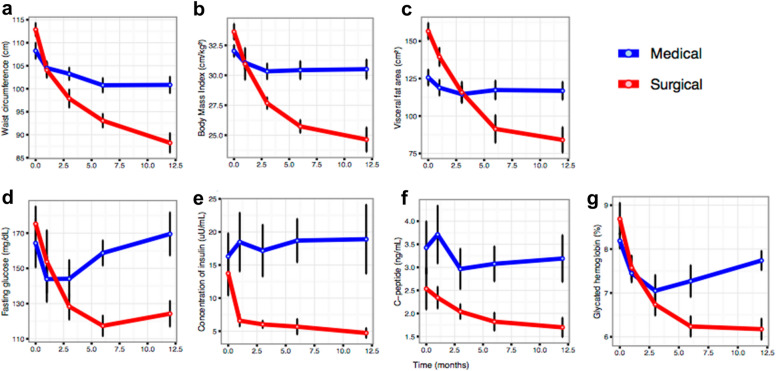
Twenty patients were included: 10 in surgical and 10 in medical arm. Anthropometric and metabolic comparative analysis favoured RYGB over medical arm. At M12, the percentage of weight loss was 25.5 vs. 4.9% (p < 0.001) and HbA1c was 6.2 vs. 7.7% (p < 0.001) respectively. We observed a continuous increase of genus richness after RYGB up until M12. In the medical arm, genus richness ended-up being significantly lower at M12. Composition analysis indicated significant changes of the overall microbial ecosystem (permanova p = 0.004, [R = 0.17]) during the follow-up period after RYGB. There was a strong association between improvement of anthropometric/metabolic/inflammatory biomarkers and increase in microbial richness and Proteobacterial lineages.
This was the first RCT studying composite clinical, analytic, and microbiome changes in T2DM patients with class 1 obesity after RYGB versus standard medical therapy. The remarkable phenotypic improvement after surgery occurred concomitantly with changes in the gut microbiome, but at a lower level.
ISRCTN53984585.
胃旁路手术(RYGB)是治疗肥胖症最有效的手术方法之一,对于轻度肥胖患者,该手术还能改善其代谢和炎症状态。其潜在机制尚未完全明确,但有假说认为肠道微生物群起着关键作用。我们的目的是评估在轻度肥胖(BMI 30 - 35kg/m²)的2型糖尿病(T2DM)成年患者中,与药物治疗相比,代谢手术后肠道微生物群变化与人体测量学、代谢和炎症指标之间的关联。
糖尿病(DM)是一项开放标签、随机对照临床试验(RCT:ISRCTN53984585),分为两组:(i)手术组,(ii)药物组。主要结局是代谢手术(胃旁路手术 - RYGB)与标准药物治疗后肠道微生物群的变化。次要结局包括人体测量学、代谢和炎症指标。在基线以及第1、3、6、12个月(M)进行临床访视、血液检查和粪便样本采集。使用16S rRNA靶向测序对肠道微生物群进行分析。
共纳入20例患者:手术组10例,药物组10例。人体测量学和代谢的对比分析显示,RYGB手术组优于药物组。在第12个月时,体重减轻百分比分别为25.5%和4.9%(p < 0.001),糖化血红蛋白分别为6.2%和7.7%(p < 0.001)。我们观察到RYGB手术后直至第12个月属丰富度持续增加。在药物组中,第12个月时属丰富度最终显著降低。组成分析表明,RYGB手术后随访期间整体微生物生态系统发生了显著变化(PERMANOVA p = 0.004,[R = 0.17])。人体测量学/代谢/炎症生物标志物的改善与微生物丰富度和变形菌门谱系的增加之间存在密切关联。
这是第一项研究胃旁路手术(RYGB)与标准药物治疗相比,1级肥胖T2DM患者综合临床、分析和微生物组变化的随机对照试验。手术后显著的表型改善与肠道微生物群的变化同时发生,但程度较低。
ISRCTN53984585。