Department of Radiology, Union Hospital, Tongji Medical College, Huazhong University of Science and Technology, 430022, Wuhan, China.
Hubei Province Key Laboratory of Molecular Imaging, 430022, Wuhan, China.
Transl Psychiatry. 2021 May 21;11(1):307. doi: 10.1038/s41398-021-01426-3.
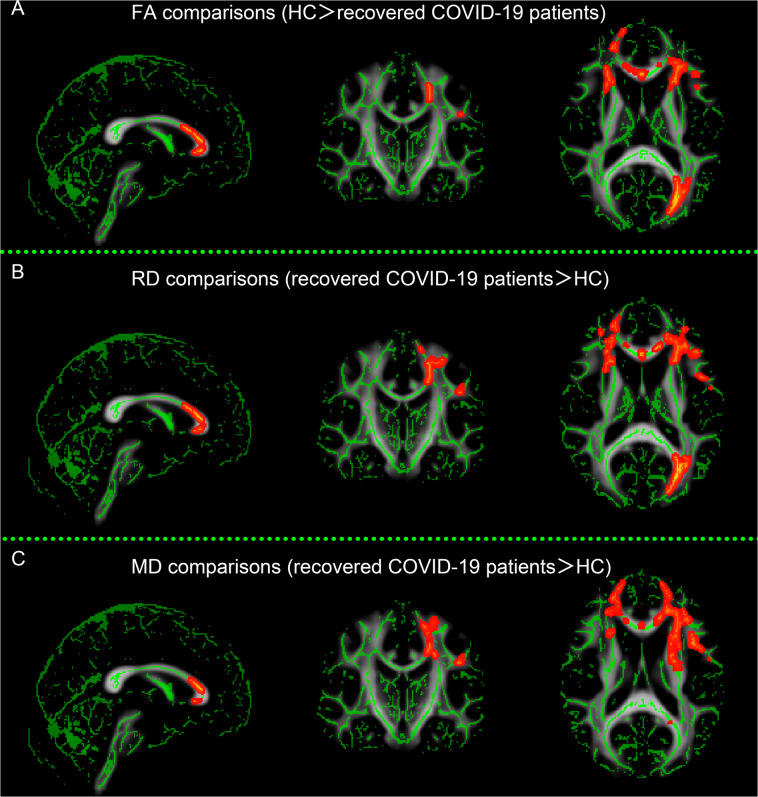
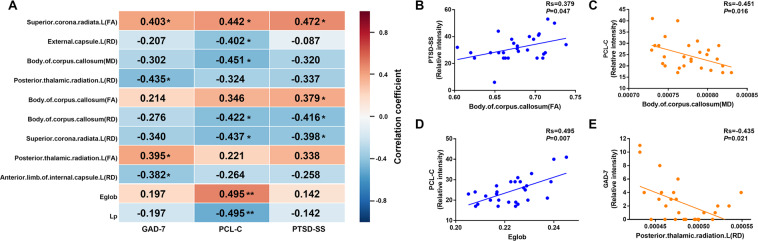
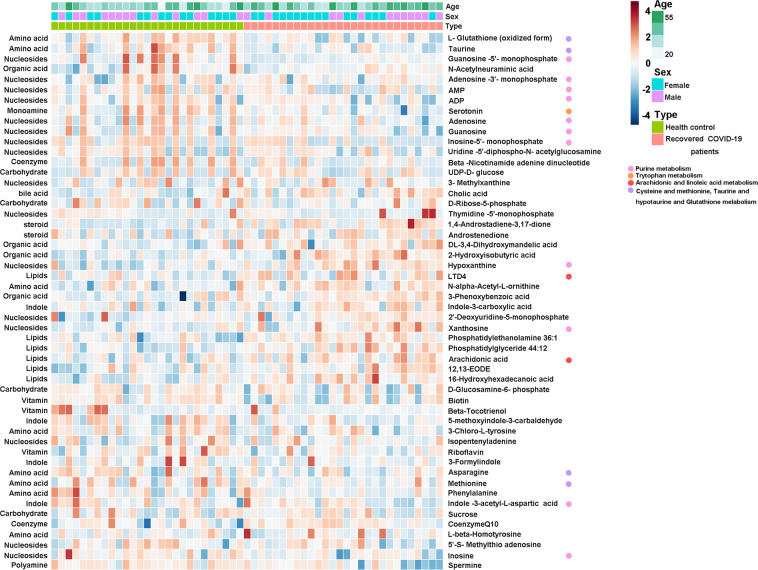
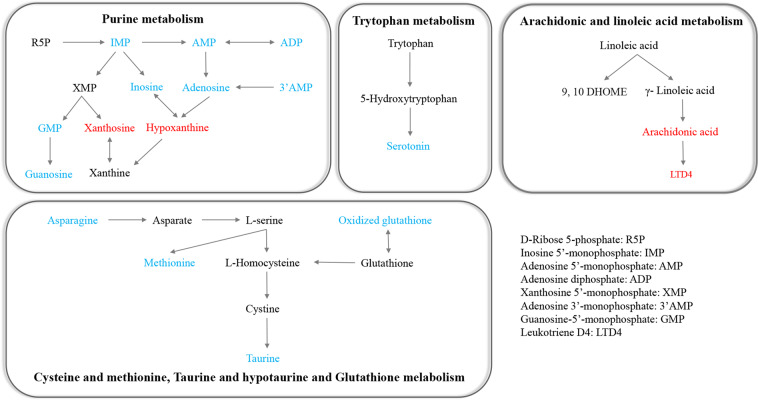
This study aimed to explore the associations between cerebral white matter (WM) alterations, mental health status, and metabolism in recovered COVID-19 patients. We included 28 recovered COVID-19 patients and 27 healthy controls between April 2020 and June 2020. Demographic data, the mental health scores, diffusion-tensor imaging (DTI) data, and plasma metabolomics were collected and compared between the two groups. Tract-based spatial statistics and graph theory approaches were used for DTI data analysis. Untargeted metabolomics analysis of the plasma was performed. Correlation analyses were performed between these characteristics. Recovered COVID-19 patients showed decreased fractional anisotropy, increased mean diffusivity and radial diffusivity values in widespread brain regions, and significantly lower global efficiency, longer shortest path length, and less nodal local efficiency in superior occipital gyrus (all, P < 0.05, Bonferroni corrected). Our results also demonstrated significantly different plasma metabolic profiling in recovered COVID-19 patients even at 3 months after their hospital discharge, which was mainly related to purine pathways, amino acids, lipids, and amine metabolism. Certain regions with cerebral WM alterations in the recovered patients showed significant correlations with different metabolites and the mental health scores. We observed multiple alterations in both WM integrity and plasma metabolomics that may explain the deteriorated mental health of recovered COVID-19 patients. These findings may provide potential biomarkers for the mental health evaluation for the recovered COVID-19 patients and potential targets for novel therapeutics.
本研究旨在探讨新冠肺炎康复患者脑白质(WM)改变、心理健康状况和代谢之间的关联。我们纳入了 2020 年 4 月至 6 月期间的 28 名新冠肺炎康复患者和 27 名健康对照者。收集并比较了两组患者的人口统计学数据、心理健康评分、弥散张量成像(DTI)数据和血浆代谢组学数据。采用基于束流的空间统计学和图论方法进行 DTI 数据分析。对血浆进行非靶向代谢组学分析。对这些特征进行相关性分析。新冠肺炎康复患者在广泛的脑区显示出部分各向异性分数降低、平均弥散度和径向弥散度增加,以及在顶枕上回的全局效率显著降低、最短路径长度显著增加和节点局部效率显著减少(所有 P < 0.05,经 Bonferroni 校正)。我们的结果还表明,新冠肺炎康复患者即使在出院后 3 个月,其血浆代谢谱也存在显著差异,这主要与嘌呤途径、氨基酸、脂质和胺代谢有关。在康复患者中,脑 WM 改变的某些区域与不同的代谢物和心理健康评分有显著的相关性。我们观察到 WM 完整性和血浆代谢组学的多个改变,这可能解释了新冠肺炎康复患者心理健康状况的恶化。这些发现可能为新冠肺炎康复患者的心理健康评估提供潜在的生物标志物,并为新的治疗方法提供潜在的靶点。