Batty G David, Deary Ian J, Fawns-Ritchie Chloe, Gale Catharine R, Altschul Drew
Department of Epidemiology and Public Health, University College London, UK.
Lothian Birth Cohorts, Department of Psychology, University of Edinburgh, UK.
Brain Behav Immun. 2021 Aug;96:100-105. doi: 10.1016/j.bbi.2021.05.016. Epub 2021 May 20.
Whereas several predictors of COVID-19 vaccine hesitancy have been reported, the role of cognitive function is largely unknown. Accordingly, our objective was to evaluate the association between scores from an array of cognitive function tests and self-reported vaccine hesitancy after the announcement of the successful testing of the first COVID-19 vaccine (Oxford University/AstraZeneca).
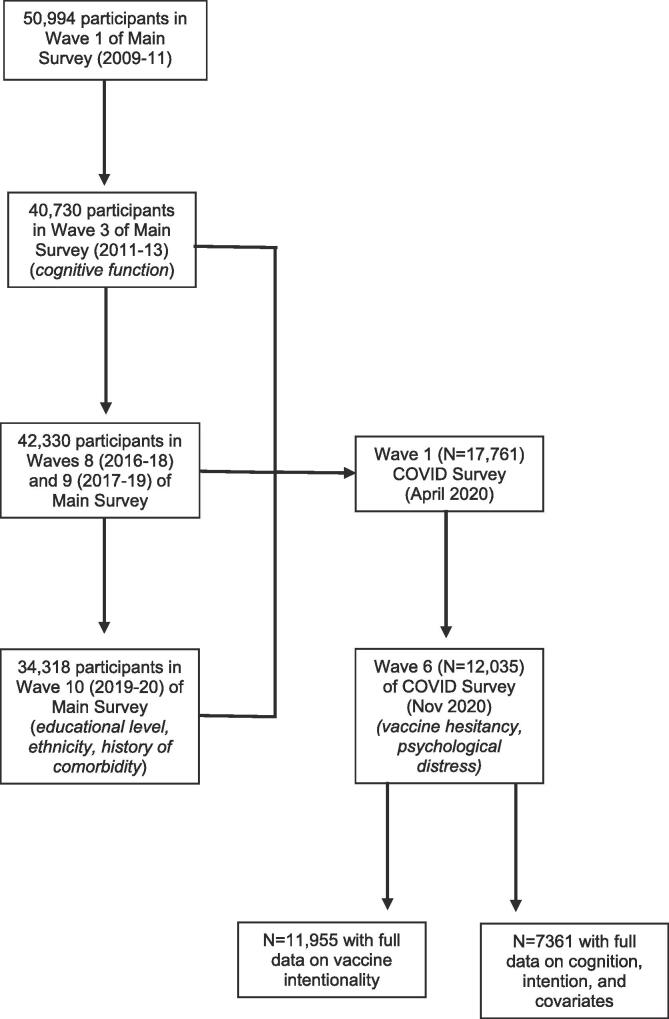
We used individual-level data from a pandemic-focused study ('COVID Survey'), a prospective cohort study nested within United Kingdom Understanding Society ('Main Survey'). In the week immediately following the announcement of successful testing of the first efficacious inoculation (November/December 2020), data on vaccine intentionality were collected in 11,740 individuals (6702 women) aged 16-95 years. Pre-pandemic scores on general cognitive function, ascertained from a battery of six tests, were captured in 2011/12 wave of the Main Survey. Study members self-reported their intention to take up a vaccination in the COVID-19 Survey.
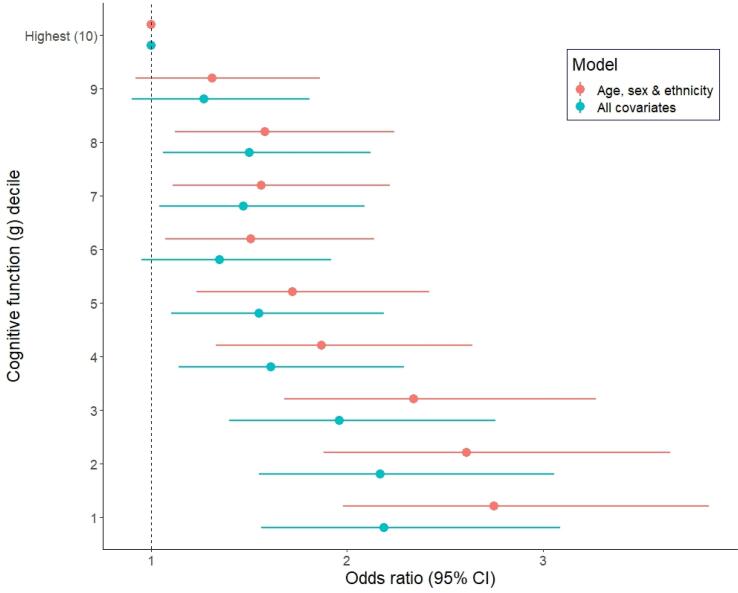
Of the study sample, 17.2% (N = 1842) indicated they were hesitant about having the vaccine. After adjustment for age, sex, and ethnicity, study members with a lower baseline cognition score were markedly more likely to be vaccine hesitant (odds ratio per standard deviation lower score in cognition; 95% confidence interval: 1.76; 1.62, 1.90). Adjustment for mental and physical health plus household shielding status had no impact on these results, whereas controlling for educational attainment led to partial attenuation but the probability of hesitancy was still elevated (1.52; 1.37, 1.67). There was a linear association for vaccine hesitancy across the full range of cognition scores (p for trend: p < 0.0001).
Erroneous social media reports might have complicated personal decision-making, leading to people with lower cognitive ability being vaccine-hesitant. With individuals with lower cognition also experiencing higher rates of COVID-19 in studies conducted prior to vaccine distribution, these new findings are suggestive of a potential additional disease burden.
尽管已有多项关于新冠疫苗犹豫的预测因素的报道,但认知功能的作用在很大程度上仍不明确。因此,我们的目标是评估在首个新冠疫苗(牛津大学/阿斯利康)成功测试公布后,一系列认知功能测试得分与自我报告的疫苗犹豫之间的关联。
我们使用了一项以大流行疫情为重点的研究(“新冠调查”)中的个体层面数据,该研究是嵌套于英国理解社会调查(“主要调查”)中的一项前瞻性队列研究。在首个有效疫苗测试成功公布后的第一周(2020年11月/12月),收集了11740名年龄在16 - 95岁之间的个体(6702名女性)的疫苗接种意向数据。在主要调查的2011/12轮中获取了通过一系列六项测试确定的大流行前的一般认知功能得分。研究成员在新冠调查中自我报告了他们接种疫苗的意向。
在研究样本中,17.2%(N = 1842)表示他们对接种疫苗持犹豫态度。在对年龄、性别和种族进行调整后,基线认知得分较低的研究成员明显更有可能对接种疫苗持犹豫态度(认知得分每降低一个标准差的优势比;95%置信区间:1.76;1.62,1.90)。对心理和身体健康以及家庭防护状况进行调整对这些结果没有影响,而控制教育程度导致部分减弱,但犹豫的可能性仍然升高(1.52;1.37,1.67)。在整个认知得分范围内,疫苗犹豫存在线性关联(趋势p值:p < 0.0001)。
错误的社交媒体报道可能使个人决策变得复杂,导致认知能力较低的人对接种疫苗持犹豫态度。鉴于在疫苗分发之前进行的研究中,认知能力较低的个体感染新冠的比例也较高,这些新发现提示了一种潜在的额外疾病负担。