Zhu Shizhe, Sui Youxin, Shen Ying, Zhu Yi, Ali Nawab, Guo Chuan, Wang Tong
Department of Rehabilitation, The First Affiliated Hospital of Nanjing Medical University, Nanjing, China.
School of Rehabilitation Medicine, Nanjing Medical University, Nanjing, China.
Front Aging Neurosci. 2021 May 5;13:586999. doi: 10.3389/fnagi.2021.586999. eCollection 2021.
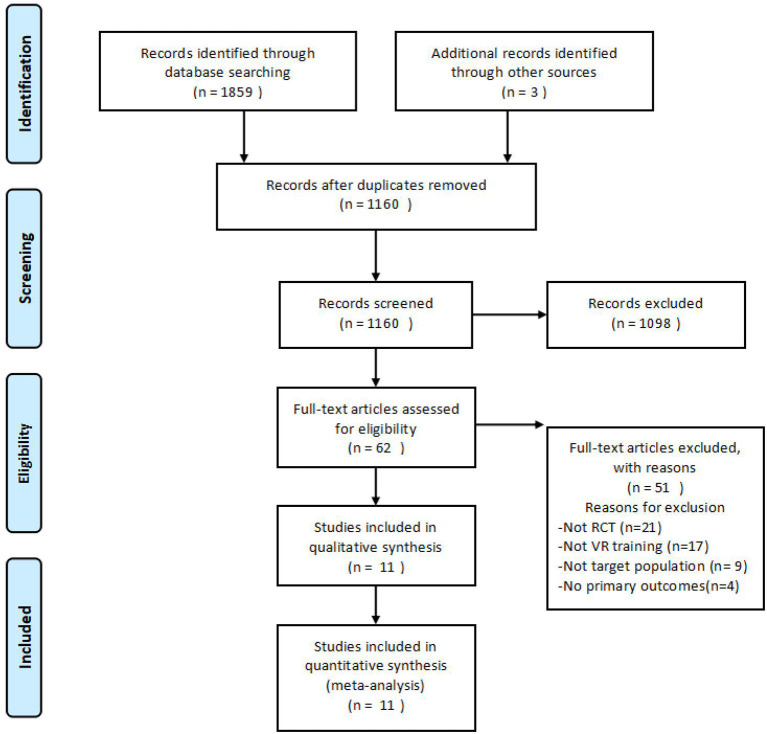
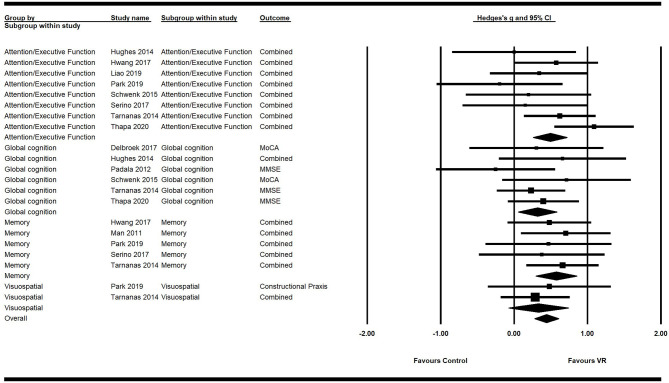
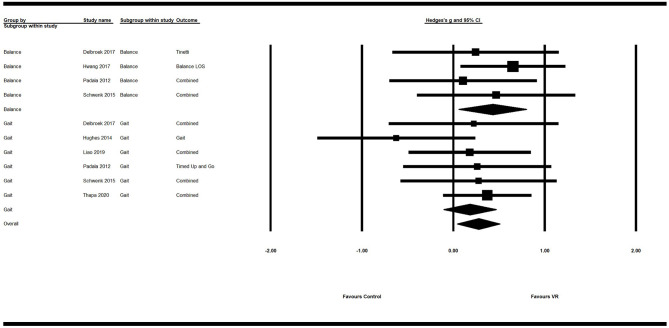
Virtual reality (VR) intervention is an innovative and efficient rehabilitative tool for patients affected by stroke, Parkinson's disease, and other neurological disorders. This meta-analysis aims to evaluate the effects of VR intervention on cognition and motor function in older adults with mild cognitive impairment or dementia. Seven databases were systematically searched for relevant articles published from inception to April 2020. Randomized controlled trials examining VR intervention in adults with mild cognitive impairment or dementia aged >60 years were included. The primary outcome of the study was cognitive function, including overall cognition, global cognition, attention, executive function, memory, and visuospatial ability. The secondary outcome was motor function, consisting of overall motor function, balance, and gait. A subgroup analysis was also performed based on study characteristics to identify the potential factors for heterogeneity. Eleven studies including 359 participants were included for final analysis. Primary analysis showed a significant moderate positive effect size (ES) of VR on overall cognition ( = 0.45; 95% confidence interval (CI) = 0.31-0.59; < 0.001), attention/execution ( = 0.49; 95% CI = 0.26-0.72; < 0.001), memory ( = 0.57; 95% CI = 0.29-0.85; < 0.001), and global cognition ( = 0.32; 95% CI = 0.06-0.58; = 0.02). Secondary analysis showed a significant small positive ES on overall motor function ( = 0.28; 95% CI = 0.05-0.51; = 0.018). The ES on balance ( = 0.43; 95% CI = 0.06-0.80; = 0.02) was significant and moderate. The ES on visuospatial ability and gait was not significant. In the subgroup analysis, heterogeneity was detected in type of immersion and population diagnosis. VR intervention is a beneficial non-pharmacological approach to improve cognitive and motor function in older adults with mild cognitive impairment or dementia, especially in attention/execution, memory, global cognition, and balance. VR intervention does not show superiority on visuospatial ability and gait performance.
虚拟现实(VR)干预是一种针对中风、帕金森病和其他神经系统疾病患者的创新且高效的康复工具。这项荟萃分析旨在评估VR干预对轻度认知障碍或痴呆老年人认知和运动功能的影响。系统检索了7个数据库,以查找从数据库建立至2020年4月发表的相关文章。纳入了对60岁以上患有轻度认知障碍或痴呆的成年人进行VR干预的随机对照试验。该研究的主要结局是认知功能,包括整体认知、全局认知、注意力、执行功能、记忆和视觉空间能力。次要结局是运动功能,包括整体运动功能、平衡和步态。还根据研究特征进行了亚组分析,以确定异质性的潜在因素。最终分析纳入了11项研究,共359名参与者。初步分析显示,VR对整体认知(效应量=0.45;95%置信区间(CI)=0.31 - 0.59;P<0.001)、注意力/执行功能(效应量=0.49;95%CI = 0.26 - 0.72;P<0.001)、记忆(效应量=0.57;95%CI = 0.29 - 0.85;P<0.001)和全局认知(效应量=0.32;95%CI = 0.06 - 0.58;P = 0.02)具有显著的中度正向效应。次要分析显示,VR对整体运动功能具有显著的小正向效应量(效应量=0.28;95%CI = 0.05 - 0.51;P = 0.018)。VR对平衡的效应量(效应量=0.43;95%CI = 0.06 - 0.80;P = 0.02)显著且为中度。VR对视觉空间能力和步态的效应量不显著。在亚组分析中,在沉浸类型和人群诊断方面检测到了异质性。VR干预是一种有益的非药物方法,可改善轻度认知障碍或痴呆老年人的认知和运动功能,尤其是在注意力/执行功能、记忆、全局认知和平衡方面。VR干预在视觉空间能力和步态表现方面未显示出优势。