Shao Bao-Yi, Zhang Shao-Fei, Li Hai-Di, Meng Xiao-Ming, Chen Hai-Yong
Li Ka Shing Faculty of Medicine, The University of Hong Kong, Hong Kong, China.
Inflammation and Immune Mediated Diseases Laboratory of Anhui Province, Anhui Institute of Innovative Drugs, School of Pharmacy, Anhui Medical University, Hefei, China.
Front Physiol. 2021 May 5;12:649587. doi: 10.3389/fphys.2021.649587. eCollection 2021.
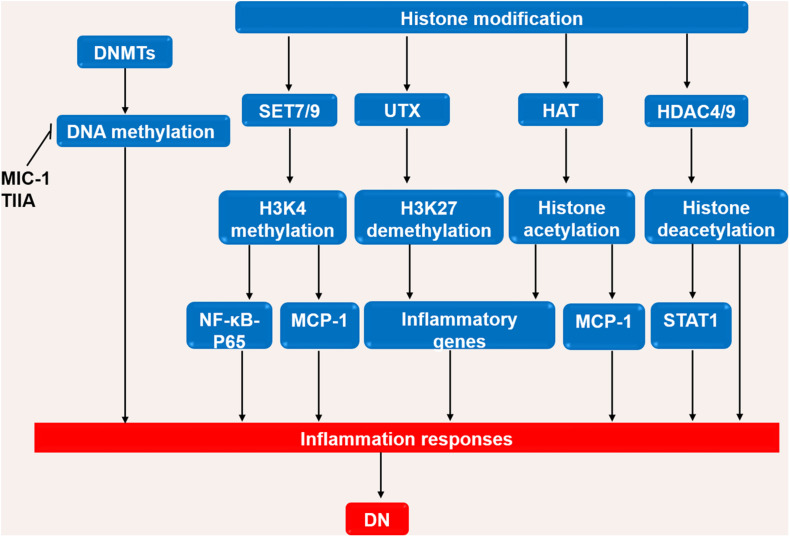
Diabetic nephropathy (DN) leads to high morbidity and disability. Inflammation plays a critical role in the pathogenesis of DN, which involves renal cells and immune cells, the microenvironment, as well as extrinsic factors, such as hyperglycemia, chemokines, cytokines, and growth factors. Epigenetic modifications usually regulate gene expression via DNA methylation, histone modification, and non-coding RNAs without altering the DNA sequence. During the past years, numerous studies have been published to reveal the mechanisms of epigenetic modifications that regulate inflammation in DN. This review aimed to summarize the latest evidence on the interplay of epigenetics and inflammation in DN, and highlight the potential targets for treatment and diagnosis of DN.
糖尿病肾病(DN)会导致高发病率和残疾率。炎症在DN的发病机制中起关键作用,其涉及肾细胞和免疫细胞、微环境以及外在因素,如高血糖、趋化因子、细胞因子和生长因子。表观遗传修饰通常通过DNA甲基化、组蛋白修饰和非编码RNA来调节基因表达,而不改变DNA序列。在过去几年中,已发表了大量研究以揭示调节DN炎症的表观遗传修饰机制。本综述旨在总结关于DN中表观遗传学与炎症相互作用的最新证据,并强调DN治疗和诊断的潜在靶点。