Implementation Research and Delivery Science Unit, Health Section, Programme Division, UNICEF, New York, USA.
Universal Health Coverage/Health Systems Department, WHO Regional Office for Eastern Mediterranean.
J Glob Health. 2021 May 8;11:06003. doi: 10.7189/jogh.11.06003.
Embedded implementation research (IR) can play a critical role in health systems strengthening by tackling systems and implementation bottlenecks of a program. To achieve this aim, with the financial support of GAVI, the Vaccine Alliance, in 2016, the Government of Pakistan, UNICEF and the Alliance for Health Policy and Systems Research (AHPSR) launched an Embedded IR for Immunisation Initiative (the Initiative) to explore health systems and implementation bottlenecks, and potential strategies to tackle such bottlenecks in the Expanded Programme on Immunisation (EPI) in Pakistan. In total, 10 research teams were involved in the Initiative, which was the first of its kind in the country. In this paper, we provided a brief overview of the Initiative's approach as well as the key learnings including challenges and successes of the research teams which could inform future embedded IR Initiatives.
Data were collected from members of the IR teams through an online survey. In addition, in-depth interviews were conducted via phone and in-person from IR team members to explore further the challenges they faced while conducting IR in Pakistan and recommendations for future IR initiatives. The qualitative information obtained from these sources was collated and categorized into themes reflecting some of the challenges, successes, and lessons learned, as well as teams' recommendations for future initiatives.
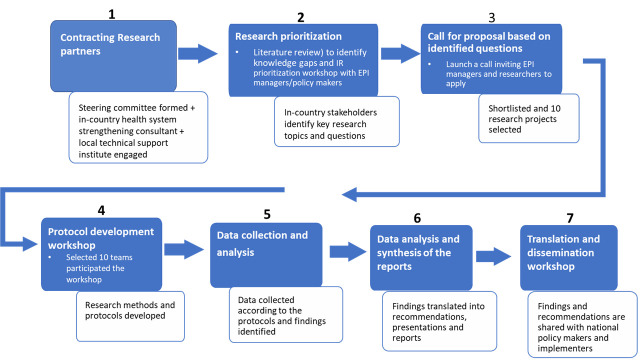
The embedded IR Initiative in Pakistan followed several steps starting with a desk review to compile information on key implementation challenges of EPI and ended with a dissemination workshop where all the research teams shared their IR results with policymakers and implementers. Key factors that facilitated the successful and timely completion of the studies included appreciation by and leadership of implementers in generation and use of local knowledge, identification of research priorities jointly by EPI managers and researchers and provision of continuous and high-quality support from in-country research partners. Participants in the Initiative indicated that challenges included a lack of clarity on the role and responsibilities of each partner involved and need for further support to facilitate use and dissemination of research findings.
The Initiative established that an immunisation programme in a lower middle-income country can use small and time-bound embedded IR, based on partnerships between programme managers and local researchers, to generate information and evidence that can inform decision-making. Future embedded IR initiatives should strive to ensure effective coordination and active participation of all key stakeholders, a clear research utilisation plan from the outset, and efforts to strengthen research teams' capacity to foster utilisation of research findings.
嵌入式实施研究(IR)可以通过解决项目的系统和实施瓶颈来在加强卫生系统方面发挥关键作用。为了实现这一目标,在全球疫苗免疫联盟(Gavi)的财政支持下,巴基斯坦政府、儿基会和卫生政策与体系研究联盟(AHPSR)于 2016 年启动了一项嵌入式免疫接种倡议(该倡议),以探索巴基斯坦扩大免疫规划(EPI)中的卫生系统和实施瓶颈,以及解决这些瓶颈的潜在策略。总共有 10 个研究小组参与了该倡议,这在该国尚属首例。在本文中,我们简要介绍了该倡议的方法,以及关键经验教训,包括研究小组所面临的挑战和成功经验,这些经验教训可为今后的嵌入式 IR 倡议提供参考。
通过在线调查收集 IR 团队成员的数据。此外,通过电话和亲自访谈的方式,对 IR 团队成员进行深入访谈,以进一步探讨他们在巴基斯坦开展 IR 时所面临的挑战以及对未来 IR 倡议的建议。从这些来源获得的定性信息被整理并分类为主题,反映了一些挑战、成功和经验教训,以及团队对未来倡议的建议。
巴基斯坦的嵌入式 IR 倡议采取了几个步骤,首先是进行桌面审查,以收集 EPI 主要实施挑战的信息,最后是一个传播研讨会,所有研究团队都在会上与政策制定者和实施者分享了他们的 IR 成果。促进研究成功及时完成的关键因素包括:实施者对生成和利用本地知识的赞赏和领导,EPI 管理者和研究人员共同确定研究重点,以及来自国内研究伙伴的持续和高质量支持。该倡议的参与者表示,挑战包括每个参与伙伴的角色和责任不明确,以及需要进一步支持以促进研究结果的使用和传播。
该倡议表明,一个中低收入国家的免疫规划可以利用基于方案管理者和当地研究人员之间伙伴关系的小型和限时嵌入式 IR,来生成能够为决策提供信息和证据的信息。未来的嵌入式 IR 倡议应努力确保所有主要利益攸关方的有效协调和积极参与,从一开始就制定明确的研究利用计划,并努力加强研究团队利用研究结果的能力。