Beukers Nicky G F M, Su Naichuan, Loos Bruno G, van der Heijden Geert J M G
Academic Centre for Dentistry Amsterdam, Department of Periodontology, University of Amsterdam and Vrije Universiteit Amsterdam, Amsterdam, Netherlands.
Academic Centre for Dentistry Amsterdam, Department of Social Dentistry, University of Amsterdam and Vrije Universiteit Amsterdam, Amsterdam, Netherlands.
Front Cardiovasc Med. 2021 May 7;8:621626. doi: 10.3389/fcvm.2021.621626. eCollection 2021.
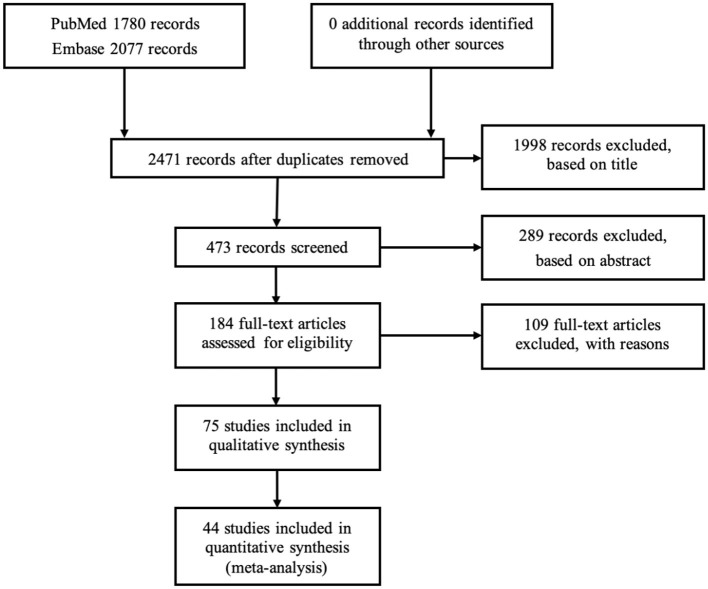
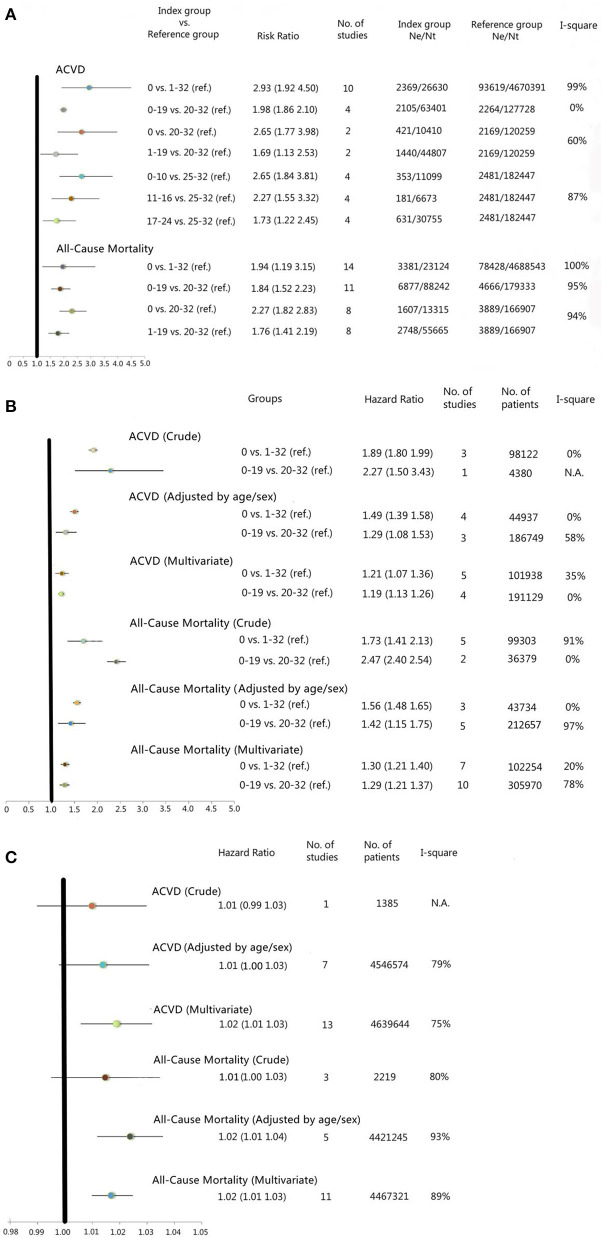
Tooth loss reflects the endpoint of two major dental diseases: dental caries and periodontitis. These comprise 2% of the global burden of human diseases. A lower number of teeth has been associated with various systemic diseases, in particular, atherosclerotic cardiovascular diseases (ACVD). The aim was to summarize the evidence of tooth loss related to the risk for ACVD or death. Cohort studies with prospective follow-up data were retrieved from Medline-PubMed and EMBASE. Following the PRISMA guidelines, two reviewers independently selected articles, assessed the risk of bias, and extracted data on the number of teeth (tooth loss; exposure) and ACVD-related events and all-cause mortality (ACM) (outcome). A total of 75 articles were included of which 44 were qualified for meta-analysis. A lower number of teeth was related to a higher outcome risk; the pooled risk ratio (RR) for the cumulative incidence of ACVD ranged from 1.69 to 2.93, and for the cumulative incidence of ACM, the RR ranged from 1.76 to 2.27. The pooled multiple adjusted hazard ratio (HR) for the incidence density of ACVD ranged from 1.02 to 1.21, and for the incidence density of ACM, the HR ranged from 1.02 to 1.30. This systematic review and meta-analyses of survival data show that a lower number of teeth is a risk factor for both ACVD and death. Health care professionals should use this information to inform their patients and increase awareness on the importance of good dental health and increase efforts to prevent tooth loss.
龋齿和牙周炎。这些疾病占全球人类疾病负担的2%。牙齿数量减少与多种全身性疾病相关,尤其是动脉粥样硬化性心血管疾病(ACVD)。目的是总结与ACVD风险或死亡相关的牙齿缺失证据。从Medline-PubMed和EMBASE检索了具有前瞻性随访数据的队列研究。按照PRISMA指南,两名评审员独立选择文章、评估偏倚风险并提取有关牙齿数量(牙齿缺失;暴露因素)以及ACVD相关事件和全因死亡率(ACM)(结果)的数据。总共纳入了75篇文章,其中44篇符合荟萃分析的条件。牙齿数量减少与更高的结果风险相关;ACVD累积发病率的合并风险比(RR)范围为1.69至2.93,ACM累积发病率的RR范围为1.76至2.27。ACVD发病密度的合并多因素调整风险比(HR)范围为1.02至1.21,ACM发病密度的HR范围为1.02至1.30。这项对生存数据的系统评价和荟萃分析表明,牙齿数量减少是ACVD和死亡的危险因素。医疗保健专业人员应利用这些信息告知患者,并提高对良好口腔健康重要性的认识,加大预防牙齿缺失的力度。