Center of Gerontology and Geriatrics, West China Hospital, Sichuan University, GuoXueXiang 37, Chengdu, 610041, Sichuan, China.
National Clinical Research Center of Geriatrics, West China Hospital, Sichuan University, Chengdu, Sichuan, China.
Aging Clin Exp Res. 2021 Dec;33(12):3215-3222. doi: 10.1007/s40520-021-01883-2. Epub 2021 May 24.
Sarcopenia is associated with cognitive impairment in older adults. However, the underlying mechanisms are not fully understood.
To explore the mediating role of nutritional status in the relationship between sarcopenia and cognitive impairment.
Three thousand eight hundred and ten participants (mean age 61.94 ± 8.01 years) from the West China Health and Aging Trend (WCHAT) study were included. We defined sarcopenia using the Asian Working Group for Sarcopenia (AWGS) 2019 criteria. Cognitive status and nutritional status were measured using the Short Portable Mental Status Questionnaire (SPMSQ) and the Mini Nutritional Assessment Short Form (MNA-SF). Relationships between sarcopenia, nutritional status, and cognitive function were explored using multiple linear regression. Two mediation models were generated to examine whether nutritional status mediates the association between sarcopenia and cognitive function using PROCESS macro version 3.5.
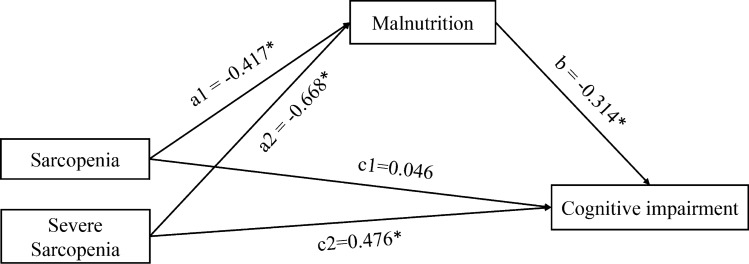
The study involved 3147 (82.6%) non-sarcopenic, 387 (10.2%) sarcopenic, and 276 (7.2%) severely sarcopenic individuals. In mediation model 1, sarcopenia (β = 0.208, 95% CI 0.072 to 0.344, P = 0.0028) was significantly associated with cognitive impairment, and nutritional status mediated this association (indirect effect = 0.162, bootstrap 95% CI 0.116 to 0.212). Mediation model 2 indicated that nutritional status exhibited a full mediating effect regarding the association between sarcopenia and cognitive impairment (indirect effect = 0.131, bootstrap 95% CI: 0.08 to 0.188; direct effect = 0.046, bootstrap 95% CI - 0.115 to 0.21) and a partial mediating effect regarding the association between severe sarcopenia and cognitive impairment (indirect effect = 0.21, bootstrap 95% CI: 0.143 to 0.283; direct effect = 0.476, bootstrap 95% CI: 0.234-0.724).
The relationship between sarcopenia and cognitive impairment was significantly mediated by nutritional status. Early nutritional interventions may prevent cognitive decline in sarcopenic older adults.
肌少症与老年人的认知障碍有关。然而,其潜在机制尚不完全清楚。
探讨营养状况在肌少症与认知障碍之间的关系中的中介作用。
纳入来自华西健康与老龄化队列研究(WCHAT)的 3810 名参与者(平均年龄 61.94±8.01 岁)。我们使用亚洲肌少症工作组(AWGS)2019 标准定义肌少症。使用简易精神状态检查量表(SPMSQ)和微型营养评估简表(MNA-SF)评估认知状态和营养状况。使用多元线性回归探讨肌少症、营养状况和认知功能之间的关系。使用 PROCESS 宏版本 3.5 生成了两个中介模型,以检验营养状况是否在肌少症与认知功能之间的关系中起中介作用。
研究中包括 3147 名(82.6%)非肌少症、387 名(10.2%)肌少症和 276 名(7.2%)严重肌少症患者。在中介模型 1 中,肌少症(β=0.208,95%CI 0.072 至 0.344,P=0.0028)与认知障碍显著相关,营养状况介导了这种关联(间接效应=0.162,自举 95%CI 0.116 至 0.212)。中介模型 2 表明,营养状况对肌少症与认知障碍之间的关联具有完全中介作用(间接效应=0.131,自举 95%CI:0.08 至 0.188;直接效应=0.046,自举 95%CI:-0.115 至 0.21),对严重肌少症与认知障碍之间的关联具有部分中介作用(间接效应=0.21,自举 95%CI:0.143 至 0.283;直接效应=0.476,自举 95%CI:0.234 至 0.724)。
肌少症与认知障碍之间的关系显著受营养状况的中介。早期营养干预可能预防肌少症老年人的认知能力下降。