Russell Berrie Nanotechnology Institute, Technion-Israel Institute of Technology, Haifa, Israel.
Lorry Lokey Interdisciplinary Center for Life Sciences and Engineering, Technion-Israel Institute of Technology, Haifa, Israel.
Nat Commun. 2021 May 24;12(1):3067. doi: 10.1038/s41467-021-23279-6.
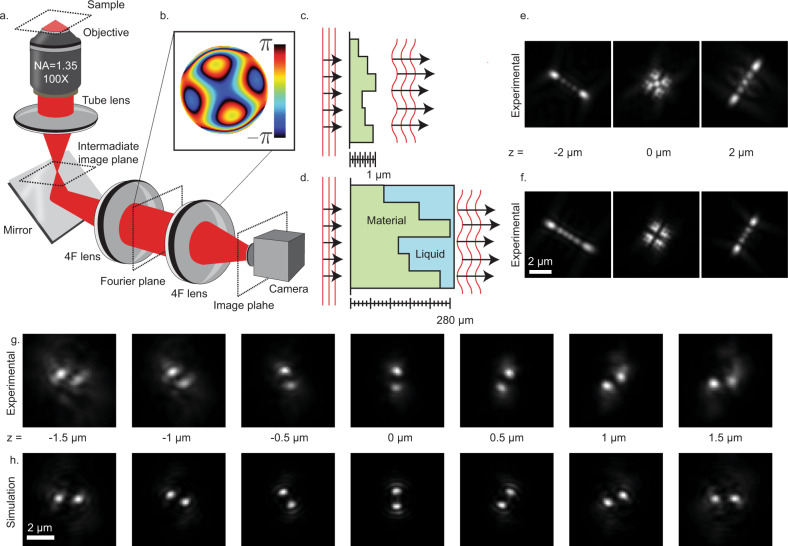
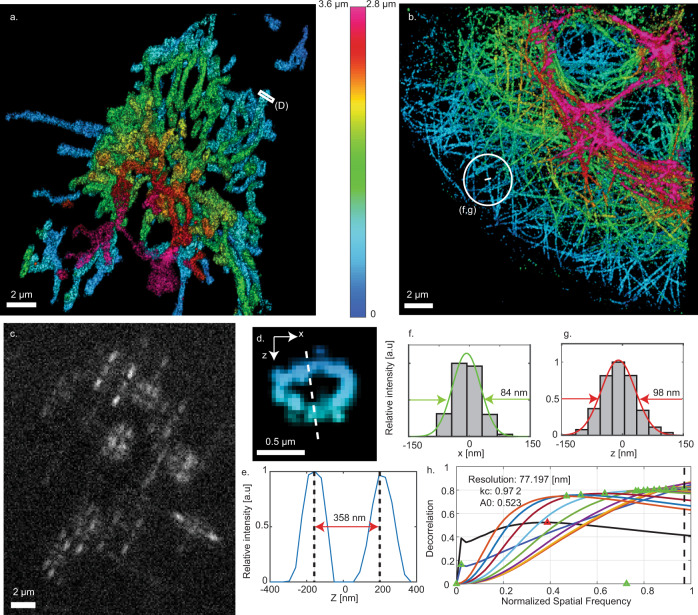
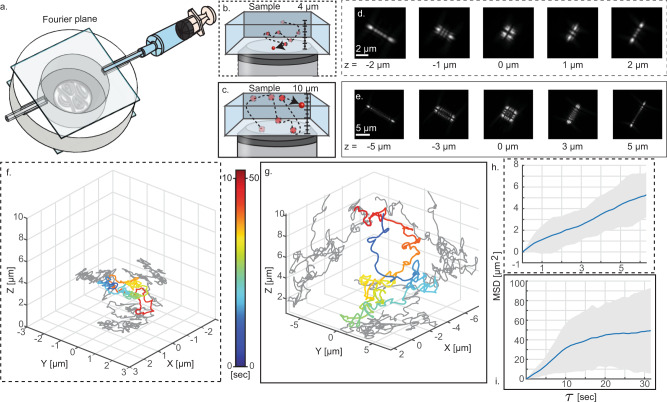
Diffractive optical elements (DOEs) are used to shape the wavefront of incident light. This can be used to generate practically any pattern of interest, albeit with varying efficiency. A fundamental challenge associated with DOEs comes from the nanoscale-precision requirements for their fabrication. Here we demonstrate a method to controllably scale up the relevant feature dimensions of a device from tens-of-nanometers to tens-of-microns by immersing the DOEs in a near-index-matched solution. This makes it possible to utilize modern 3D-printing technologies for fabrication, thereby significantly simplifying the production of DOEs and decreasing costs by orders of magnitude, without hindering performance. We demonstrate the tunability of our design for varying experimental conditions, and the suitability of this approach to ultrasensitive applications by localizing the 3D positions of single molecules in cells using our microscale fabricated optical element to modify the point-spread-function (PSF) of a microscope.
衍射光学元件 (DOE) 用于改变入射光的波前。这可以用来生成几乎任何感兴趣的图案,尽管效率有所不同。DOE 制造的一个基本挑战来自于对其纳米级精度的要求。在这里,我们展示了一种通过将 DOE 浸入近折射率匹配溶液中来将器件的相关特征尺寸从几十纳米可控地扩展到几十微米的方法。这使得利用现代 3D 打印技术进行制造成为可能,从而显著简化 DOE 的制造并将成本降低几个数量级,而不会影响性能。我们展示了我们的设计在不同实验条件下的可调谐性,以及通过使用我们的微尺度制造的光学元件来改变显微镜的点扩散函数 (PSF),从而在细胞中定位单个分子的 3D 位置,来证明这种方法对超灵敏应用的适用性。