Department of Radiology and Medical Imaging, University of Virginia Health System, 1215 Lee St., Charlottesville, VA, 22903, USA.
Department of Surgery, University of Virginia School of Medicine, Charlottesville, VA, USA.
Breast Cancer Res Treat. 2021 Aug;189(1):237-246. doi: 10.1007/s10549-021-06252-1. Epub 2021 May 25.
In order to facilitate targeted outreach, we sought to identify patient populations with a lower likelihood of returning for breast cancer screening after COVID-19-related imaging center closures.
Weekly total screening mammograms performed throughout 2019 (baseline year) and 2020 (COVID-19-impacted year) were compared. Demographic and clinical characteristics, including age, race, ethnicity, breast density, breast cancer history, insurance status, imaging facility type used, and need for interpreter, were compared between patients imaged from March 16 to October 31 in 2019 (baseline cohort) and 2020 (COVID-19-impacted cohort). Census data and an online map service were used to impute socioeconomic variables and calculate travel times for each patient. Logistic regression was used to identify patient characteristics associated with a lower likelihood of returning for screening after COVID-19-related closures.
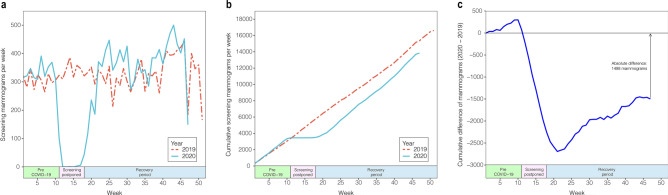
The year-over-year cumulative difference in screening mammogram volumes peaked in week 21, with 2962 fewer exams in the COVID-19-impacted year. By week 47, this deficit had reduced by 49.4% to 1498. A lower likelihood of returning for screening after COVID-19-related closures was independently associated with younger age (odds ratio (OR) 0.78, p < 0.001), residence in a higher poverty area (OR 0.991, p = 0.014), lack of health insurance (OR 0.65, p = 0.007), need for an interpreter (OR 0.68, p = 0.029), longer travel time (OR 0.998, p < 0.001), and utilization of mobile mammography services (OR 0.27, p < 0.001).
Several patient factors are associated with a lower likelihood of returning for screening mammography after COVID-19-related closures. Knowledge of these factors can guide targeted outreach to vulnerable patients to facilitate breast cancer screening.
为了便于有针对性地开展外展工作,我们试图确定在与 COVID-19 相关的影像中心关闭后,不太可能返回进行乳腺癌筛查的患者人群。
比较了 2019 年(基线年)和 2020 年(COVID-19 受影响年)每周进行的总筛查乳房 X 光检查。比较了 2019 年 3 月 16 日至 10 月 31 日(基线队列)和 2020 年(COVID-19 受影响队列)进行影像学检查的患者的人口统计学和临床特征,包括年龄、种族、族裔、乳房密度、乳腺癌病史、保险状况、使用的影像学设施类型以及是否需要翻译。使用人口普查数据和在线地图服务来推断社会经济变量并计算每位患者的旅行时间。使用逻辑回归确定与 COVID-19 相关关闭后进行筛查的可能性较低相关的患者特征。
筛查乳房 X 光检查量的年同比累积差异在第 21 周达到峰值,COVID-19 受影响年份减少了 2962 次检查。到第 47 周,这一赤字减少了 49.4%,至 1498 次。与 COVID-19 相关关闭后进行筛查的可能性较低独立相关的因素包括年龄较小(优势比(OR)0.78,p<0.001)、居住在贫困程度较高的地区(OR 0.991,p=0.014)、缺乏医疗保险(OR 0.65,p=0.007)、需要翻译(OR 0.68,p=0.029)、旅行时间较长(OR 0.998,p<0.001)和使用移动乳房 X 光服务(OR 0.27,p<0.001)。
一些患者因素与 COVID-19 相关关闭后进行乳房 X 光筛查的可能性较低有关。了解这些因素可以指导对弱势患者进行有针对性的外展工作,以促进乳腺癌筛查。