Department of Radiology, Duke University, Durham, North Carolina; Vice Chair, National Mammography Database.
NYU Langone Health, New York, New York.
J Am Coll Radiol. 2022 Aug;19(8):919-934. doi: 10.1016/j.jacr.2022.04.008. Epub 2022 Jun 8.
The aim of this study was to quantify the initial decline and subsequent rebound in breast cancer screening metrics throughout the coronavirus disease 2019 (COVID-19) pandemic.
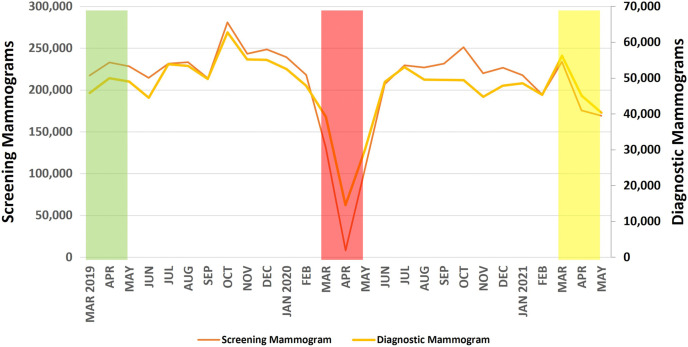
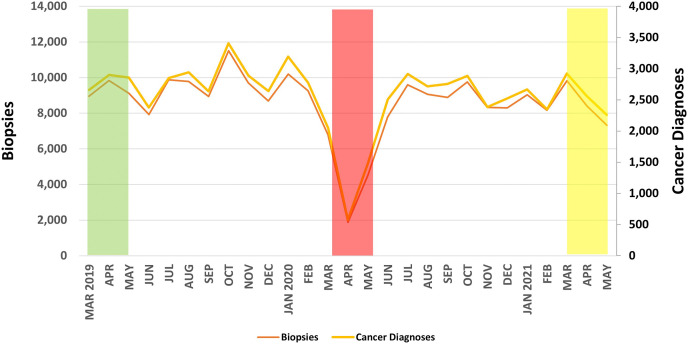
Screening and diagnostic mammographic examinations, biopsies performed, and cancer diagnoses were extracted from the ACR National Mammography Database from March 1, 2019, through May 31, 2021. Patient (race and age) and facility (regional location, community type, and facility type) demographics were collected. Three time periods were used for analysis: pre-COVID-19 (March 1, 2019, to May 31, 2019), peak COVID-19 (March 1, 2020, to May 31, 2020), and COVID-19 recovery (March 1, 2021, to May 31, 2021). Analysis was performed at the facility level and overall between time periods.
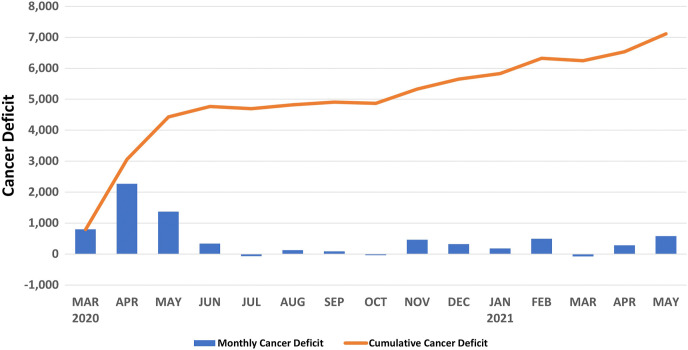
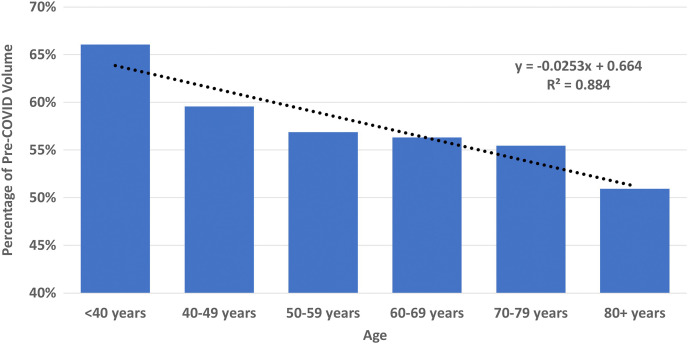
In total, 5,633,783 screening mammographic studies, 1,282,374 diagnostic mammographic studies, 231,390 biopsies, and 69,657 cancer diagnoses were analyzed. All peak COVID-19 metrics were less than pre-COVID-19 volumes: 36.3% of pre-COVID-19 for screening mammography, 57.9% for diagnostic mammography, 47.3% for biopsies, and 48.7% for cancer diagnoses. There was some rebound during COVID-19 recovery as a percentage of pre-COVID-19 volumes: 85.3% of pre-COVID-19 for screening mammography, 97.8% for diagnostic mammography, 91.5% for biopsies, and 92.0% for cancer diagnoses. Across various metrics, there was a disproportionate negative impact on older women, Asian women, facilities in the Northeast, and facilities affiliated with academic medical centers.
COVID-19 had the greatest impact on screening mammography volumes, which have not returned to pre-COVID-19 levels. Cancer diagnoses declined significantly in the acute phase and have not fully rebounded, emphasizing the need to increase outreach efforts directed at specific patient population and facility types.
本研究旨在量化 2019 年冠状病毒病(COVID-19)大流行期间乳腺癌筛查指标的初始下降和随后的反弹。
从 2019 年 3 月 1 日至 2021 年 5 月 31 日,从 ACR 国家乳腺摄影数据库中提取筛查和诊断性乳腺 X 线摄影检查、进行的活检和诊断出的癌症。收集患者(种族和年龄)和医疗机构(区域位置、社区类型和医疗机构类型)人口统计学信息。分析使用了三个时间段:COVID-19 前(2019 年 3 月 1 日至 2019 年 5 月 31 日)、COVID-19 高峰(2020 年 3 月 1 日至 2020 年 5 月 31 日)和 COVID-19 恢复期(2021 年 3 月 1 日至 2021 年 5 月 31 日)。在医疗机构层面和不同时间段之间进行了分析。
共分析了 5633783 例筛查性乳腺 X 线摄影检查、1282374 例诊断性乳腺 X 线摄影检查、231390 例活检和 69657 例癌症诊断。所有 COVID-19 高峰期的指标均低于 COVID-19 前的水平:筛查性乳腺 X 线摄影检查为 36.3%,诊断性乳腺 X 线摄影检查为 57.9%,活检为 47.3%,癌症诊断为 48.7%。在 COVID-19 恢复期,各指标较 COVID-19 前水平的百分比有所反弹:筛查性乳腺 X 线摄影检查为 85.3%,诊断性乳腺 X 线摄影检查为 97.8%,活检为 91.5%,癌症诊断为 92.0%。在各种指标中,老年女性、亚裔女性、东北地区的医疗机构以及与学术医疗中心有关联的医疗机构受到的负面影响不成比例。
COVID-19 对筛查性乳腺 X 线摄影检查的影响最大,其尚未恢复到 COVID-19 前的水平。癌症诊断在急性期显著下降,尚未完全反弹,这强调了需要增加针对特定患者人群和医疗机构类型的宣传工作。