Dalda Yasin, Akbulut Sami, Kucukakcali Zeynep, Ogut Zeki, Dalda Ozlem, Alan Saadet, Isik Burak
Department of Surgery and Liver Transplant Institute, Inonu University Faculty of Medicine, Malatya 44280, Turkey.
Department of Biostatistics and Medical Informatics, Inonu University Faculty of Medicine, Malatya 44280, Turkey.
J Clin Med. 2024 Dec 16;13(24):7673. doi: 10.3390/jcm13247673.
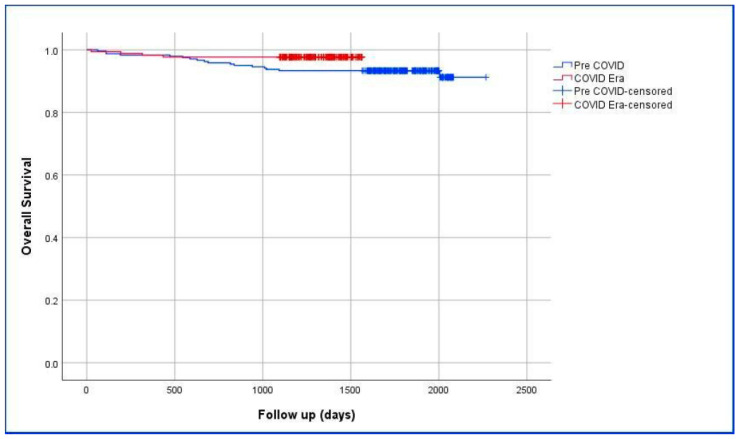
The COVID-19 pandemic has significantly affected breast cancer patients by causing delays in diagnosis and treatment processes. This study aims to investigate the effects of the pandemic on the treatment process and short-term outcomes of breast cancer patients. This retrospective, cross-sectional, single-center study included 414 patients who underwent surgery for breast cancer at the Inonu University General Surgery Clinic between March 2018 and June 2021. The patients were divided into two groups: pre-pandemic (Pre-COVID-19; n = 240) and pandemic (COVID-19 Era; n = 174) periods. The groups were compared in terms of demographic, clinical, and histopathological variables. During the pandemic period, the use of neoadjuvant therapy (from 21.3% to 34.5%) and preoperative PET-CT imaging (from 80.4% to 90.8%) rates increased, while breast-conserving surgery (from 27.9% to 19.0%) and the presence of comorbid diseases (from 45.0% to 29.9%) decreased significantly. While there was no significant difference between the groups in terms of the time from diagnosis to surgery (25 vs. 28.5 days, = 0.121), the time to report the pathology result after surgery decreased during the pandemic period (28 vs. 23 days, < 0.001). There was no significant difference between the groups in terms of immunohistochemical (ER, PR, Ki-67, E-cadherin, and c-erbB2), histopathological (lymphovascular invasion, perineural invasion, comedo necrosis, modified Bloom-Richardson grade, and TNM classification), and clinical (recurrence, metastasis, and axillary lymph node metastasis) features of the tumor. The mortality rate in the Pre-COVID-19 group (7.1%) was significantly higher than in the COVID-19 Era group (2.3%) ( = 0.049). Finally, in terms of the survival analysis, a statistically significant difference was found between the Pre-COVID-19 and COVID-19 Era groups in terms of the mean follow-up duration of the patients ( = 0.044). The study results show that the use of neoadjuvant therapy and radical surgery preference increased in breast cancer treatment during the pandemic period, but there was no significant change in tumor biology and histopathological features. Breast-conserving surgery rates, comorbidity rates, and pathology reporting times were significantly shortened. Long-term follow-up periods of 3 and 5 years are needed to see the impact of the pandemic on breast cancer patients.
新冠疫情通过导致乳腺癌患者诊断和治疗过程延迟,对其产生了重大影响。本研究旨在调查疫情对乳腺癌患者治疗过程和短期预后的影响。这项回顾性、横断面、单中心研究纳入了2018年3月至2021年6月期间在伊诺努大学普通外科诊所接受乳腺癌手术的414例患者。患者被分为两组:疫情前(新冠疫情前;n = 240)和疫情期间(新冠疫情时代;n = 174)。对两组患者的人口统计学、临床和组织病理学变量进行了比较。在疫情期间,新辅助治疗的使用率(从21.3%升至34.5%)和术前PET-CT成像的使用率(从80.4%升至90.8%)有所增加,而保乳手术率(从27.9%降至19.0%)和合并症的发生率(从45.0%降至29.9%)显著下降。虽然两组患者从诊断到手术的时间没有显著差异(25天对28.5天,P = 0.121),但疫情期间手术后报告病理结果的时间缩短了(28天对23天,P < 0.001)。两组患者肿瘤的免疫组化(雌激素受体、孕激素受体、Ki-67、E-钙黏蛋白和c-erbB2)、组织病理学(脉管侵犯、神经侵犯、粉刺样坏死、改良Bloom-Richardson分级和TNM分期)以及临床(复发、转移和腋窝淋巴结转移)特征没有显著差异。新冠疫情前组的死亡率(7.1%)显著高于新冠疫情时代组(2.3%)(P = 0.049)。最后,在生存分析方面,新冠疫情前组和新冠疫情时代组患者的平均随访时间存在统计学显著差异(P = 0.044)。研究结果表明,疫情期间乳腺癌治疗中,新辅助治疗的使用和根治性手术的偏好有所增加,但肿瘤生物学和组织病理学特征没有显著变化。保乳手术率、合并症发生率和病理报告时间显著缩短。需要3年和5年的长期随访期来观察疫情对乳腺癌患者的影响。