Department of Pathology, Microbiology, and Immunology, School of Veterinary Medicine, University of California, Davis, CA 95616.
Department of Virology and Emerging Infectious Diseases, US Naval Medical Research Unit No. 6, Lima, Peru, Washington, DC 20521-3230.
Proc Natl Acad Sci U S A. 2022 Jun 28;119(26):e2118283119. doi: 10.1073/pnas.2118283119. Epub 2022 Jun 23.
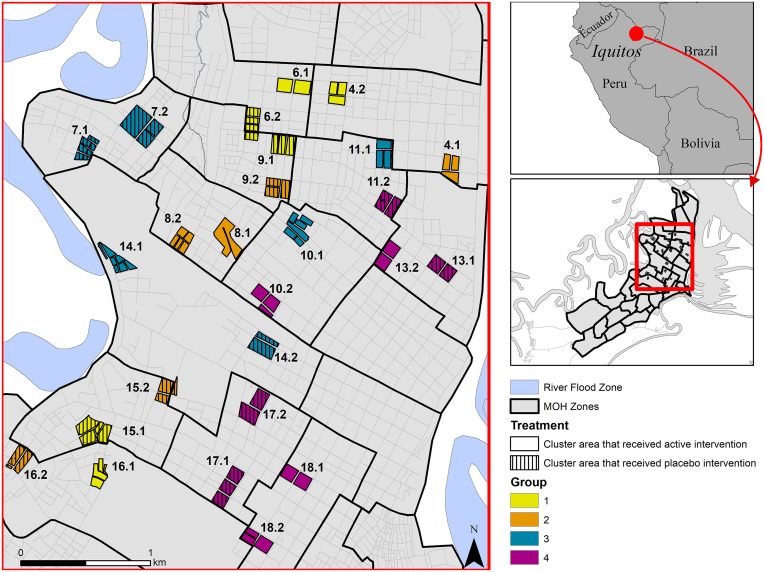
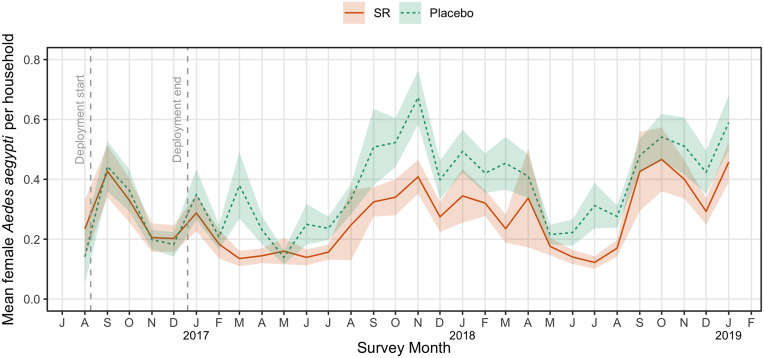
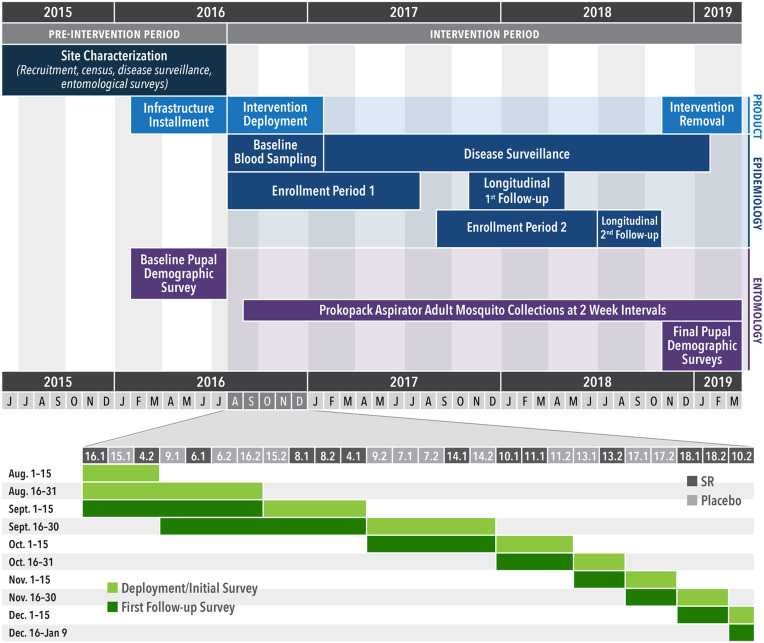
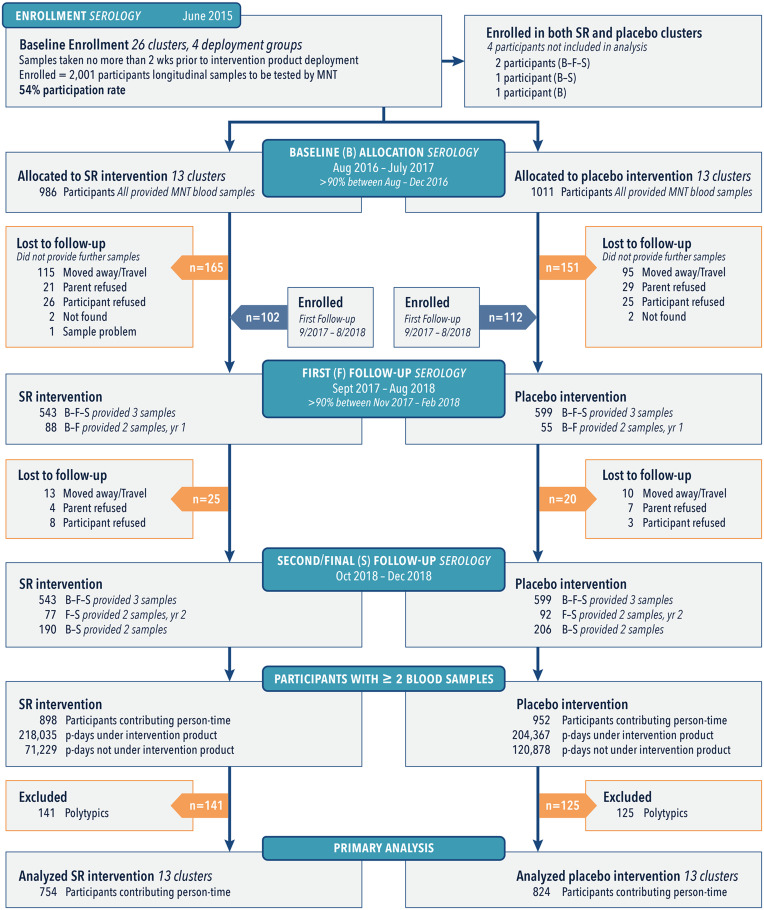
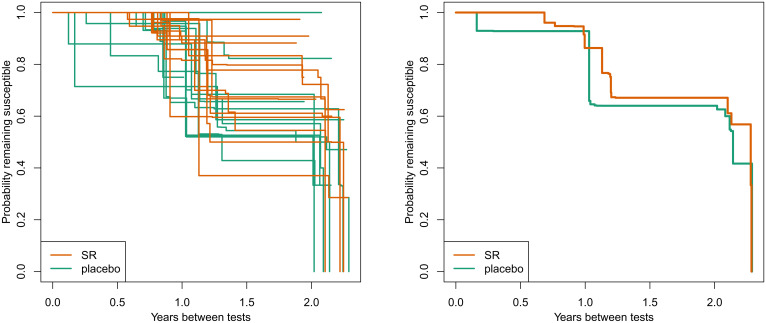
Over half the world's population is at risk for viruses transmitted by mosquitoes, such as dengue and Zika. The primary vector, , thrives in urban environments. Despite decades of effort, cases and geographic range of -borne viruses (ABVs) continue to expand. Rigorously proven vector control interventions that measure protective efficacy against ABV diseases are limited to in a single trial in Indonesia and do not include any chemical intervention. Spatial repellents, a new option for efficient deployment, are designed to decrease human exposure to ABVs by releasing active ingredients into the air that disrupt mosquito-human contact. A parallel, cluster-randomized controlled trial was conducted in Iquitos, Peru, to quantify the impact of a transfluthrin-based spatial repellent on human ABV infection. From 2,907 households across 26 clusters (13 per arm), 1,578 participants were assessed for seroconversion (primary endpoint) by survival analysis. Incidence of acute disease was calculated among 16,683 participants (secondary endpoint). Adult mosquito collections were conducted to compare abundance, blood-fed rate, and parity status through mixed-effect difference-in-difference analyses. The spatial repellent significantly reduced ABV infection by 34.1% (one-sided 95% CI lower limit, 6.9%; one-sided value = 0.0236, z = 1.98). abundance and blood-fed rates were significantly reduced by 28.6 (95% CI 24.1%, ∞); z = -9.11) and 12.4% (95% CI 4.2%, ∞); = -2.43), respectively. Our trial provides conclusive statistical evidence from an appropriately powered, preplanned cluster-randomized controlled clinical trial of the impact of a chemical intervention, in this case a spatial repellent, to reduce the risk of ABV transmission compared to a placebo.
超过一半的世界人口面临着由蚊子传播的病毒的风险,例如登革热和寨卡病毒。主要媒介 ,在城市环境中茁壮成长。尽管经过几十年的努力, 病媒病毒(ABV)的病例和地理范围仍在继续扩大。经过严格验证的针对 ABV 疾病具有保护效果的媒介控制干预措施仅限于印度尼西亚的一项单一试验,并且不包括任何化学干预措施。空间驱避剂是一种新的高效部署选择,旨在通过向空气中释放活性成分来减少人类接触 ABV,从而降低人类感染 ABV 的风险。在秘鲁伊基托斯进行了一项平行的、基于集群的随机对照试验,以量化基于 Transfluthrin 的空间驱避剂对人类 ABV 感染的影响。在 26 个集群(每组 13 个)的 2907 个家庭中,对 1578 名参与者进行了生存分析评估,以确定血清转化率(主要终点)。在 16683 名参与者中计算了急性疾病的发病率(次要终点)。进行了成年蚊子采集,通过混合效应差分差异分析比较了 丰度、吸血率和生殖力状态。空间驱避剂显著降低了 34.1%的 ABV 感染率(单侧 95%置信区间下限,6.9%;单侧 值=0.0236,z=1.98)。 丰度和吸血率分别显著降低了 28.6%(95%置信区间 24.1%,∞);z=-9.11)和 12.4%(95%置信区间 4.2%,∞); =-2.43)。我们的试验提供了来自适当加权、预先计划的基于集群的随机对照临床试验的结论性统计证据,证明了化学干预措施(在这种情况下是空间驱避剂)的影响,与安慰剂相比,降低了 ABV 传播的风险。