Department of Psychological Sciences, University of Liverpool, Bedford Street South, Liverpool, L69 7ZA, UK.
Centre des Sciences Du Goût et de l'Alimentation, Agrosup Dijon, CNRS, INRAE, Université Bourgogne Franche-Comté, 17 Rue Sully, 21065, Dijon Cedex, France.
BMC Public Health. 2021 May 25;21(1):975. doi: 10.1186/s12889-021-11007-0.
There are a range of interventions designed to promote healthier food choices in full-service restaurants. However, it is unclear how these interventions affect dietary choices in people of lower and higher socioeconomic position (SEP).
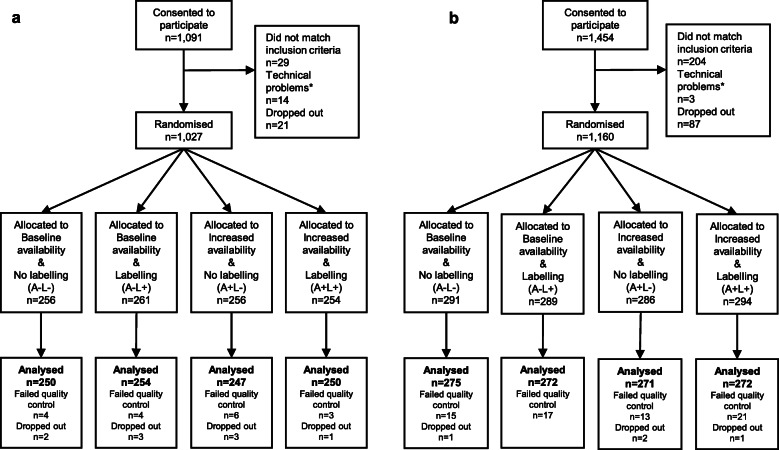
A total of 2091 US participants recruited online completed Study 1 (n = 1001) and Study 2 (n = 1090). Recruitment was stratified by participant highest education level, resulting in higher SEP and lower SEP groups. In a between-subjects design, participants made hypothetical food choices (main dish, plus optional sides and desserts) from six restaurants menus in the absence vs. presence of menu energy labelling and from menus with baseline (10%) vs. increased availability (50%) of lower energy main dishes. Data were collected and analysed in 2019. Two studies were conducted in order to examine replicability and generalisability of findings across different restaurant menu types.
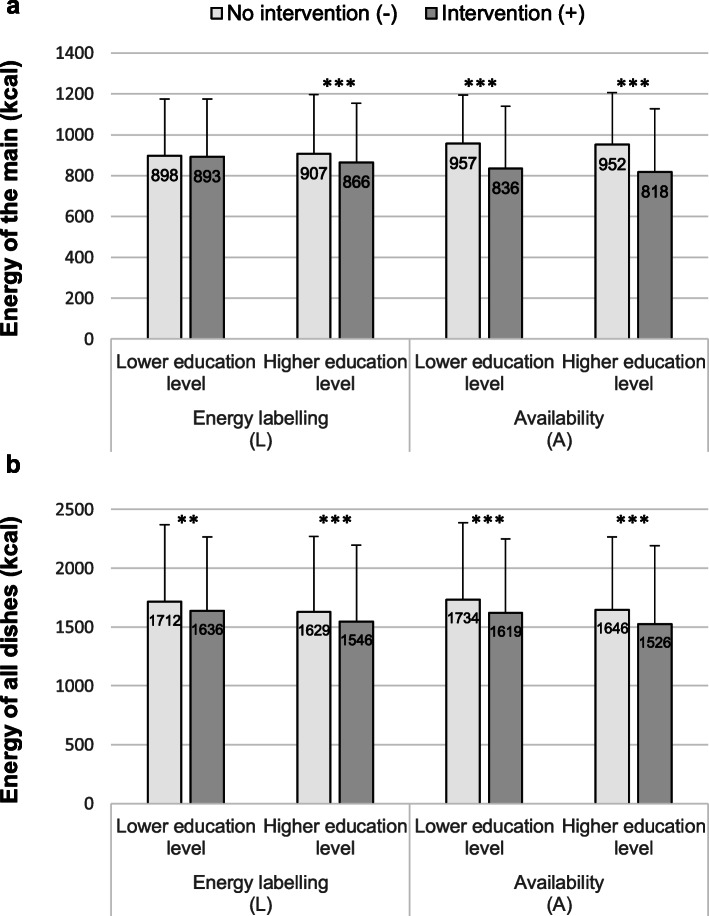
Across both studies, increasing the availability of lower energy main menu options decreased the average energy content of the ordered main dish (- 129 kcal, 95% CI [- 139; - 119]) and total energy ordered (- 117 kcal, 95% CI [- 138; - 95]) in both higher and lower SEP participants. Energy labelling significantly reduced the energy content of ordered main dishes in higher SEP participants (- 41 kcal, 95% CI [- 54; - 29]), but not lower SEP participants (- 5 kcal, 95% CI [- 22; 11]). However, energy labelling reduced total energy ordered (- 83 kcal, 95% CI [- 105; - 60]) irrespective of SEP.
In two virtual experiments, increasing the availability of lower energy restaurant main menu options impacted on main menu dish choice and decreased total energy ordered irrespective of SEP. Energy labelling had a less pronounced effect on total energy ordered and had a larger impact on the energy content of main menu dish choice in higher as opposed to lower SEP participants.
Clinicaltrials.gov NCT04336540 retrospectively registered (7 April, 2020).
有一系列旨在促进全方位服务餐厅更健康食品选择的干预措施。然而,这些干预措施对社会经济地位(SEP)较低和较高的人群的饮食选择的影响尚不清楚。
共有 2091 名美国参与者在线完成了研究 1(n=1001)和研究 2(n=1090)。参与者的最高教育水平进行分层招募,从而产生了较高 SEP 和较低 SEP 组。在一个被试间设计中,参与者在不存在和存在菜单能量标签的情况下,从六家餐厅的菜单中做出假设性的食物选择(主菜,加上可选的配菜和甜点),并且从菜单中选择基线(10%)和增加(50%)较低能量主菜的供应。数据于 2019 年收集和分析。进行了两项研究,以检验发现结果在不同餐厅菜单类型中的可重复性和普遍性。
在两项研究中,增加较低能量主菜的供应选择降低了被订购的主菜的平均能量含量(-129 卡路里,95%CI[-139;-119])和总能量摄入(-117 卡路里,95%CI[-138;-95]),无论是在较高还是较低 SEP 参与者中。能量标签显著降低了较高 SEP 参与者所订购主菜的能量含量(-41 卡路里,95%CI[-54;-29]),但对较低 SEP 参与者没有影响(-5 卡路里,95%CI[-22;11])。然而,能量标签降低了总能量摄入(-83 卡路里,95%CI[-105;-60]),而与 SEP 无关。
在两项虚拟实验中,增加较低能量餐厅主菜单选项的供应选择影响主菜的选择,并降低了总能量摄入,而与 SEP 无关。能量标签对总能量摄入的影响较小,而对较高 SEP 参与者的主菜选择的能量含量的影响较大,而不是较低 SEP 参与者。
Clinicaltrials.gov NCT04336540 (2020 年 4 月 7 日)。