Unidad de Investigación en Reproducción Humana, Instituto Nacional de Perinatología-Facultad de Química, Universidad Nacional Autónoma de México, Montes Urales 800, Lomas Virreyes, Miguel Hidalgo, 11000, Ciudad de México, Mexico.
Departamento de Inmunobioquímica, Instituto Nacional de Perinatología, Ciudad de México, Mexico.
Clin Epigenetics. 2021 May 25;13(1):116. doi: 10.1186/s13148-021-01103-8.
The human endometrium is a highly dynamic tissue whose function is mainly regulated by the ovarian steroid hormones estradiol and progesterone. The serum levels of these and other hormones are associated with three specific phases that compose the endometrial cycle: menstrual, proliferative, and secretory. Throughout this cycle, the endometrium exhibits different transcriptional networks according to the genes expressed in each phase. Epigenetic mechanisms are crucial in the fine-tuning of gene expression to generate such transcriptional networks. The present review aims to provide an overview of current research focused on the epigenetic mechanisms that regulate gene expression in the cyclical endometrium and discuss the technical and clinical perspectives regarding this topic.
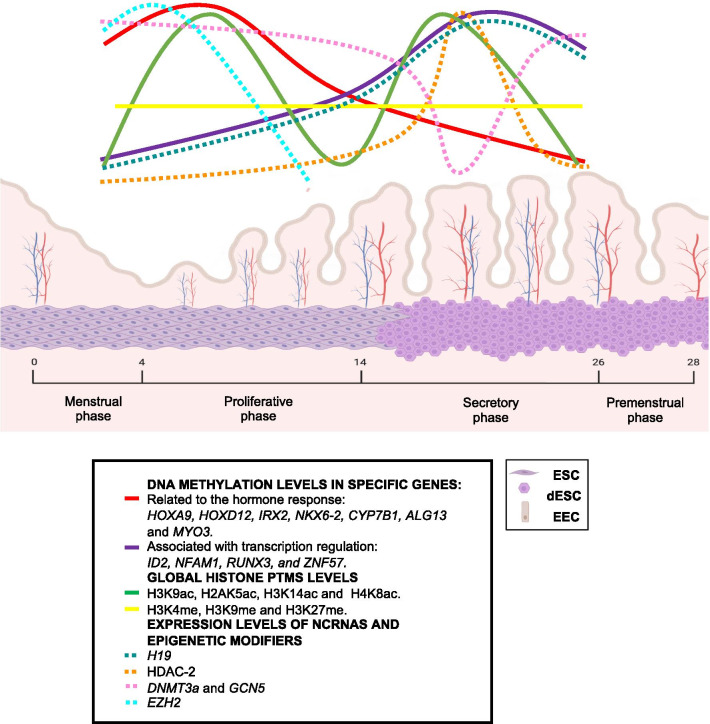
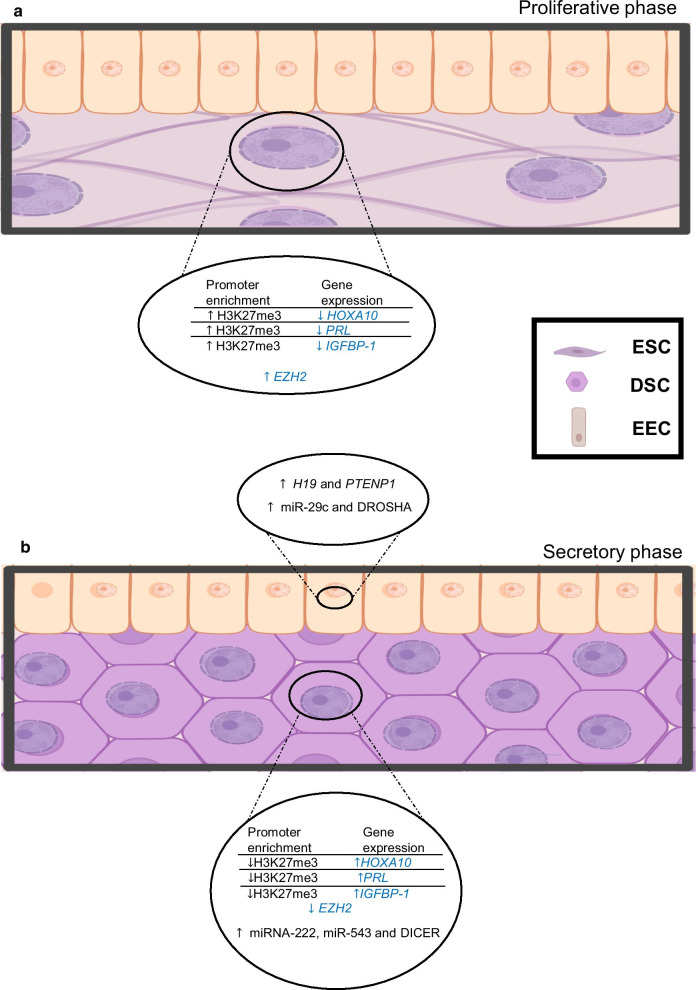
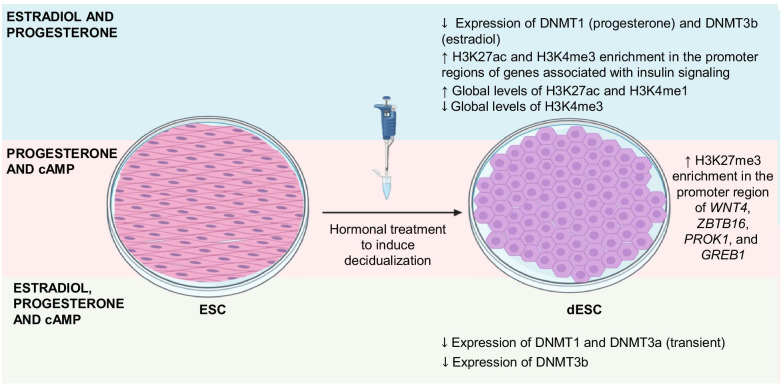
The main epigenetic mechanisms reported are DNA methylation, histone post-translational modifications, and non-coding RNAs. These epigenetic mechanisms induce the expression of genes associated with transcriptional regulation, endometrial epithelial growth, angiogenesis, and stromal cell proliferation during the proliferative phase. During the secretory phase, epigenetic mechanisms promote the expression of genes associated with hormone response, insulin signaling, decidualization, and embryo implantation. Furthermore, the global content of specific epigenetic modifications and the gene expression of non-coding RNAs and epigenetic modifiers vary according to the menstrual cycle phase. In vitro and cell type-specific studies have demonstrated that epithelial and stromal cells undergo particular epigenetic changes that modulate their transcriptional networks to accomplish their function during decidualization and implantation.
Epigenetic mechanisms are emerging as key players in regulating transcriptional networks associated with key processes and functions of the cyclical endometrium. Further studies using next-generation sequencing and single-cell technology are warranted to explore the role of other epigenetic mechanisms in each cell type that composes the endometrium throughout the menstrual cycle. The application of this knowledge will definitively provide essential information to understand the pathological mechanisms of endometrial diseases, such as endometriosis and endometrial cancer, and to identify potential therapeutic targets and improve women's health.
人子宫内膜是一种高度动态的组织,其功能主要受卵巢甾体激素雌二醇和孕酮的调节。这些激素和其他激素的血清水平与构成子宫内膜周期的三个特定阶段相关:月经期、增殖期和分泌期。在整个周期中,子宫内膜根据每个阶段表达的基因表现出不同的转录网络。表观遗传机制在精细调节基因表达以产生这种转录网络方面至关重要。本综述旨在概述目前关于调节周期性子宫内膜中基因表达的表观遗传机制的研究,并讨论该主题的技术和临床观点。
报道的主要表观遗传机制是 DNA 甲基化、组蛋白翻译后修饰和非编码 RNA。这些表观遗传机制在增殖期诱导与转录调节、子宫内膜上皮生长、血管生成和基质细胞增殖相关的基因表达。在分泌期,表观遗传机制促进与激素反应、胰岛素信号、蜕膜化和胚胎植入相关的基因表达。此外,特定表观遗传修饰的总体含量和非编码 RNA 和表观遗传修饰剂的基因表达根据月经周期阶段而变化。体外和细胞类型特异性研究表明,上皮和基质细胞经历特定的表观遗传变化,调节其转录网络以在蜕膜化和植入过程中完成其功能。
表观遗传机制正在成为调节与周期性子宫内膜的关键过程和功能相关的转录网络的关键参与者。使用下一代测序和单细胞技术的进一步研究是必要的,以探索其他表观遗传机制在构成子宫内膜的每个细胞类型中的作用。这方面知识的应用将明确为理解子宫内膜疾病(如子宫内膜异位症和子宫内膜癌)的病理机制以及确定潜在的治疗靶点和改善妇女健康提供必要的信息。