Park Jaehyun, Jang Haerin, Kim Mina, Hong Jung Yeon, Kim Yoon Hee, Sohn Myung Hyun, Park Sang-Cheol, Won Sungho, Kim Kyung Won
Interdisciplinary Program of Bioinformatics, College of Natural Sciences, Seoul National University, Seoul, Republic of Korea.
Department of Pediatrics, Severance Hospital, Seoul, Republic of Korea.
World Allergy Organ J. 2021 May 8;14(5):100539. doi: 10.1016/j.waojou.2021.100539. eCollection 2021 May.
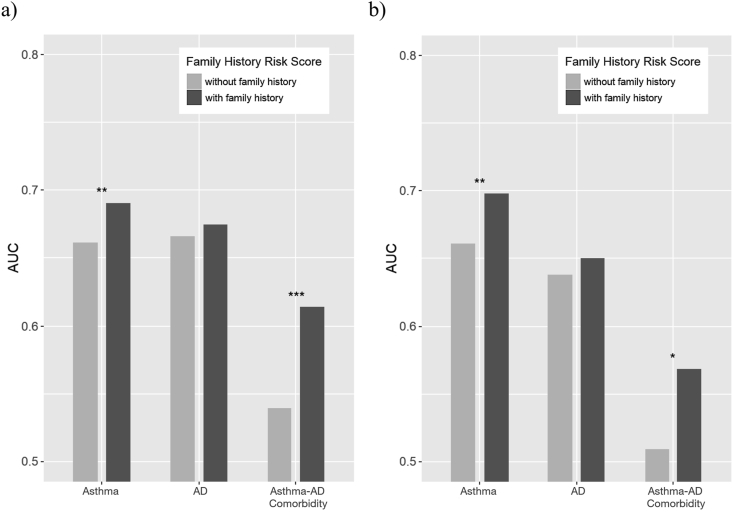
The recent rise in the prevalence of chronic allergic diseases among children has increased disease burden and reduced quality of life, especially for children with comorbid allergic diseases. Predicting the occurrence of allergic diseases can help prevent its onset for those in high risk groups. Herein, we aimed to construct prediction models for asthma, atopic dermatitis (AD), and asthma-AD comorbidity (also known as atopic march) using a genome-wide association study (GWAS) and family history data from patients of Korean heritage. Among 973 patients and 481 healthy controls, we evaluated single nucleotide polymorphism (SNP) heritability for each disease using genome-based restricted maximum likelihood (GREML) analysis. We then compared the performance of prediction models constructed using Least Absolute Shrinkage and Selection Operator (LASSO) and penalized ridge regression methods. Our results indicate that the addition of family history risk scores to the prediction model greatly increase the predictability of asthma and asthma-AD comorbidity. However, prediction of AD was mostly attributable to GWAS SNPs.
近期儿童慢性过敏性疾病患病率的上升增加了疾病负担并降低了生活质量,对于患有合并过敏性疾病的儿童而言尤其如此。预测过敏性疾病的发生有助于预防高危人群发病。在此,我们旨在利用全基因组关联研究(GWAS)以及韩国裔患者的家族史数据,构建哮喘、特应性皮炎(AD)和哮喘-AD共病(也称为特应性进程)的预测模型。在973例患者和481名健康对照中,我们使用基于基因组的限制最大似然法(GREML)分析评估了每种疾病的单核苷酸多态性(SNP)遗传力。然后,我们比较了使用最小绝对收缩和选择算子(LASSO)及惩罚岭回归方法构建的预测模型的性能。我们的结果表明,在预测模型中加入家族史风险评分可显著提高哮喘和哮喘-AD共病的预测能力。然而,AD的预测主要归因于GWAS SNPs。