Bhatt Kinal, Agolli Arjola, Patel Mehrie H, Garimella Radhika, Devi Madhuri, Garcia Efrain, Amin Harshad, Domingue Carlos, Guerra Del Castillo Roberto, Sanchez-Gonzalez Marcos
Division of Clinical and Translational Research, Larkin Health System, South Miami, FL, USA.
Pakistan Ziauddin Medical College, Karachi, Pakistan.
Discoveries (Craiova). 2021 Mar 31;9(1):e126. doi: 10.15190/d.2021.5.
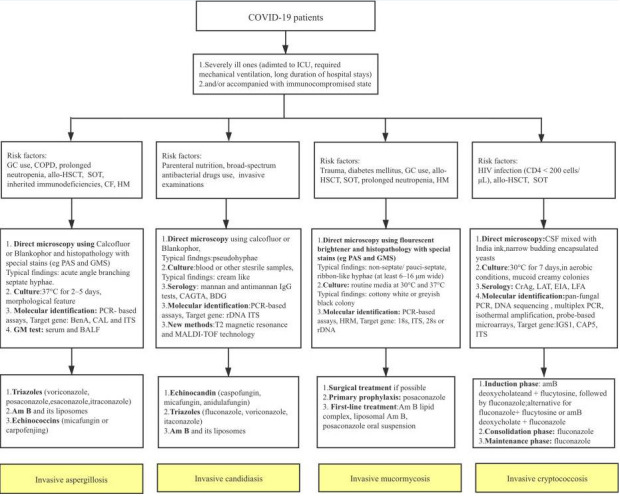
Severe COVID-19 disease is associated with an increase in pro-inflammatory markers, such as IL-1, IL-6, and tumor necrosis alpha, less CD4 interferon-gamma expression, and fewer CD4 and CD8 cells, which increase the susceptibility to bacterial and fungal infections. One such opportunistic fungal infection is mucormycosis. Initially, it was debated whether a person taking immunosuppressants, such as corticosteroids, and monoclonal antibodies will be at higher risk for COVID-19 or whether the immunosuppresive state would cause a more severe COVID-19 disease. However, immunosuppressants are currently continued unless the patients are at greater risk of severe COVID-19 infection or are on high-dose corticosteroids therapy. As understood so far, COVID-19 infection may induce significant and persistent lymphopenia, which in turn increases the risk of opportunistic infections. It is also noted that 85% of the COVID-19 patients' laboratory findings showed lymphopenia. This means that patients with severe COVID-19 have markedly lower absolute number of T lymphocytes, CD4+T and CD8+ T cells and, since the lymphocytes play a major role in maintaining the immune homeostasis, the patients with COVID-19 are highly susceptible to fungal co-infections. This report is intended to raise awareness of the importance of early detection and treatment of mucormycosis and other fungal diseases, such as candidiasis, SARS-CoV-2-associated pulmonary aspergillosis, pneumocystis pneumonia and cryptococcal disease, in COVID-19 patients, to reduce the risk of mortality.
重症新型冠状病毒肺炎(COVID-19)与促炎标志物增加有关,如白细胞介素-1、白细胞介素-6和肿瘤坏死因子α,CD4干扰素-γ表达减少,CD4和CD8细胞数量减少,这增加了细菌和真菌感染的易感性。毛霉菌病就是这样一种机会性真菌感染。最初,人们争论服用免疫抑制剂(如皮质类固醇和单克隆抗体)的人是否患COVID-19的风险更高,或者免疫抑制状态是否会导致更严重的COVID-19疾病。然而,目前免疫抑制剂仍在继续使用,除非患者有更高的重症COVID-19感染风险或正在接受高剂量皮质类固醇治疗。就目前所知,COVID-19感染可能会导致显著且持续的淋巴细胞减少,进而增加机会性感染的风险。还应注意到,85%的COVID-19患者实验室检查结果显示淋巴细胞减少。这意味着重症COVID-19患者的T淋巴细胞、CD4+T和CD8+T细胞绝对数量明显更低,而且由于淋巴细胞在维持免疫稳态中起主要作用,COVID-19患者极易发生真菌合并感染。本报告旨在提高人们对COVID-19患者早期检测和治疗毛霉菌病及其他真菌疾病(如念珠菌病、SARS-CoV-2相关肺曲霉病、肺孢子菌肺炎和隐球菌病)重要性的认识,以降低死亡风险。