Chavda Vivek P, Mishra Toshika, Kamaraj Sathvika, Punetha Swati, Sengupta Oishani, Joshi Yash, Vuppu Suneetha, Vaghela Dixa, Vora Lalitkumar
Department of Pharmaceutics and Pharmaceutical Technology, L.M. College of Pharmacy, Ahmedabad 380009, Gujarat, India.
Science, Innovation, and Society Research Lab. 115, Department of Biotechnology, Hexagon (SMV), Vellore Institute of Technology, Vellore 632014, Tamil Nadu, India.
Vaccines (Basel). 2023 Feb 27;11(3):555. doi: 10.3390/vaccines11030555.
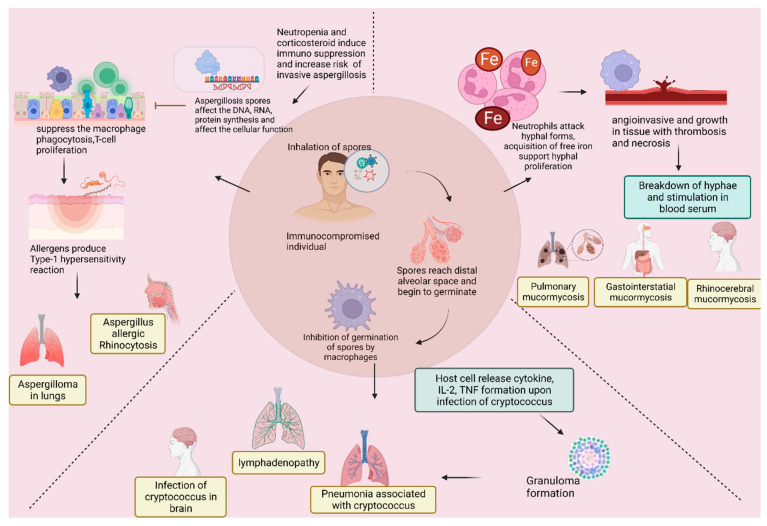
Coronavirus disease 2019 (COVID-19) infection is currently a great cause of concern for the healthcare sector around the globe. SARS-CoV-2 is an RNA virus that causes a serious infection that is associated with numerous adverse effects and multiple complications associated with different organs and systems during its pathogenic cycle in humans. Individuals affected by COVID-19, especially elderly populations and immunocompromised people, are greatly vulnerable to opportunistic fungal pathogens. Aspergillosis, invasive candidiasis, and mucormycosis are widespread fungal coinfections in COVID-19 patients. Other fungal infections that are rare but are exhibiting increased incidence in the current scenario include infections caused by , sp., sp., etc. By producing virulent spores, these pathogens increase the severity of the disease and increase the morbidity and fatality rates in COVID-19 patients globally. These infections generally occur in patients recovering from COVID-19 infection, resulting in rehospitalization. Older and immunocompromised individuals are at higher risk of developing opportunistic fungal infections. This review focuses on understanding the opportunistic fungal infections prevalent in COVID-19 patients, especially elderly people. We have also highlighted the important preventive methods, diagnostic approaches, and prophylactic measures for fungal infections.
2019冠状病毒病(COVID-19)感染目前是全球医疗保健部门极为关注的问题。严重急性呼吸综合征冠状病毒2(SARS-CoV-2)是一种RNA病毒,可引起严重感染,在其人类致病周期中会导致多种不良反应以及与不同器官和系统相关的多种并发症。受COVID-19影响的个体,尤其是老年人群体和免疫功能低下的人群,极易感染机会性真菌病原体。曲霉病、侵袭性念珠菌病和毛霉病是COVID-19患者中广泛存在的真菌合并感染。其他在当前情况下罕见但发病率正在上升的真菌感染包括由、属、属等引起的感染。通过产生有剧毒的孢子,这些病原体会增加疾病的严重程度,并提高全球COVID-19患者的发病率和死亡率。这些感染通常发生在从COVID-19感染中康复的患者身上,导致再次住院。老年人和免疫功能低下的个体发生机会性真菌感染的风险更高。本综述着重于了解COVID-19患者,尤其是老年人中普遍存在的机会性真菌感染。我们还强调了真菌感染的重要预防方法、诊断方法和预防措施。