
GPS 检测与长期癌症结果的相关性:20 年远处转移风险和前列腺癌特异性死亡率。
GPS Assay Association With Long-Term Cancer Outcomes: Twenty-Year Risk of Distant Metastasis and Prostate Cancer-Specific Mortality.
机构信息
Scott Department of Urology, Baylor College of Medicine, Houston, TX.
Glickman Urological and Kidney Institute, Cleveland Clinic, Cleveland, OH.
出版信息
JCO Precis Oncol. 2021 Feb 24;5. doi: 10.1200/PO.20.00325. eCollection 2021.
PURPOSE
To assess the association between the Oncotype DX Genomic Prostate Score (GPS) result and long-term oncological outcomes following radical prostatectomy (RP).
METHODS
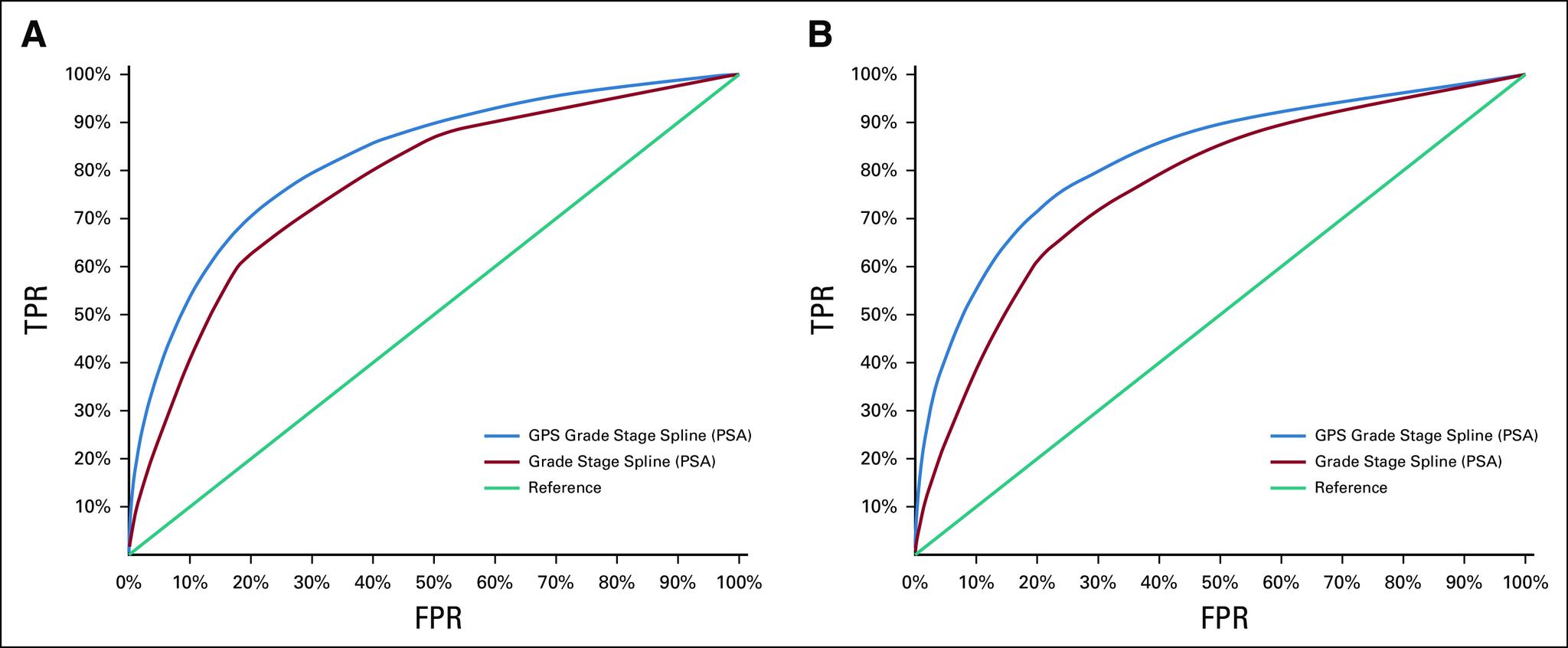
We evaluated the association of the GPS result assayed from the index lesion from RP tissue with the risk of distant metastases (DM) and prostate cancer-specific mortality (PCSM) over the 20 years following RP in a stratified cohort sample of 428 patients from 2,641 treated between 1987 and 2004. Cox regression of cause-specific hazards was used to estimate the absolute risk of both end points, with death from other causes treated as a competing risk. A correction for regression to the mean (RM) was applied since the GPS test was developed using this cohort. Exploratory analysis using presurgical parameters and the GPS test as prognostic variables was performed to assess the additional value of the GPS test on 20-year risk of DM and PCSM. Model discrimination was measured using the area under the receiver operating characteristic curve.
RESULTS
The GPS test appears to be independently associated with both 20-year risk of DM and PCSM with a low false discovery rate. Per 20-unit increase in GPS, multivariable analysis with RM correction estimated hazard ratios of 2.24 (95% CI, 1.49 to 3.53) and 2.30 (95% CI, 1.45 to 4.36) for DM and PCSM, respectively. Accuracy of models including clinical risk factors alone appeared to improve when including the GPS test in assessing risk of both end points.
CONCLUSION
The results suggest that the GPS test provides information on the risk for the meaningful long-term outcomes of DM and PCSM.
目的
评估 Oncotype DX 基因组前列腺评分(GPS)结果与根治性前列腺切除术(RP)后长期肿瘤学结果之间的关联。
方法
我们评估了从 RP 组织的索引病变检测到的 GPS 结果与 20 年 RP 后远处转移(DM)和前列腺癌特异性死亡率(PCSM)风险之间的关联,该结果来自 1987 年至 2004 年期间治疗的 2641 名患者中的 428 名分层队列样本。使用特定原因危害的 Cox 回归来估计两个终点的绝对风险,将其他原因导致的死亡视为竞争风险。由于 GPS 测试是使用该队列开发的,因此应用了回归均值(RM)校正。使用术前参数和 GPS 测试作为预后变量进行探索性分析,以评估 GPS 测试对 20 年 DM 和 PCSM 风险的额外价值。使用接收者操作特征曲线下的面积来衡量模型的区分度。
结果
GPS 测试似乎与 20 年 DM 和 PCSM 风险独立相关,且假阳性率较低。经过 RM 校正的多变量分析显示,GPS 每增加 20 个单位,估计的 DM 和 PCSM 风险的危险比分别为 2.24(95%CI,1.49 至 3.53)和 2.30(95%CI,1.45 至 4.36)。当包括 GPS 测试来评估两个终点的风险时,包括临床危险因素的模型的准确性似乎有所提高。
结论
这些结果表明,GPS 测试提供了关于 DM 和 PCSM 有意义的长期结果风险的信息。


 Zotero 插件