Universidade de Brasília. Faculdade de Ciências da Saúde. Programa de Pós-Graduação em Nutrição Humana. Brasília, Distrito Federal (DF), Brasil.
Centro Universitário Unieuro. Departamento de Nutrição. Brasília, Distrito Federal (DF), Brasil.
Rev Saude Publica. 2021 May 24;55:26. doi: 10.11606/s1518-8787.2021055002356. eCollection 2021.
To assess total usual nutrient intakes from foods and dietary supplements by age, sex, physical activity, and nutritional status, and to compare usual nutrient intakes to the Dietary Reference Intakes among non-users and users of dietary supplements in an urban population.
Cross-sectional population-based survey with 506 adults conducted in the city of Brasília, Brazil, using 24h food recalls. The 24-HR was collected on two nonconsecutive days, for which individuals reported all food, supplements, and beverages consumed in the previous 24 hours. The estimates of mean and the distribution percentiles were adjusted to reflect usual nutrient intake using the Iowa State University method. The prevalence of inadequate micronutrient intake was estimated according to sex using the Estimated Average Requirement (EAR), and values above the Tolerable Upper Intake Level (UL) were also considered. Also, a comparison was made of the total mean usual intake between supplement users and non-users according to BMI and physical activity.
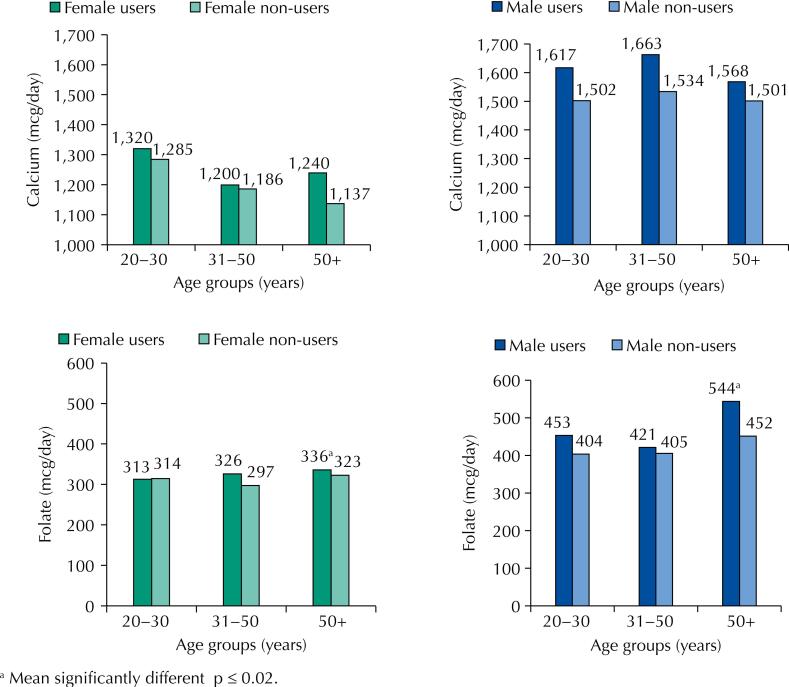
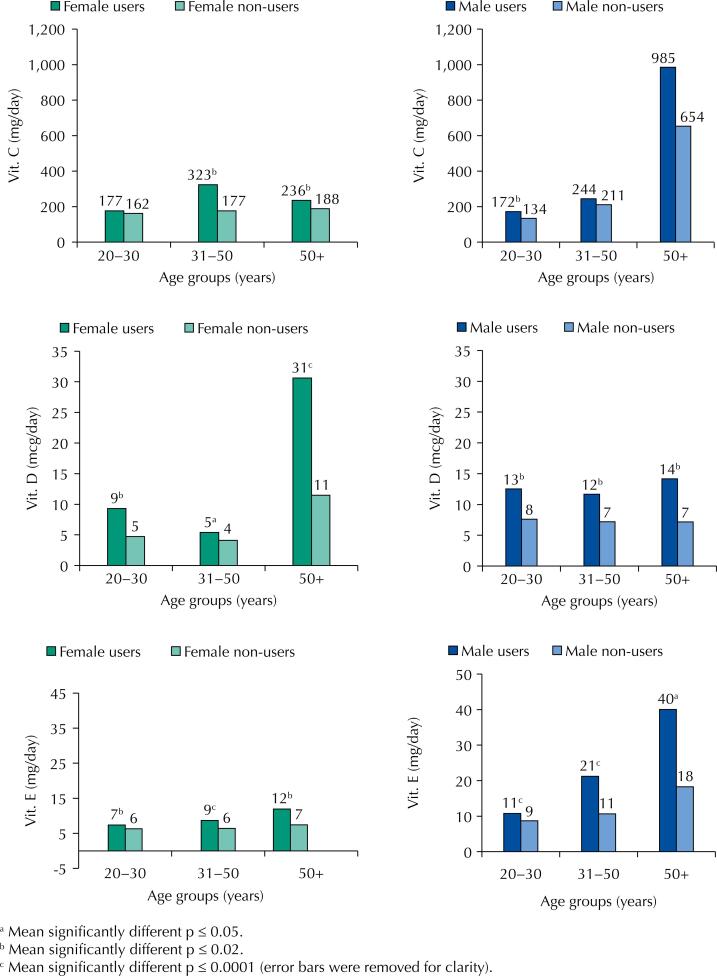
The total mean usual dietary intake was significantly higher among users than non-users of dietary supplements (p ≤ 0.02). Dietary supplement use increased intakes of nutrients and decreased prevalence of inadequacy according to sex, with only small (typically < 13%) increases in the population exceeding the Tolerable Upper Intake Level. There was a significant interaction between physical activity and BMI categories with supplement use.
The population that consumes food supplements comprises individuals with more advanced age, female, normal BMI, and physically active. Our findings show that the use of supplements appears beneficial to attain nutrient adequacy. Careful monitoring of intake from food and supplements is recommended, and the statistical methods must be powerful enough to achieve relevant information.
评估食物和膳食补充剂的总日常营养素摄入量,按年龄、性别、身体活动和营养状况进行评估,并在城市人群中比较非使用者和使用者的日常营养素摄入量与膳食参考摄入量。
采用横断面人群为基础的调查,对巴西首都巴西利亚的 506 名成年人进行了 24 小时食物回忆。24 小时回顾在两天内进行,不连续进行,在此期间,个体报告了前 24 小时内摄入的所有食物、补充剂和饮料。使用爱荷华州立大学的方法,对均值和分布百分位数进行了调整,以反映日常营养素的摄入量。根据性别使用估计平均需求量(EAR)估计微量营养素摄入不足的患病率,还考虑了超过可耐受上限(UL)的值。还根据 BMI 和身体活动比较了补充剂使用者和非使用者之间的总平均日常摄入量。
膳食补充剂的总平均日常摄入量在使用者中显著高于非使用者(p≤0.02)。膳食补充剂的使用增加了营养素的摄入量,并降低了根据性别出现的不足率,只有少数(通常<13%)人群超过了可耐受上限。身体活动和 BMI 类别与补充剂使用之间存在显著的交互作用。
食用补充剂的人群包括年龄较大、女性、正常 BMI 和身体活跃的个体。我们的发现表明,补充剂的使用似乎有助于达到营养充足。建议仔细监测食物和补充剂的摄入量,并且统计方法必须足够强大,以获取相关信息。