Centre for Longitudinal Studies, Social Research Institute, University College London, London, UK
Centre for Longitudinal Studies, Social Research Institute, University College London, London, UK.
J Epidemiol Community Health. 2021 Dec;75(12):1136-1142. doi: 10.1136/jech-2020-215664. Epub 2021 May 26.
The COVID-19 pandemic is expected to have far-reaching consequences on population health. We investigated whether these consequences included changes in health-impacting behaviours which are important drivers of health inequalities.
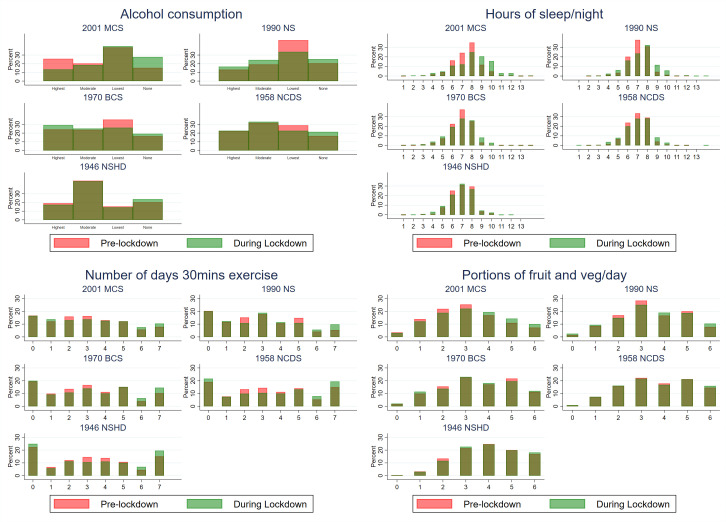
Using data from five representative British cohorts (born 2000-2002, 1989-1990, 1970, 1958 and 1946), we investigated sleep, physical activity (exercise), diet and alcohol intake (N=14 297). We investigated change in each behaviour (pre/during the May 2020 lockdown), and differences by age/cohort, gender, ethnicity and socioeconomic position (childhood social class, education attainment and adult financial difficulties). Logistic regression models were used, accounting for study design and non-response weights, and meta-analysis used to pool and test cohort differences in association.
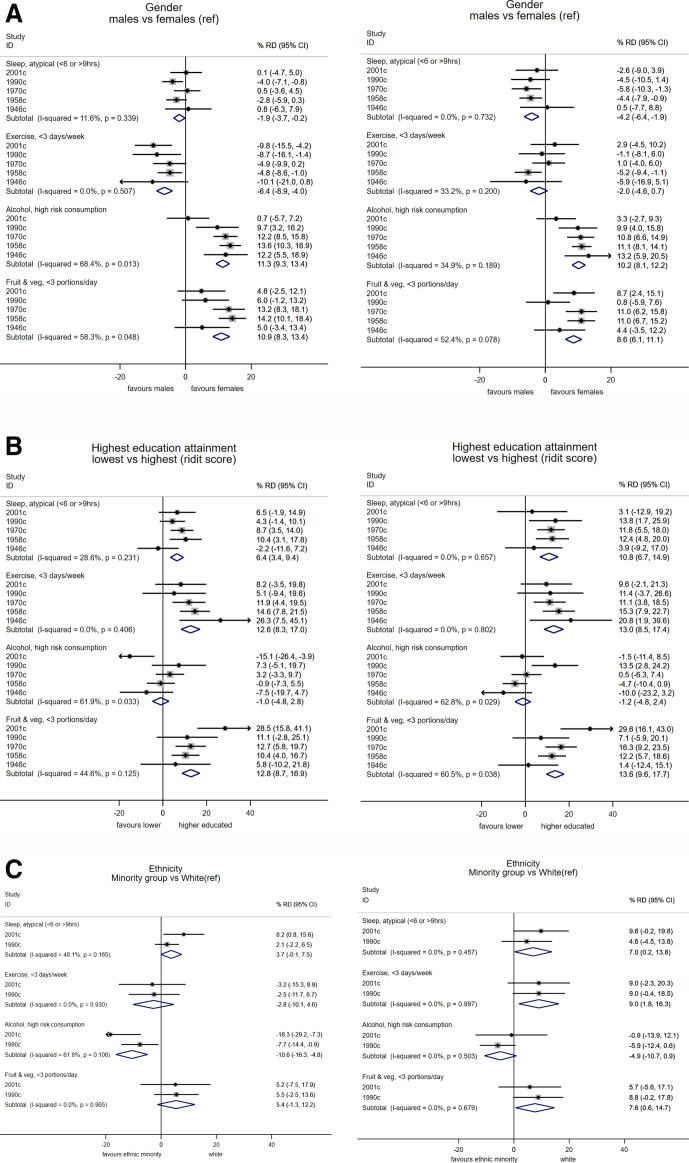
Change occurred in both directions-shifts from the middle part of the distribution to both declines and increases in sleep, exercise and alcohol use. Older cohorts were less likely to report changes in behaviours while the youngest reported more frequent increases in sleep, exercise, and fruit and vegetable intake, yet lower alcohol consumption. Widening inequalities in sleep during lockdown were more frequent among women, socioeconomically disadvantaged groups and ethnic minorities. For other outcomes, inequalities were largely unchanged, yet ethnic minorities were at higher risk of undertaking less exercise and consuming lower amounts of fruit and vegetables.
Our findings provide new evidence on the multiple changes to behavioural outcomes linked to lockdown, and the differential impacts across generation, gender, socioeconomic circumstances across life, and ethnicity. Lockdown appeared to widen some (but not all) forms of health inequality.
预计 COVID-19 大流行将对人口健康产生深远影响。我们调查了这些后果是否包括影响健康的行为发生变化,这些变化是健康不平等的重要驱动因素。
我们使用来自五个具有代表性的英国队列(出生于 2000-2002 年、1989-1990 年、1970 年、1958 年和 1946 年)的数据,调查了睡眠、身体活动(运动)、饮食和饮酒摄入情况(N=14297)。我们调查了每种行为(在 2020 年 5 月封锁期间之前/期间)的变化情况,以及年龄/队列、性别、种族和社会经济地位(童年社会阶层、教育程度和成年经济困难)方面的差异。使用逻辑回归模型,考虑研究设计和非响应权重,并使用荟萃分析来汇总和检验队列之间的关联差异。
变化发生在两个方向——从分布的中间部分向睡眠、运动和饮酒减少和增加转变。较老的队列不太可能报告行为变化,而最年轻的队列则更频繁地增加睡眠、运动以及水果和蔬菜的摄入量,但饮酒量较低。在封锁期间,睡眠不平等的程度扩大更多地发生在女性、社会经济劣势群体和少数民族中。对于其他结果,不平等程度基本保持不变,但少数民族进行较少的运动和摄入较少的水果和蔬菜的风险更高。
我们的研究结果提供了关于与封锁相关的行为结果变化的新证据,以及代际、性别、整个生命周期的社会经济环境以及种族之间的差异影响。封锁似乎扩大了一些(但不是所有)形式的健康不平等。