Granström Fredrik, Wenemark Marika, Festin Karin, Good Elin, Frielingsdorf Helena, Lowén Mats, Rystedt Ingrid
Department of Health, Medicine and Caring Sciences, Linköping University, Linköping, Sweden.
Department of Cardiology, Linköping University, Linköping, Sweden.
BMC Public Health. 2024 Jun 13;24(1):1589. doi: 10.1186/s12889-024-19100-w.
The COVID-19 pandemic precipitated heightened morbidity and elevated mortality attributed to the SARS-CoV-2 infection. The pandemic also influenced health behaviors such as physical activity (PA) and alcohol consumption. The aim of this study was to examine changes in leisure PA and alcohol consumption in Sweden during the pandemic, and elucidate potential discrepancies in changes across demographic strata and socioeconomic status (SES).
Data were retrieved from two waves of the longitudinal cohort study Life conditions, Stress and Health (LSH) (n = 2,523). Two measures of change were used; longitudinal change relative to baseline (2012-2015) and reported change compared to before the pandemic. For these two change measures, differences between sex, age group and SES were analyzed using multinomial logistic regression.
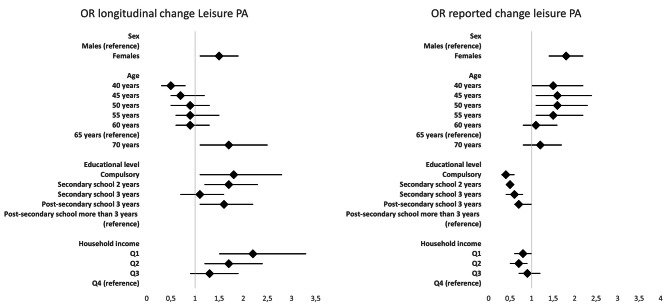
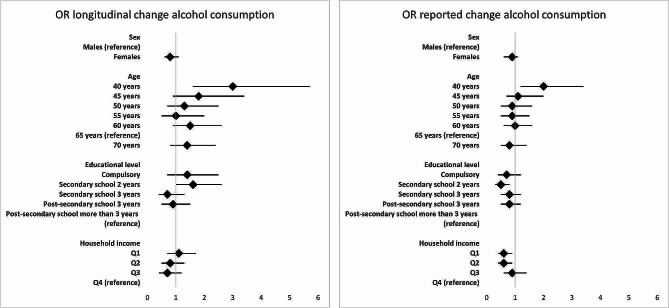
Regardless of the change measure, the proportion of individuals with diminished PA was notably higher among females compared to males. Furthermore, relative to baseline, females were less likely to have increased their PA, however according to the reported change they were more likely to have increased PA. Longitudinal change in PA compared to baseline followed a reversed age gradient, while, according to reported change, a decrease in PA during the pandemic was most prevalent in respondents 45 years of age at baseline (OR = 1.8, CI: 1.2-2.5) and respondents 50 years of age at baseline (OR = 1.7, CI: 1.2-2.4). High SES was associated with a greater variability in PA. Alcohol consumption was generally reduced during the pandemic. However, individuals aged 40 or 45 years at baseline were more likely than others to have initiated risky alcohol consumption.
Females exhibited a greater propensity to alter their PA levels during the pandemic, with the most profound decreases observed among individuals of working ages. Despite a general downturn in alcohol consumption, individuals aged 40 and 45 had a heightened likelihood of having initiated risky alcohol consumption compared to individuals in other age cohorts. In conclusion, societal restrictions during a pandemic render a dual impact on PA levels. While posing a risk for decreased PA among individuals in working ages, the restrictions also present a potential window of opportunity to increase PA, particularly among females.
新冠疫情导致因感染严重急性呼吸综合征冠状病毒2(SARS-CoV-2)而出现更高的发病率和死亡率。该疫情还影响了诸如体育活动(PA)和饮酒等健康行为。本研究的目的是调查瑞典在疫情期间休闲体育活动和饮酒情况的变化,并阐明不同人口阶层和社会经济地位(SES)在变化方面的潜在差异。
数据取自纵向队列研究“生活条件、压力与健康”(LSH)的两波调查(n = 2523)。使用了两种变化衡量指标;相对于基线(2012 - 2015年)的纵向变化以及与疫情前相比报告的变化。对于这两种变化衡量指标,使用多项逻辑回归分析性别、年龄组和SES之间的差异。
无论采用哪种变化衡量指标,体育活动减少的个体比例在女性中显著高于男性。此外,相对于基线,女性增加体育活动的可能性较小,然而根据报告的变化,她们增加体育活动的可能性更大。与基线相比体育活动的纵向变化呈现出相反的年龄梯度,而根据报告的变化,疫情期间体育活动减少在基线年龄为45岁的受访者中最为普遍(比值比[OR] = 1.8,置信区间[CI]:1.2 - 2.5)以及基线年龄为50岁的受访者中(OR = 1.7,CI:1.2 - 2.4)。高社会经济地位与体育活动的更大变异性相关。疫情期间饮酒普遍减少。然而,基线年龄为40岁或45岁的个体比其他人更有可能开始危险饮酒。
女性在疫情期间表现出更大的改变体育活动水平的倾向,在工作年龄个体中观察到的下降最为显著。尽管饮酒总体上有所减少,但与其他年龄组的个体相比,40岁和45岁的个体开始危险饮酒的可能性更高。总之,疫情期间的社会限制对体育活动水平产生了双重影响。虽然给工作年龄个体的体育活动减少带来了风险,但这些限制也为增加体育活动提供了潜在的机会窗口,尤其是在女性中。