Peter Harrison Centre for Disability Sport, School of Sport, Exercise and Health Sciences, Loughborough University, Loughborough, UK.
Research and Development, Heliomare Rehabilitation Center, Wijk aan Zee, The Netherlands.
Spinal Cord. 2021 Nov;59(11):1162-1169. doi: 10.1038/s41393-021-00642-4. Epub 2021 May 26.
Cross-sectional cohort study.
To compare ratings of perceived exertion (RPE) on Borg's 6-20 RPE scale and Category Ratio 10 (CR10) in able-bodied (AB) participants during upper and lower body exercise, and recreationally active participants with paraplegia (PARA) and athletes with tetraplegia (TETRA) during upper body exercise only.
University and rehabilitation centre-based laboratories in UK and Netherlands.
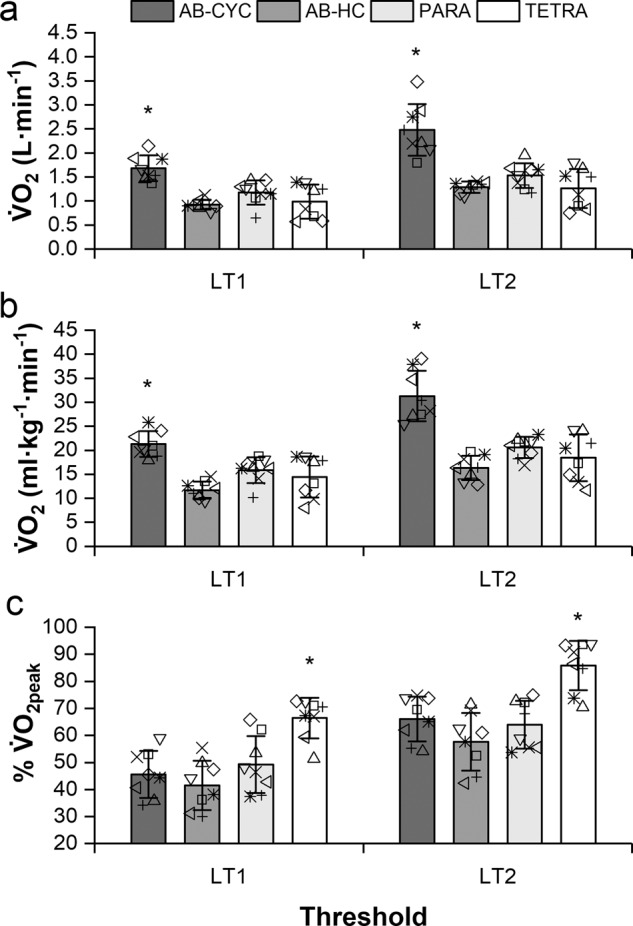
Twenty-four participants were equally split between AB, PARA, and TETRA. AB performed maximal tests using cycle (AB-CYC) and handcycle (AB-HC) ergometry. PARA and TETRA performed maximal handcycle and wheelchair propulsion tests, respectively. Oxygen uptake (V̇O) and blood lactate concentration were monitored throughout. RPE was rated each stage on Borg's RPE scale and CR10. Thresholds were identified according to log-V̇O plotted against log-blood lactate (LT), and 1.5 mmol L greater than LT (LT).
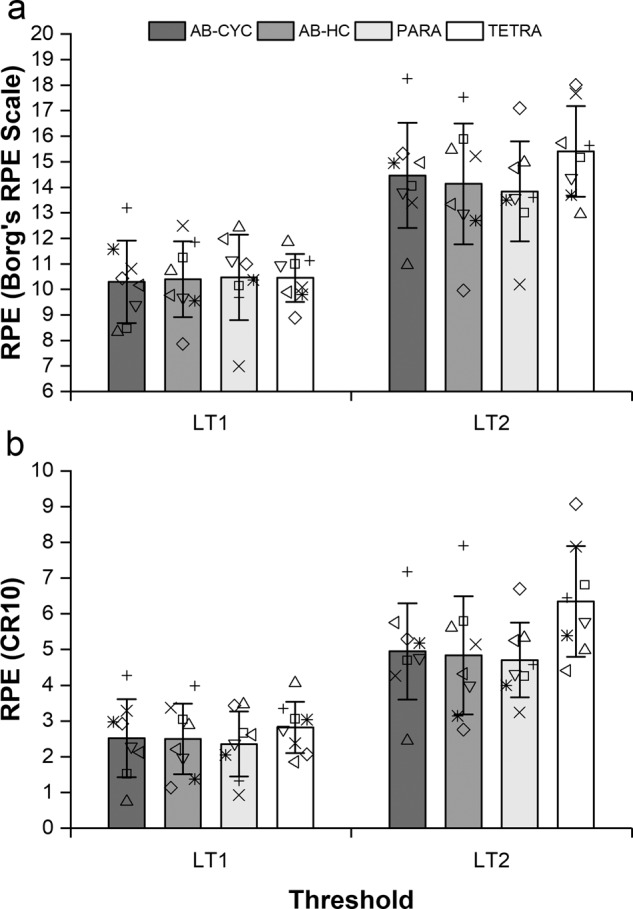
RPE from both scales were best fit against each other using a quadratic model, with high goodness of fit between scales that was independent of exercise mode and participant group (range R: 0.965-0.970, P < 0.005). Though percentage peak V̇O was significantly greater in TETRA (P < 0.005), there was no difference in RPE at LT or LT between groups on Borg's RPE scale or CR10.
Strong association between Borg's RPE scale and CR10 suggests they can be used interchangeably. RPE at lactate thresholds were independent of mode of exercise and level of spinal cord injury. However, inter-individual variation precludes from making firm recommendations about using RPE for prescribing homogenous exercise intensity.
横断面队列研究。
比较在健全(AB)参与者进行上下肢运动时,Borg 6-20 RPE 量表和等级比 10(CR10)的感知用力评分(RPE),以及在仅进行上肢运动时,有截瘫(PARA)和四肢瘫(TETRA)的竞技运动员的 RPE。
英国和荷兰的大学和康复中心实验室。
24 名参与者平均分为 AB、PARA 和 TETRA。AB 分别使用自行车(AB-CYC)和手摇车(AB-HC)测功计进行最大测试。PARA 和 TETRA 分别进行最大手摇车和轮椅推进测试。整个过程中监测氧气摄取量(V̇O)和血乳酸浓度。Borg RPE 量表和 CR10 对每个阶段的 RPE 进行评分。根据对数-V̇O 与对数血乳酸(LT)的关系图确定阈值,LT 增加 1.5mmol/L 以上(LT)。
两种量表的 RPE 最佳拟合模式为二次模型,两种量表之间的拟合度很高,与运动模式和参与者群体无关(范围 R:0.965-0.970,P<0.005)。尽管 TETRA 的最大摄氧量峰值百分比显著更高(P<0.005),但在 Borg RPE 量表或 CR10 上,LT 或 LT 时的 RPE 在各组之间没有差异。
Borg RPE 量表和 CR10 之间存在很强的关联,表明它们可以互换使用。乳酸阈值时的 RPE 与运动方式和脊髓损伤程度无关。然而,个体间的差异使得无法就使用 RPE 来规定同质运动强度提出明确建议。