Dou Yawei, Tian Wei, Wang Hongtao, Lv Shanshan
Department of Thoracic Surgery, Shaanxi Province People's Hospital, Xi'an, 710068, People's Republic of China.
Department of Cardiovascular Surgery, Xijing Hospital of Airforce Medical University, Xi'an, 710032, People's Republic of China.
Cancer Manag Res. 2021 May 11;13:3775-3787. doi: 10.2147/CMAR.S302814. eCollection 2021.
Circular RNAs (circRNAs) participate in the tumorigenesis of various cancers. CircRNA hsa_circ_0001944 (circ_0001944), derived from the TCONS_l2_00030860 gene, has been uncovered to be upregulated in NSCLC (non-small cell lung cancer). Nevertheless, the influence of circ_0001944 on glycolysis and tumor growth in NSCLC is unclear.
Expression trend of circ_0001944 in NSCLC tissues and cells were evaluated by quantitative real-time polymerase chain reaction (qRT-PCR). Loss-of-function experiments were performed to assess the influence of circ_0001944 knockdown on proliferation, migration, invasion, and glycolysis of NSCLC cells. Protein levels were assessed by Western blotting. The regulatory mechanism of circ_0001944 was analyzed by bioinformatics analysis, dual-luciferase reporter assay, and/or RNA pull-down assay. The tumorigenicity of circ_0001944 was confirmed by xenograft assay.
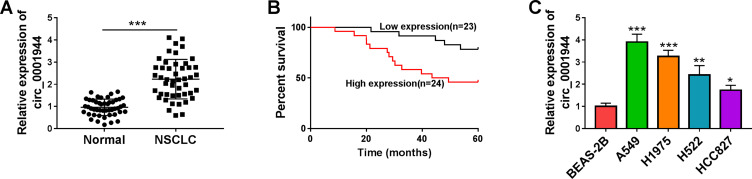
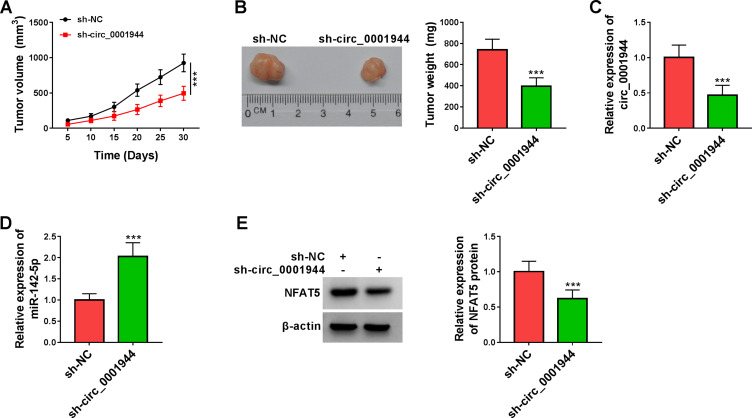
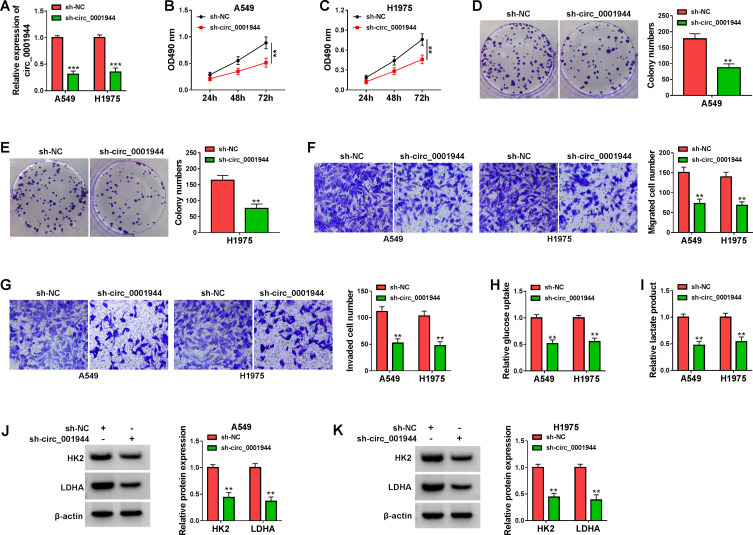
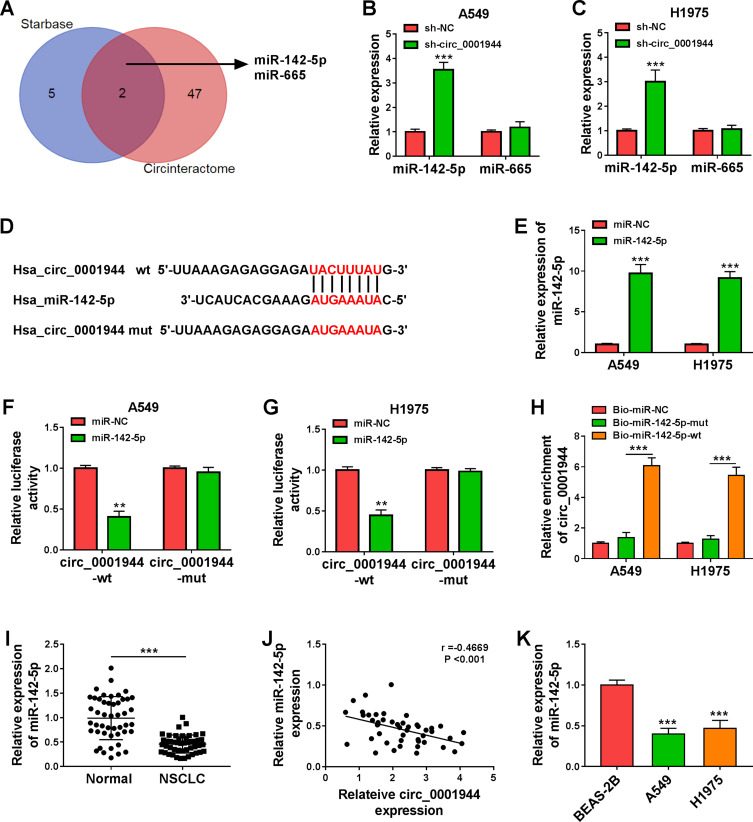
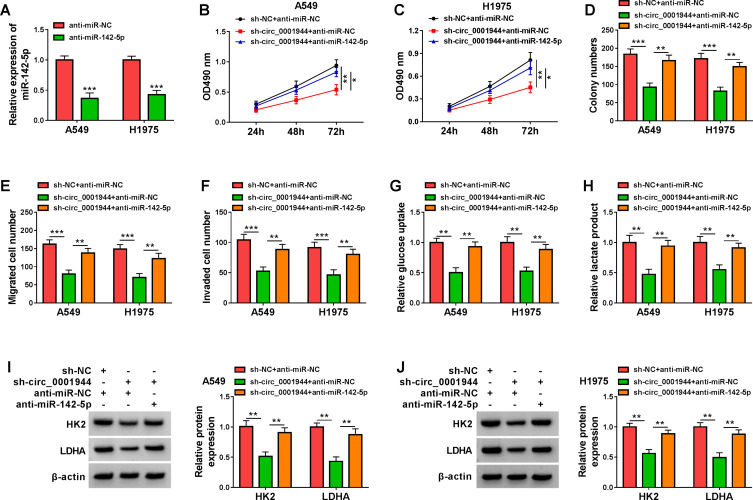
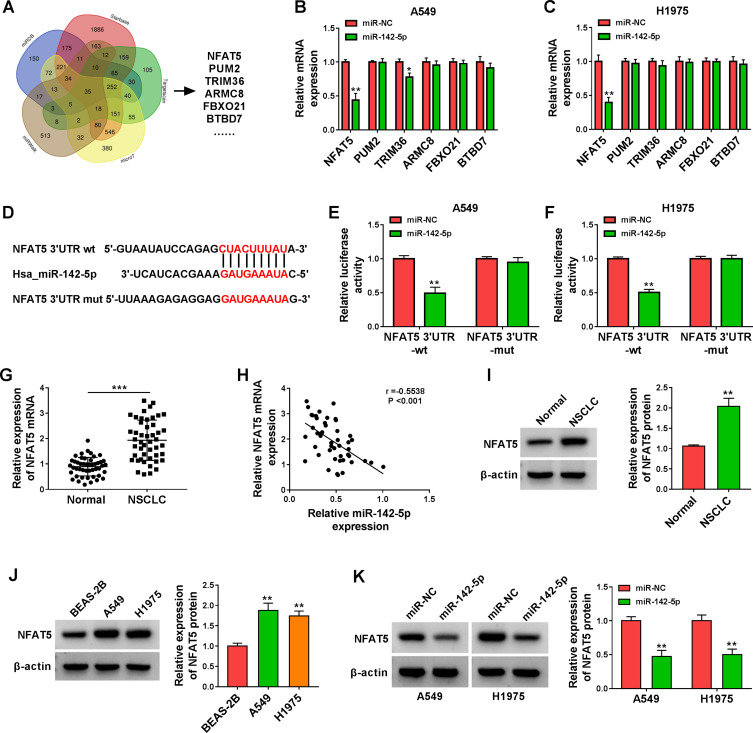
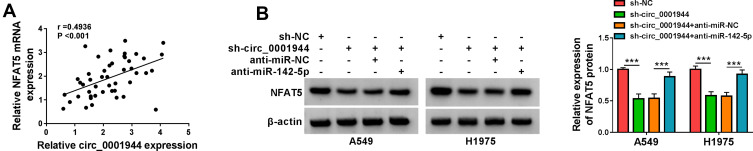
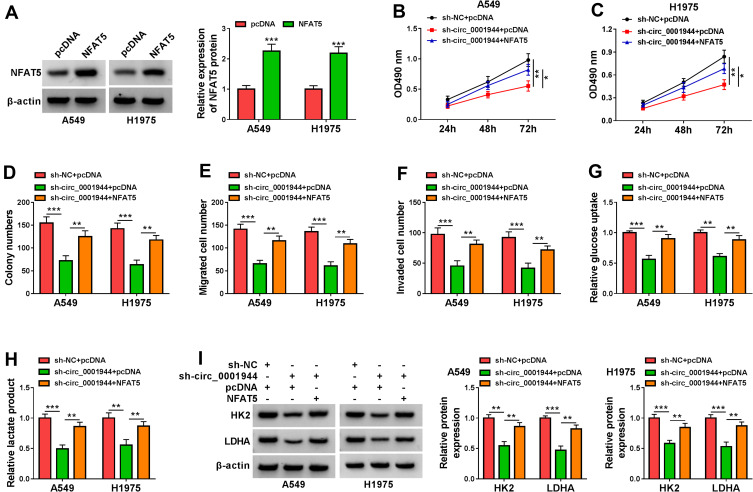
Circ_0001944 was highly expressed in NSCLC, and NSCLC patients with high expression of circ_0001944 had a worse prognosis. Circ_0001944 silencing decreased xenograft tumor growth in vivo and repressed proliferation, migration, invasion, and glycolysis of NSCLC cells in vitro. Circ_0001944 was verified as a decoy for microRNA (miR)-142-5p, which targeted NFAT5 (nuclear factor of activated T cells 5). MiR-142-5p was downregulated while NFAT5 was upregulated in NSCLC. Both miR-142-5p inhibition and NFAT5 overexpression offset the suppressive impact of circ_0001944 silencing on proliferation, migration, invasion, and glycolysis of NSCLC cells. Circ_0001944 adsorbed miR-142-5p to elevate NFAT5 expression in NSCLC cells.
Circ_0001944 promotes proliferation, migration, invasion, and glycolysis of NSCLC cells by upregulating NFAT5 through adsorbing miR-142-5p, offering a novel mechanism for understanding the advancement of NSCLC.
环状RNA(circRNAs)参与多种癌症的肿瘤发生过程。来源于TCONS_l2_00030860基因的环状RNA hsa_circ_0001944(circ_0001944)已被发现在非小细胞肺癌(NSCLC)中上调。然而,circ_0001944对NSCLC糖酵解和肿瘤生长的影响尚不清楚。
通过定量实时聚合酶链反应(qRT-PCR)评估circ_0001944在NSCLC组织和细胞中的表达趋势。进行功能缺失实验以评估circ_0001944敲低对NSCLC细胞增殖、迁移、侵袭和糖酵解的影响。通过蛋白质印迹法评估蛋白质水平。通过生物信息学分析、双荧光素酶报告基因检测和/或RNA下拉检测分析circ_0001944的调控机制。通过异种移植实验证实circ_0001944的致瘤性。
circ_0001944在NSCLC中高表达,circ_0001944高表达的NSCLC患者预后较差。circ_0001944沉默可降低体内异种移植肿瘤的生长,并在体外抑制NSCLC细胞的增殖、迁移、侵袭和糖酵解。circ_0001944被证实为微小RNA(miR)-142-5p的诱饵,miR-142-5p靶向活化T细胞核因子5(NFAT5)。在NSCLC中,miR-142-5p下调而NFAT5上调。miR-142-5p抑制和NFAT5过表达均抵消了circ_0001944沉默对NSCLC细胞增殖、迁移、侵袭和糖酵解的抑制作用。circ_0001944吸附miR-142-5p以提高NSCLC细胞中NFAT5的表达。
circ_0001944通过吸附miR-142-5p上调NFAT5,从而促进NSCLC细胞的增殖、迁移、侵袭和糖酵解,为理解NSCLC的进展提供了一种新机制。