Casotti Gianluca, Ciancaleoni Gianluca, Lipparini Filippo, Nieri Chiara, Iuliano Anna
Dipartimento di Chimica e Chimica Industriale, Università di Pisa Via G. Moruzzi 13 56124 Pisa Italy
Chem Sci. 2019 Nov 11;11(1):257-263. doi: 10.1039/c9sc04820k.
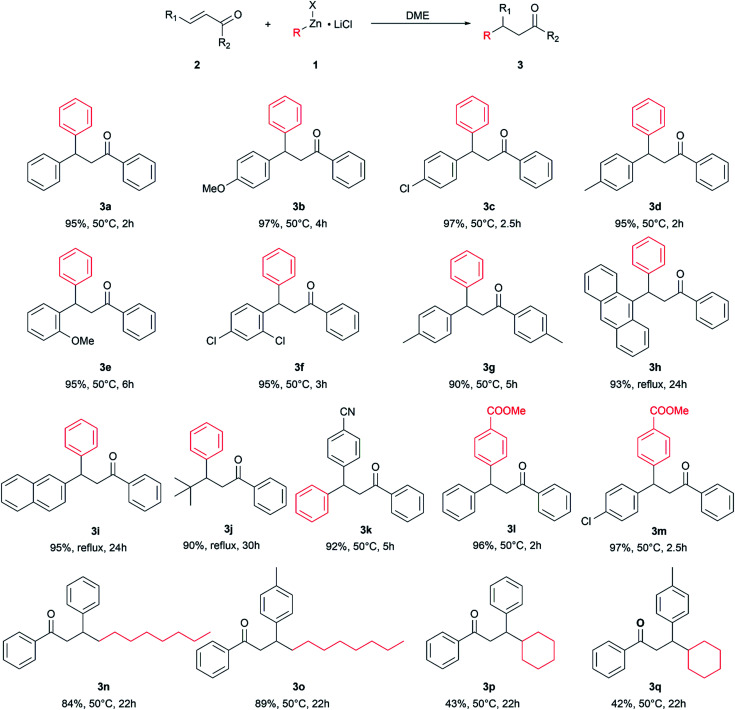
Both aryl and alkylzinc halides prepared by direct insertion of zinc into organic halides in the presence of LiCl underwent the conjugate addition reaction to nonenolizable unsaturated ketones in excellent yield, provided that DME was used instead of THF as the solvent. Diffusion NMR measurements highlighted that the species undergo considerable aggregation under the experimental conditions used in the synthetic procedure, but no substantial differences have been found between the two solvents. Density functional theory calculations, prompted by the experimental aggregation study, revealed an unexpected reaction mechanism, where the coordinating capabilities of DME stabilize a transition state involving two organozinc moieties, lowering the activation energy of the reaction with respect to that seen for THF, enough to explain the fast and quantitative reactions observed experimentally and the different behaviors of the two solvents.
通过在LiCl存在下将锌直接插入有机卤化物中制备的芳基卤化锌和烷基卤化锌,只要使用1,2 - 二甲氧基乙烷(DME)代替四氢呋喃(THF)作为溶剂,就能以优异的产率与不可烯醇化的不饱和酮发生共轭加成反应。扩散核磁共振测量结果表明,在合成过程中所使用的实验条件下,这些物质会发生相当程度的聚集,但在这两种溶剂之间未发现实质性差异。受实验聚集研究的启发,密度泛函理论计算揭示了一种意想不到的反应机理,其中DME的配位能力稳定了涉及两个有机锌部分的过渡态,相对于THF而言降低了反应的活化能,足以解释实验中观察到的快速定量反应以及两种溶剂的不同行为。