Liu Hsuan, Gong Yu-Nong, Shaw-Saliba Kathryn, Mehoke Thomas, Evans Jared, Liu Zhen-Ying, Lewis Mitra, Sauer Lauren, Thielen Peter, Rothman Richard, Chen Kuan-Fu, Pekosz Andrew
W. Harry Feinstone Department of Molecular Microbiology and Immunology, The Johns Hopkins Bloomberg School of Public Health, Baltimore, Maryland 21205, USA.
Research Center for Emerging Viral Infections, College of Medicine, Chang Gung University, Taoyuan, Taiwan.
Virus Evol. 2021 May 18;7(1):veab044. doi: 10.1093/ve/veab044. eCollection 2021 Jan.
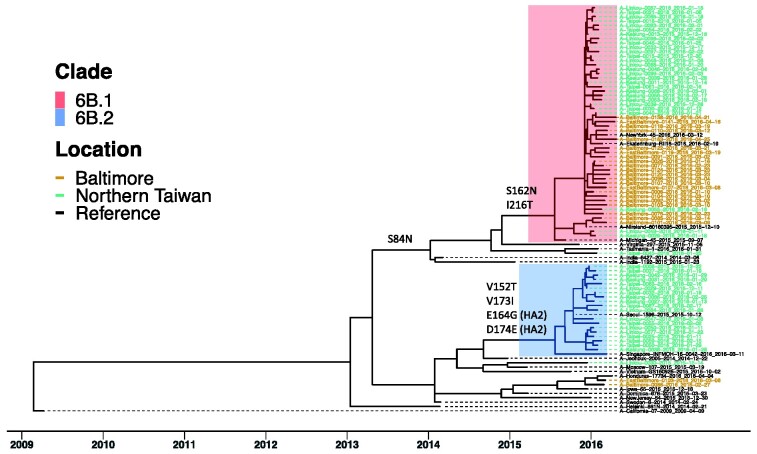
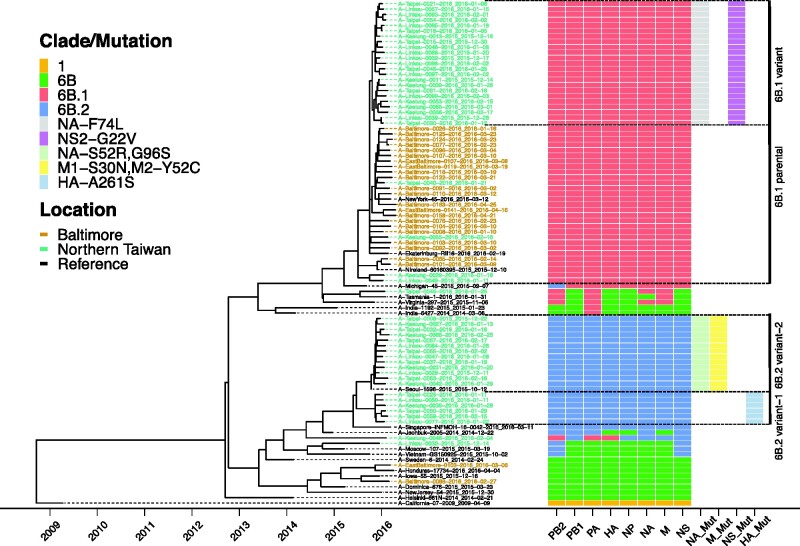
During the 2015-16 winter, the US experienced a relatively mild influenza season compared to Taiwan, which had a higher number of total and severe cases. While H1N1pdm viruses dominated global surveillance efforts that season, the global distribution of genetic variants and their contributions to disease severity have not been investigated. Samples collected from influenza A-positive patients by the Johns Hopkins Center of Excellence for Influenza Research and Surveillance active surveillance in the emergency rooms in Baltimore, Maryland, USA, and northern Taiwan between November 2015 and April 2016, were processed for influenza A virus whole-genome sequencing. In Baltimore, the majority of the viruses were the H1N1pdm clade 6B.1 and no H1N1pdm clade 6B.2 viruses were detected. In northern Taiwan, more than half of the H1N1pdm viruses were clade 6B.1 and 38% were clade 6B.2, consistent with the global observation that most 6B.2 viruses circulated in Asia and not North America. Whole virus genome sequence analysis identified two genetic subgroups present in each of the 6B.1 and 6B.2 clades and one 6B.1 interclade reassortant virus. Clinical data showed 6B.2 patients had more disease symptoms including higher crude and inverse probability weighted odds of pneumonia than 6B.1 patients, suggesting 6B.2 circulation may be one of the reasons for the severe flu season in Taiwan. Local surveillance efforts linking H1N1pdm virus sequences to patient clinical and demographic data improve our understanding of influenza circulation and disease potential.
在2015 - 16年冬季,与台湾相比,美国经历了一个相对温和的流感季节,台湾的流感总病例数和重症病例数更多。虽然该季节H1N1pdm病毒主导了全球监测工作,但尚未对基因变异体的全球分布及其对疾病严重程度的影响进行研究。2015年11月至2016年4月期间,美国马里兰州巴尔的摩市和台湾北部的急诊室通过约翰·霍普金斯流感研究与监测卓越中心的主动监测,从甲型流感阳性患者中采集样本,进行甲型流感病毒全基因组测序。在巴尔的摩,大多数病毒是H1N1pdm 6B.1分支,未检测到H1N1pdm 6B.2病毒。在台湾北部,超过一半的H1N1pdm病毒是6B.1分支,38%是6B.2分支,这与全球观察结果一致,即大多数6B.2病毒在亚洲而非北美传播。全病毒基因组序列分析确定了6B.1和6B.2分支中各存在两个基因亚组以及一个6B.1分支间重配病毒。临床数据显示,6B.2患者有更多疾病症状,包括肺炎的粗发病率和逆概率加权比值高于6B.1患者,这表明6B.2病毒传播可能是台湾流感季节严重的原因之一。将H1N1pdm病毒序列与患者临床和人口统计学数据相关联的本地监测工作,有助于我们更好地了解流感传播情况和疾病潜在风险。