Centre for Infectious Disease Research in Zambia, Lusaka, Zambia.
Department of Biostatistics, School of Public Health, University of Ghana, Accra, Ghana.
PLoS One. 2021 May 27;16(5):e0252222. doi: 10.1371/journal.pone.0252222. eCollection 2021.
Shigellosis, is a leading cause of moderate-to-severe diarrhoea and related mortality in young children in low and middle income countries (LMICs). Knowledge on naturally acquired immunity can support the development of Shigella candidate vaccines mostly needed in LMICs. We aimed to quantify Shigella-specific antibodies of maternal origin and those naturally acquired in Zambian infants.
Plasma samples collected from infants at age 6, 14 and 52-weeks were tested for Shigella (S. sonnei and S. flexneri 2a) lipopolysaccharide (LPS) antigen specific immunoglobulin G (IgG) and A (IgA) by enzyme-linked immunosorbent assay.
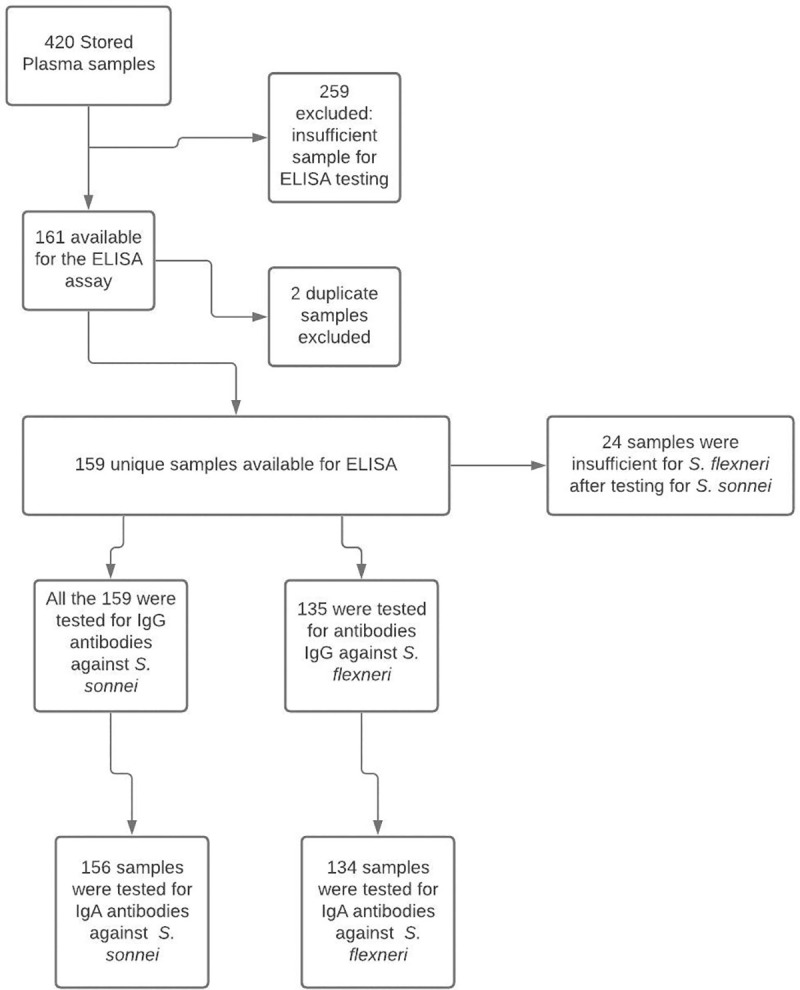
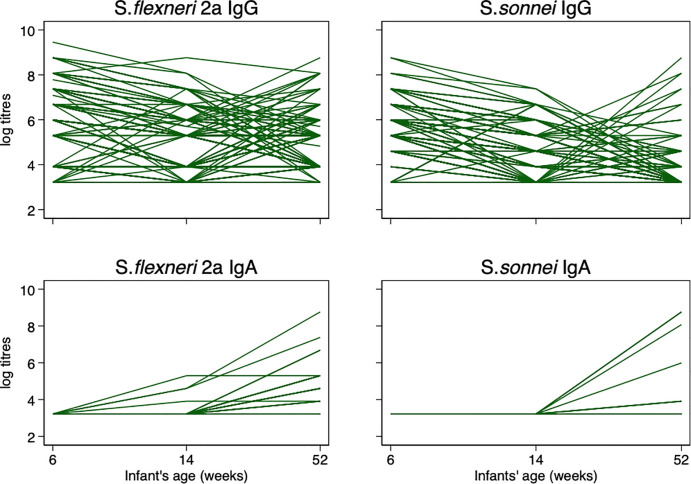
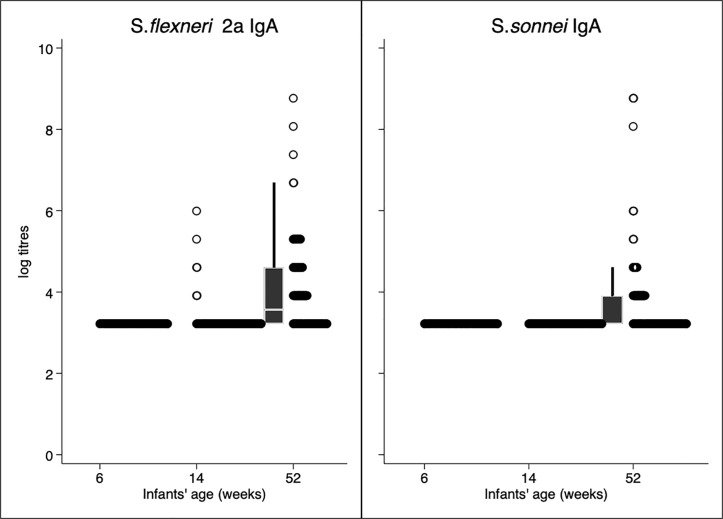
At 6 weeks infant age, the IgG geometric mean titres (GMT) against S. sonnei (N = 159) and S. flexneri 2a (N = 135) LPS were 311 (95% CI 259-372) and 446 (95% CI 343-580) respectively. By 14 weeks, a decline in IgG GMT was observed for both S. sonnei to 104 (95% CI 88-124), and S. flexneri 2a to 183 (95% CI 147-230). Both S. sonnei and S. flexneri 2a specific IgG GMT continued to decrease by 52 weeks infant age when compared to 6 weeks. In 27% and 8% of infants a significant rise in titre (4 fold and greater) against S. flexneri 2a and S. sonnei LPS, respectively, was detected between the ages of 14 and 52 weeks. IgA levels against both species LPS were very low at 6 and 14 weeks and raised significantly against S. flexneri 2a and S. sonnei LPS in 29% and 10% of the infants, respectively.
In our setting, transplacental IgG anti-Shigella LPS is present at high levels in early infancy, and begins to decrease by age 14 weeks. Our results are consistent with early exposure to Shigella and indicate naturally acquired IgG and IgA antibodies to S. flexneri 2a and S. sonnei LPS in part of infants between 14 and 52 weeks of age. These results suggest that a potential timing of vaccination would be after 14 and before 52 weeks of age to ensure early infant protection against shigellosis.
志贺菌病是中低收入国家(LMICs)幼儿中导致中度至重度腹泻和相关死亡的主要原因。对天然获得性免疫的了解可以支持在 LMICs 中最需要的志贺菌候选疫苗的开发。我们旨在量化母体来源和赞比亚婴儿自然获得的志贺菌特异性抗体。
在 6、14 和 52 周龄时收集婴儿的血浆样本,通过酶联免疫吸附试验检测志贺菌(S. sonnei 和 S. flexneri 2a)脂多糖(LPS)抗原特异性免疫球蛋白 G(IgG)和 A(IgA)。
在 6 周龄时,针对 S. sonnei(N=159)和 S. flexneri 2a(N=135)LPS 的 IgG 几何平均滴度(GMT)分别为 311(95%CI 259-372)和 446(95%CI 343-580)。到 14 周时,两种 S. sonnei 和 S. flexneri 2a 的 IgG GMT 均下降,分别为 104(95%CI 88-124)和 183(95%CI 147-230)。与 6 周龄相比,两种 S. sonnei 和 S. flexneri 2a 的特异性 IgG GMT 在 52 周龄时继续下降。在 14 至 52 周龄之间,分别有 27%和 8%的婴儿对 S. flexneri 2a 和 S. sonnei LPS 的血清滴度(4 倍或更高)显著升高。6 周和 14 周时,两种 LPS 的 IgA 水平均较低,在 29%和 10%的婴儿中,分别对 S. flexneri 2a 和 S. sonnei LPS 的 IgA 水平显著升高。
在我们的研究中,胎儿来源的针对志贺菌 LPS 的 IgG 在婴儿早期处于高水平,并在 14 周龄时开始下降。我们的结果与早期接触志贺菌一致,并表明在 14 至 52 周龄之间的部分婴儿中,自然获得了针对 S. flexneri 2a 和 S. sonnei LPS 的 IgG 和 IgA 抗体。这些结果表明,接种疫苗的潜在时间是在 14 至 52 周龄之间,以确保婴儿早期免受志贺菌病的侵害。