Obiero Christina W, Ndiaye Augustin G W, Sciré Antonella Silvia, Kaunyangi Bonface M, Marchetti Elisa, Gone Ann M, Schütte Lena Dorothee, Riccucci Daniele, Auerbach Joachim, Saul Allan, Martin Laura B, Bejon Philip, Njuguna Patricia, Podda Audino
KEMRI-Wellcome Trust Research Programme, Clinical Research Department, Kilifi, Kenya.
GSK Vaccines Institute for Global Health, Siena, Italy.
Front Immunol. 2017 Dec 22;8:1884. doi: 10.3389/fimmu.2017.01884. eCollection 2017.
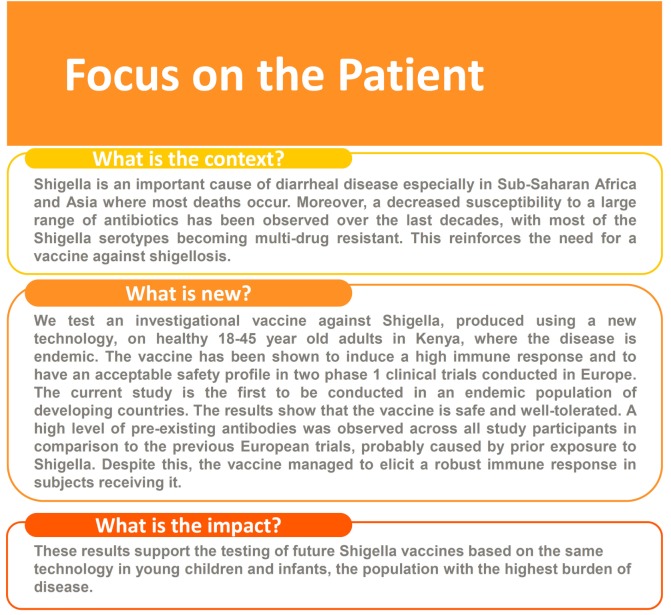
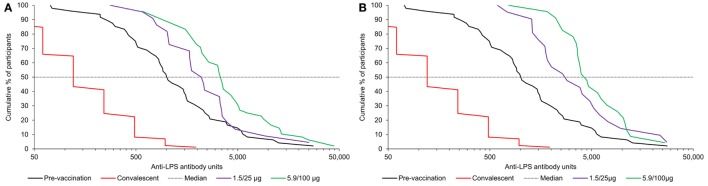
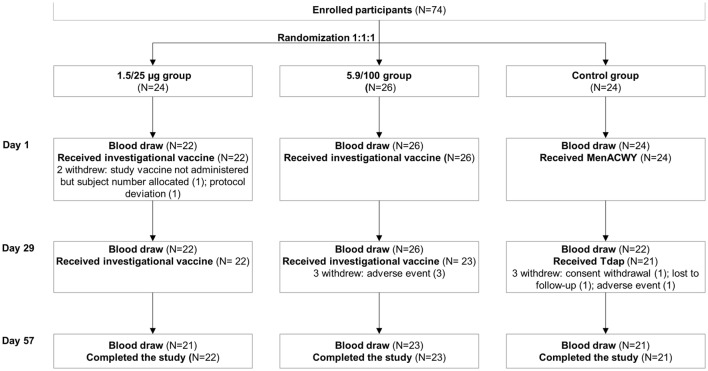
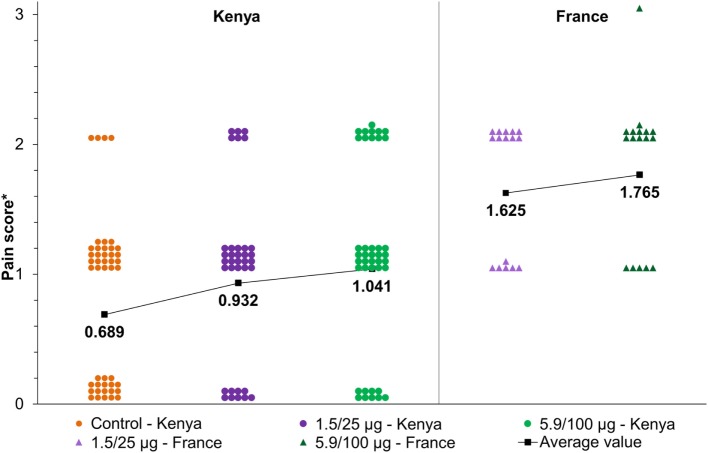
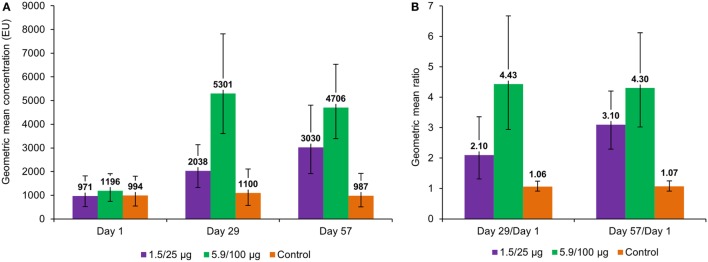
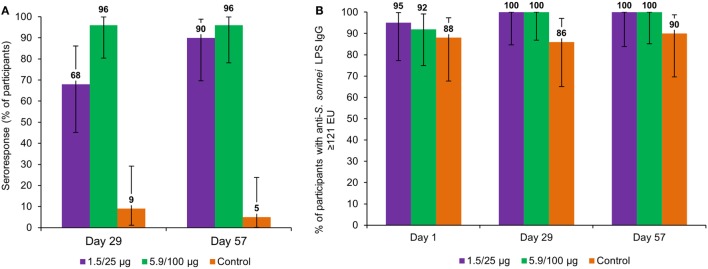
Shigellosis is a mild-to-severe diarrheal infection, caused by the genus , and is responsible for significant morbidity and mortality worldwide. We evaluated the safety and immunogenicity of an investigational vaccine (1790GAHB) based on generalized modules for membrane antigens (GMMA) in Kenya, a -endemic country. This phase 2a, observer-blind, controlled randomized study (NCT02676895) enrolled 74 healthy adults aged 18-45 years, of whom 72 were vaccinated. Participants received, in a 1:1:1 ratio, two vaccinations with the 1790GAHB vaccine at doses of either 1.5/25 μg of O antigen (OAg)/protein (group 1.5/25 μg) or 5.9/100 μg (group 5.9/100 μg) at day (D) 1 and D29, or vaccination with a quadrivalent meningococcal vaccine at D1 and tetanus, diphtheria, and acellular pertussis vaccine at D29 (control group). Solicited and unsolicited adverse events (AEs), serious AEs (SAEs), and AEs of special interest (neutropenia and reactive arthritis) were collected. Anti- lipopolysaccharide (LPS) serum immunoglobulin G (IgG) geometric mean concentrations (GMC) were evaluated at D1, D29, and D57 and compared to anti- LPS antibody levels in convalescent patients naturally exposed to . The percentages of participants with seroresponse were also calculated. The most frequently reported solicited local and systemic AEs across all groups were pain and headache, respectively. Only one case of severe systemic reaction was reported (severe headache after first vaccination in group 5.9/100 μg). Seven and three episodes of neutropenia, assessed as probably or possibly related to vaccination respectively, were reported in the investigational and control groups, respectively. No other SAEs were reported. Despite very high baseline anti- LPS serum IgG levels, the 1790GAHB vaccine induced robust antibody responses. At D29, GMC increased 2.10- and 4.43-fold from baseline in groups 1.5/25 and 5.9/100 μg, respectively, whereas no increase was observed in the control group. Antibody titers at D57 were not statistically different from those at D29. Seroresponse was 68% at D29 and 90% at D57 in group 1.5/25 μg, and 96% after each vaccination in group 5.9/100 μg. The 1790GAHB vaccine was well tolerated and highly immunogenic in a population of African adults, regardless of the GMMA OAg/protein content used.
志贺氏菌病是一种由志贺氏菌属引起的轻度至重度腹泻感染,在全球范围内导致了显著的发病率和死亡率。我们在肯尼亚这个志贺氏菌流行的国家评估了一种基于膜抗原通用模块(GMMA)的研究性疫苗(1790GAHB)的安全性和免疫原性。这项2a期、观察者盲法、对照随机研究(NCT02676895)招募了74名年龄在18至45岁的健康成年人,其中72人接种了疫苗。参与者按1:1:1的比例,在第1天和第29天分别接受两次1790GAHB疫苗接种,剂量分别为1.5/25μg的O抗原(OAg)/蛋白质(第1.5/25μg组)或5.9/100μg(第5.9/100μg组),或者在第1天接种四价脑膜炎球菌疫苗,在第29天接种破伤风、白喉和无细胞百日咳疫苗(对照组)。收集了主动和被动不良事件(AE)、严重不良事件(SAE)以及特别关注的不良事件(中性粒细胞减少症和反应性关节炎)。在第1天、第29天和第57天评估抗脂多糖(LPS)血清免疫球蛋白G(IgG)几何平均浓度(GMC),并与自然感染志贺氏菌的恢复期患者的抗LPS抗体水平进行比较。还计算了血清反应阳性参与者的百分比。所有组中最常报告的主动局部和全身AE分别是疼痛和头痛。仅报告了1例严重全身反应(第5.9/100μg组首次接种后严重头痛)。研究组和对照组分别报告了7例和3例中性粒细胞减少症发作,分别评估为可能或可能与疫苗接种有关。未报告其他SAE。尽管基线抗LPS血清IgG水平非常高,但1790GAHB疫苗诱导了强烈的抗体反应。在第29天,第1.5/25μg组和第5.9/100μg组的GMC分别比基线增加了2.10倍和4.43倍,而对照组未观察到增加。第57天的抗体滴度与第29天无统计学差异。第1.5/25μg组在第29天的血清反应率为68%,在第57天为90%,第5.9/100μg组每次接种后的血清反应率为96%。无论使用的GMMA OAg/蛋白质含量如何,1790GAHB疫苗在非洲成年人群中耐受性良好且具有高度免疫原性。