Ahmad Sufian S, Hoos Lorenz, Perka Carsten, Stöckle Ulrich, Braun Karl F, Konrads Christian
Center for Musculoskeletal Surgery, Charité - University Medical Center Berlin, Berlin, Germany.
Department of Trauma and Reconstructive Surgery, BG Klinik, Eberhard Karls University Tübingen, Tubingen, Germany.
Bone Jt Open. 2021 May;2(5):344-350. doi: 10.1302/2633-1462.25.BJO-2021-0007.R1.
The follow-up interval of a study represents an important aspect that is frequently mentioned in the title of the manuscript. Authors arbitrarily define whether the follow-up of their study is short-, mid-, or long-term. There is no clear consensus in that regard and definitions show a large range of variation. It was therefore the aim of this study to systematically identify clinical research published in high-impact orthopaedic journals in the last five years and extract follow-up information to deduce corresponding evidence-based definitions of short-, mid-, and long-term follow-up.
A systematic literature search was performed to identify papers published in the six highest ranked orthopaedic journals during the years 2015 to 2019. Follow-up intervals were analyzed. Each article was assigned to a corresponding subspecialty field: sports traumatology, knee arthroplasty and reconstruction, hip-preserving surgery, hip arthroplasty, shoulder and elbow arthroplasty, hand and wrist, foot and ankle, paediatric orthopaedics, orthopaedic trauma, spine, and tumour. Mean follow-up data were tabulated for the corresponding subspecialty fields. Comparison between means was conducted using analysis of variance.
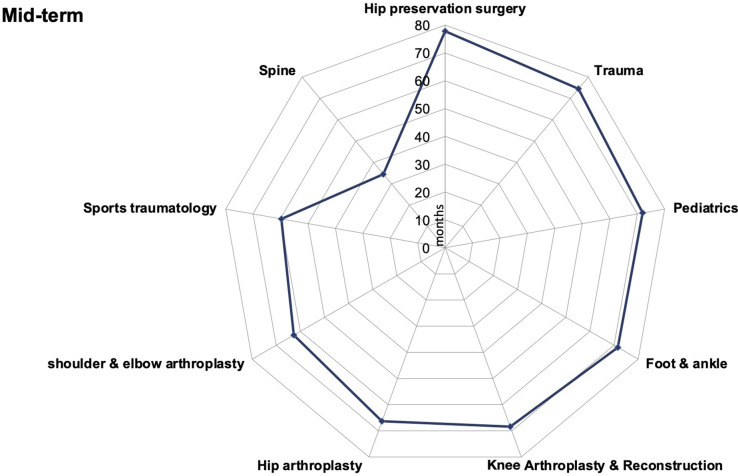
Of 16,161 published articles, 590 met the inclusion criteria. Of these, 321 were of level IV evidence, 176 level III, 53 level II, and 40 level I. Considering all included articles, a long-term study published in the included high impact journals had a mean follow-up of 151.6 months, a mid-term study of 63.5 months, and a short-term study of 30.0 months.
The results of this study provide evidence-based definitions for orthopaedic follow-up intervals that should provide a citable standard for the planning of clinical studies. A minimum mean follow-up of a short-term study should be 30 months (2.5 years), while a mid-term study should aim for a mean follow-up of 60 months (five years), and a long-term study should aim for a mean of 150 months (12.5 years). Level of Evidence: Level I. Cite this article: 2021;2(5):344-350.
研究的随访期是论文标题中经常提及的一个重要方面。作者随意界定其研究的随访是短期、中期还是长期。在这方面尚无明确共识,定义差异很大。因此,本研究的目的是系统识别过去五年在高影响力骨科期刊上发表的临床研究,并提取随访信息,以推导短期、中期和长期随访相应的循证定义。
进行系统文献检索,以识别2015年至2019年期间在六种排名最高的骨科期刊上发表的论文。分析随访期。每篇文章被归入相应的亚专业领域:运动创伤学、膝关节置换与重建、保髋手术、髋关节置换、肩肘关节置换、手和腕部、足和踝部、小儿骨科、骨科创伤、脊柱和肿瘤。将相应亚专业领域的平均随访数据制成表格。使用方差分析进行均值比较。
在16161篇已发表文章中,590篇符合纳入标准。其中,321篇为IV级证据,176篇为III级,53篇为II级,40篇为I级。考虑所有纳入文章,在纳入的高影响力期刊上发表的长期研究的平均随访时间为151.6个月,中期研究为63.5个月,短期研究为30.0个月。
本研究结果为骨科随访期提供了循证定义,应为临床研究规划提供可引用的标准。短期研究的最短平均随访时间应为30个月(2.5年),中期研究的平均随访目标应为60个月(5年),长期研究的平均随访目标应为150个月(12.5年)。证据级别:I级。引用本文:2021;2(5):344 - 350。