Burnet Institute for Medical Research and Public Health, Melbourne, Australia.
Centre for Epidemiology and Biostatistics, Melbourne School of Population and Global Health, The University of Melbourne, Melbourne, Australia.
BMC Med. 2021 May 28;19(1):121. doi: 10.1186/s12916-021-01993-8.
In the Greater Mekong Subregion (GMS), current malaria surveillance strategies rely on a network of village health volunteers (VHVs) reporting the results of rapid diagnostic tests (RDTs), known to miss many asymptomatic infections. Integration of more sensitive diagnostic molecular and serological measures into the VHV network may improve surveillance of residual malaria transmission in hard-to-reach areas in the region and inform targeted interventions and elimination responses. However, data on residual malaria transmission that would be captured by these measures in the VHV-led testing and treatment surveillance network in the GMS is unknown.
A total of 114 VHVs were trained to collect dried blood spots from villagers undergoing routine RDTs as part of VHV-led active and passive case detection from April 2015 to June 2016. Samples were subjected to molecular testing (quantitative polymerase chain reaction [qPCR]) to determine Plasmodium falciparum and P. vivax infection and serological testing (against P. falciparum and P. vivax antigens) to determine exposure to P. falciparum and P. vivax.
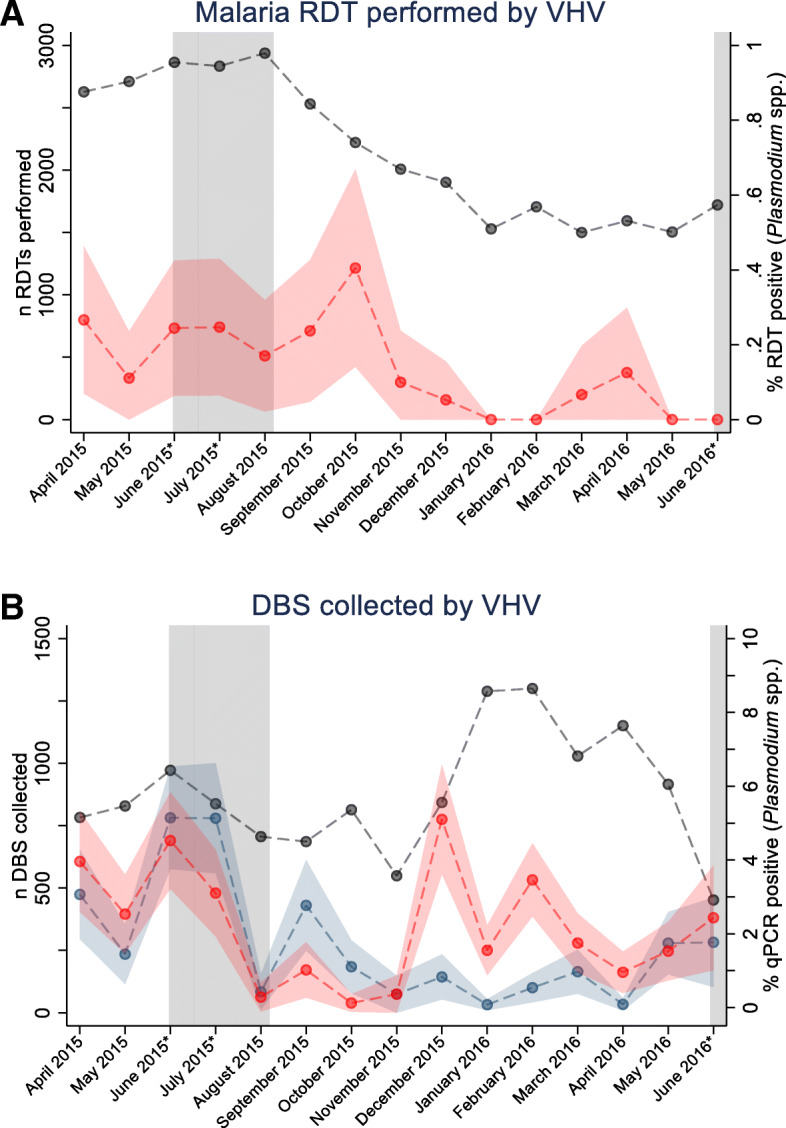
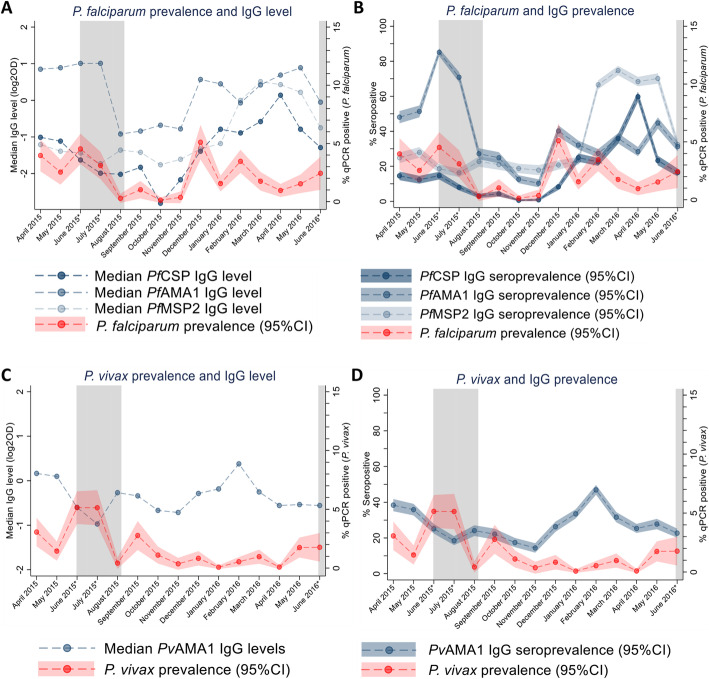
Over 15 months, 114 VHVs performed 32,194 RDTs and collected samples for molecular (n = 13,157) and serological (n = 14,128) testing. The prevalence of molecular-detectable P. falciparum and P. vivax infection was 3.2% compared to the 0.16% prevalence of Plasmodium spp. by RDT, highlighting the large burden of infections undetected by standard surveillance. Peaks in anti-P. falciparum, but not P. vivax, merozoite IgG seroprevalence coincided with seasonal P. falciparum transmission peaks, even in those with no molecularly detectable parasites. At the individual level, antibody seropositivity was associated with reduced odds of contemporaneous P. falciparum (OR for PfCSP 0.51 [95%CI 0.35, 0.76], p = 0.001, PfAMA1 0.70 [95%CI 0.52, 0.93], p = 0.01, and PfMSP2 0.81 [95%CI 0.61, 1.08], p = 0.15), but not P. vivax infection (OR PvAMA1 1.02 [95%CI 0.73, 1.43], p = 0.89) indicating a potential role of immunity in protection against molecular-detectable P. falciparum parasitaemia.
We demonstrated that integration and implementation of sample collection for molecular and serological surveillance into networks of VHV servicing hard-to-reach populations in the GMS is feasible, can capture significant levels of ongoing undetected seasonal malaria transmission and has the potential to supplement current routine RDT testing. Improving malaria surveillance by advancing the integration of molecular and serological techniques, through centralised testing approaches or novel point-of-contact tests, will advance progress, and tracking, towards malaria elimination goals in the GMS.
在大湄公河次区域(GMS),当前的疟疾监测策略依赖于一个由乡村卫生志愿者(VHVs)组成的网络,通过他们报告快速诊断检测(RDT)的结果,但该方法存在漏检许多无症状感染的问题。将更敏感的分子和血清学诊断措施整合到 VH 网络中,可能有助于提高该地区难以到达地区残留疟疾传播的监测水平,并为有针对性的干预和消除措施提供信息。然而,关于这些措施在 GMS 中 VH 主导的检测和治疗监测网络中可以捕获的残留疟疾传播的数据尚不清楚。
共有 114 名 VH 接受了培训,以便在 2015 年 4 月至 2016 年 6 月期间,对接受常规 RDT 的村民采集干血斑,作为 VH 主导的主动和被动病例检测的一部分。对样本进行分子检测(定量聚合酶链反应[qPCR])以确定恶性疟原虫和间日疟原虫感染情况,以及血清学检测(针对恶性疟原虫和间日疟原虫抗原)以确定对恶性疟原虫和间日疟原虫的暴露情况。
在 15 个月期间,114 名 VH 进行了 32,194 次 RDT,并采集了分子(n=13,157)和血清学(n=14,128)检测样本。与 RDT 检测的 0.16%的疟原虫 spp. 流行率相比,恶性疟原虫和间日疟原虫的分子可检测感染率为 3.2%,突出表明标准监测中存在大量未被检测到的感染。抗恶性疟原虫裂殖体 IgG 血清阳性率的峰值与恶性疟原虫季节性传播的峰值相吻合,即使在那些没有分子检测到寄生虫的患者中也是如此,但间日疟原虫无此现象。在个体水平上,抗体血清阳性与同期恶性疟原虫感染的可能性降低有关(PfCSP 的 OR 为 0.51[95%CI 0.35, 0.76],p=0.001,PfAMA1 的 OR 为 0.70[95%CI 0.52, 0.93],p=0.01,PfMSP2 的 OR 为 0.81[95%CI 0.61, 1.08],p=0.15),但与间日疟原虫感染无关(OR PvAMA1 为 1.02[95%CI 0.73, 1.43],p=0.89),这表明免疫可能在预防分子可检测的恶性疟原虫寄生血症方面发挥作用。
我们证明,将分子和血清学监测的样本采集整合到为难以到达的人群提供服务的 VH 网络中是可行的,它可以捕获到大量未被发现的季节性疟疾传播,并且有可能补充当前的常规 RDT 检测。通过集中检测方法或新型接触点检测,推进分子和血清学技术的整合,提高疟疾监测水平,将有助于推动大湄公河次区域的疟疾消除目标的进展和跟踪。