Van Ditshuizen Jan C, Sewalt Charlie A, Palmer Cameron S, Van Lieshout Esther M M, Verhofstad Michiel H J, Den Hartog Dennis
Department of Surgery, Trauma Research Unit, Erasmus MC, University Medical Center Rotterdam, P.O. Box 2040, 3000, CA, Rotterdam, The Netherlands.
Department of Public Health, Erasmus University Medical Centre Rotterdam, Rotterdam, The Netherlands.
Scand J Trauma Resusc Emerg Med. 2021 May 27;29(1):71. doi: 10.1186/s13049-021-00873-7.
A threshold Injury Severity Score (ISS) ≥ 16 is common in classifying major trauma (MT), although the Abbreviated Injury Scale (AIS) has been extensively revised over time. The aim of this study was to determine effects of different AIS revisions (1998, 2008 and 2015) on clinical outcome measures.
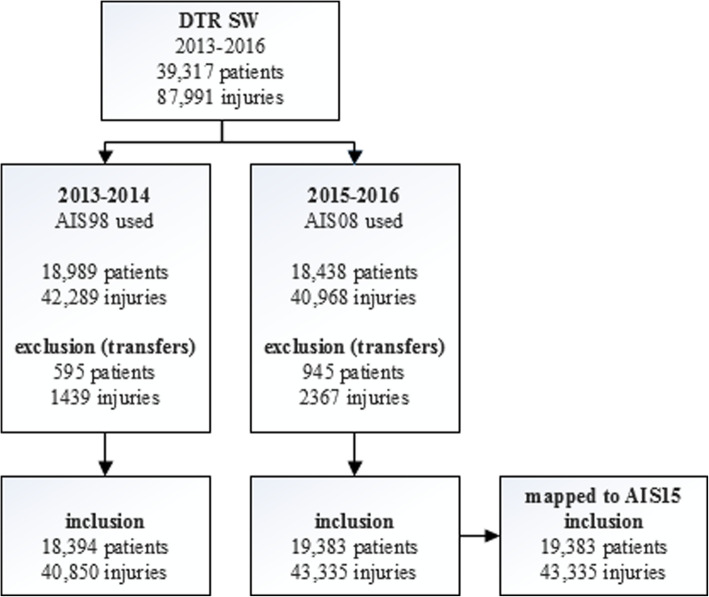
A retrospective observational cohort study including all primary admitted trauma patients was performed (in 2013-2014 AIS98 was used, in 2015-2016 AIS08, AIS08 mapped to AIS15). Different ISS thresholds for MT and their corresponding observed mortality and intensive care (ICU) admission rates were compared between AIS98, AIS08, and AIS15 with Chi-square tests and logistic regression models.
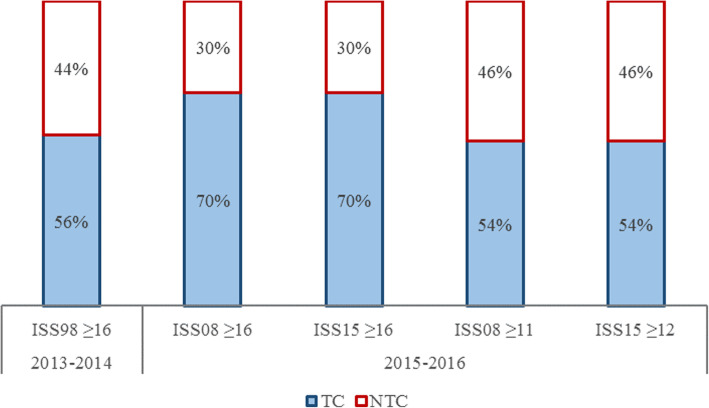
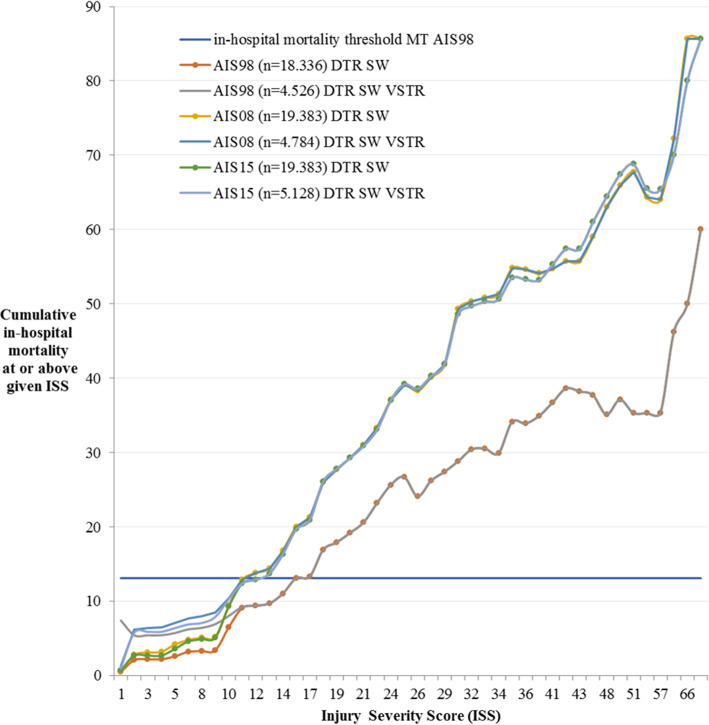
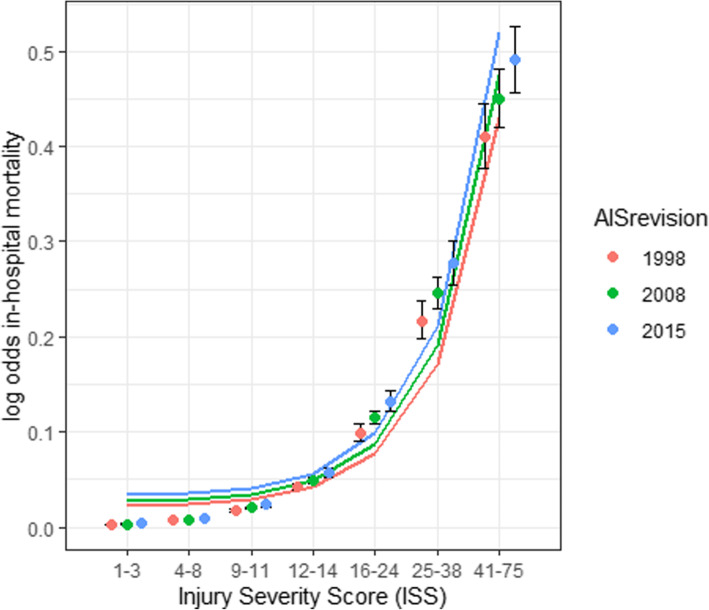
Thirty-nine thousand three hundred seventeen patients were included. Thresholds ISS08 ≥ 11 and ISS15 ≥ 12 were similar to a threshold ISS98 ≥ 16 for in-hospital mortality (12.9, 12.9, 13.1% respectively) and ICU admission (46.7, 46.2, 46.8% respectively). AIS98 and AIS08 differed significantly for in-hospital mortality in ISS 4-8 (χ = 9.926, p = 0.007), ISS 9-11 (χ = 13.541, p = 0.001), ISS 25-40 (χ = 13.905, p = 0.001) and ISS 41-75 (χ = 7.217, p = 0.027). Mortality risks did not differ significantly between AIS08 and AIS15.
ISS08 ≥ 11 and ISS15 ≥ 12 perform similarly to a threshold ISS98 ≥ 16 for in-hospital mortality and ICU admission. This confirms studies evaluating mapped datasets, and is the first to present an evaluation of implementation of AIS15 on registry datasets. Defining MT using appropriate ISS thresholds is important for quality indicators, comparing datasets and adjusting for injury severity.
Prognostic and epidemiological, level III.
尽管简明损伤定级标准(AIS)随着时间推移已被广泛修订,但损伤严重程度评分(ISS)≥16仍是常见的主要创伤(MT)分类标准。本研究旨在确定不同版本的AIS(1998年、2008年和2015年)对临床结局指标的影响。
进行了一项回顾性观察队列研究,纳入所有初次入院的创伤患者(2013 - 2014年使用AIS98,2015 - 2016年使用AIS08,AIS08映射至AIS15)。采用卡方检验和逻辑回归模型比较AIS98、AIS08和AIS15之间MT的不同ISS阈值及其相应的观察到的死亡率和重症监护病房(ICU)入住率。
共纳入39317例患者。ISS08≥11和ISS15≥12与ISS98≥16在院内死亡率(分别为12.9%、12.9%、13.1%)和ICU入住率(分别为46.7%、46.2%、46.8%)方面表现相似。AIS98和AIS08在ISS 4 - 8(χ = 9.926,p = 0.007)、ISS 9 - 11(χ = 13.541,p = 0.001)、ISS 25 - 40(χ = 13.905,p = 0.001)和ISS 41 - 75(χ = 7.217,p = 0.027)的院内死亡率方面存在显著差异。AIS08和AIS15之间的死亡风险无显著差异。
ISS08≥11和ISS15≥12在院内死亡率和ICU入住率方面与ISS98≥16表现相似。这证实了对映射数据集的评估研究,并且首次对登记数据集上AIS15的实施情况进行了评估。使用适当的ISS阈值定义MT对于质量指标、比较数据集以及调整损伤严重程度很重要。
预后和流行病学,III级。