Ryland Howard, Cook Jonathan, Yukhnenko Denis, Fitzpatrick Ray, Fazel Seena
Department of Psychiatry, University of Oxford.
Department of Orthopaedics, Rheumatology and Musculoskeletal Sciences, University of Oxford.
Eur Psychiatry. 2021 May 28;64(1):1-40. doi: 10.1192/j.eurpsy.2021.32.
Outcome measurement in forensic mental health services can support service improvement, research, and patient progress evaluation. This systematic review aims to identify instruments available for use as outcome measures in this field and assess the evidence for the most common instruments, specific to the forensic context, which cover multiple outcome domains.
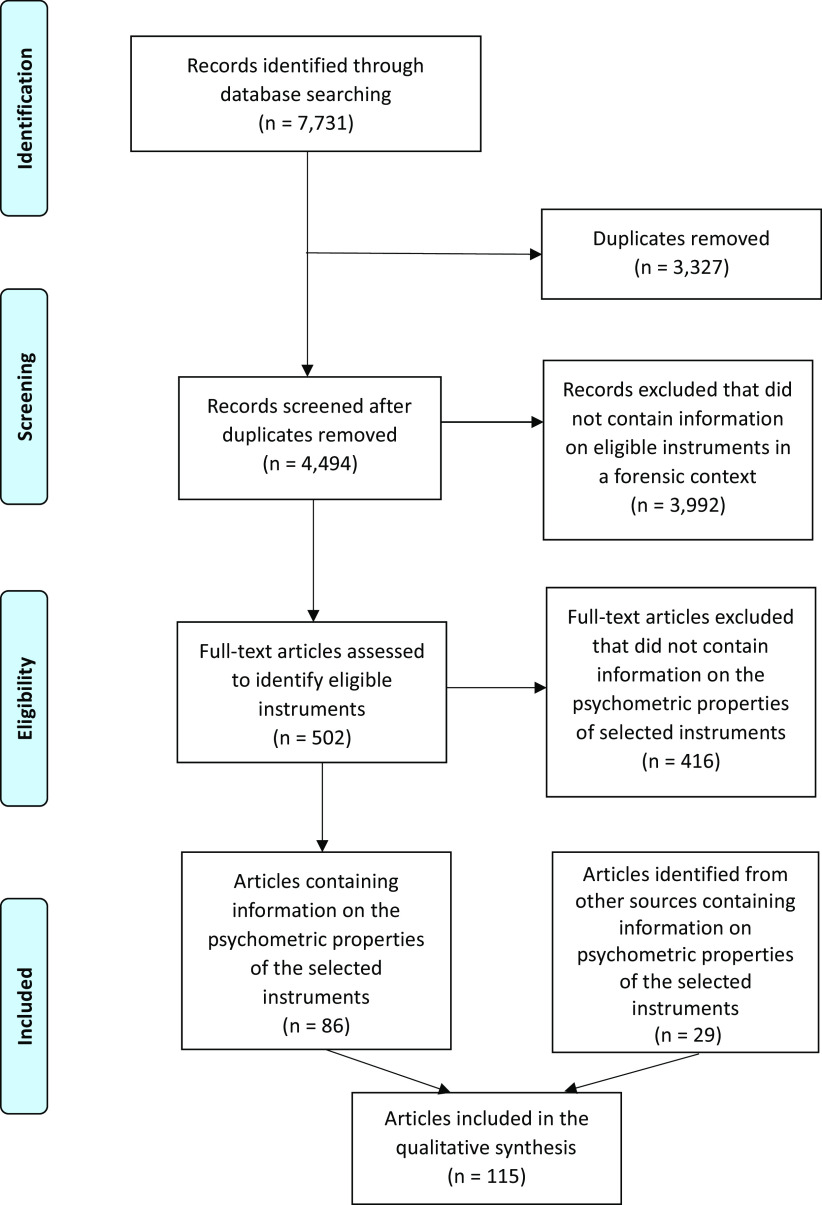
Studies were identified by searching seven online databases. Additional searches were then performed for 10 selected instruments to identify additional information on their psychometric properties. Instrument manuals and gray literature was reviewed for information about instrument development and content validity. The quality of evidence for psychometric properties was summarized for each instrument based on the COnsensus-based Standards for health Measurement INstruments (COSMIN) approach.
A total of 435 different instruments or variants were identified. Psychometric information on the 10 selected instruments was extracted from 103 studies. All 10 instruments had a clinician reported component with only two having patient reported scales. Half of the instruments were primarily focused on risk. No instrument demonstrated adequate psychometric properties in all eight COSMIN categories assessed. Only one instrument, the Camberwell Assessment of Need: Forensic Version, had adequate evidence for its development and content validity. The most evidence was for construct validity, while none was identified for construct stability between groups.
Despite the large number of instruments potentially available, evidence for their use as outcome measures in forensic mental health services is limited. Future research and instrument development should involve patients and carers to ensure adequate content validity.
法医精神卫生服务中的结果测量有助于服务改进、研究以及患者进展评估。本系统评价旨在识别可用于该领域作为结果测量的工具,并评估针对法医背景、涵盖多个结果领域的最常用工具的证据。
通过检索七个在线数据库来识别研究。然后对10种选定工具进行额外检索,以识别其心理测量学特性的更多信息。对工具手册和灰色文献进行综述,以获取有关工具开发和内容效度的信息。基于健康测量工具的基于共识的标准(COSMIN)方法,对每种工具的心理测量学特性的证据质量进行总结。
共识别出435种不同的工具或变体。从103项研究中提取了关于10种选定工具的心理测量学信息。所有10种工具都有临床医生报告的部分,只有两种有患者报告的量表。一半的工具主要关注风险。在评估的所有八个COSMIN类别中,没有一种工具表现出足够的心理测量学特性。只有一种工具,即《坎伯韦尔需求评估:法医版》,有足够的证据证明其开发和内容效度。证据最多的是结构效度,而未发现组间结构稳定性的证据。
尽管可能有大量工具可用,但在法医精神卫生服务中用作结果测量的证据有限。未来的研究和工具开发应让患者和护理人员参与,以确保足够的内容效度。