University of Toronto, Toronto, Ontario, Canada.
Women's College Research Institute, Women's College Hospital, Toronto, Ontario, Canada.
Lupus Sci Med. 2021 May;8(1). doi: 10.1136/lupus-2020-000448.
SLE is an independent risk factor for cardiovascular disease (CVD). This study aimed to determine which among QRISK2, QRISK3, Framingham Risk Score (FRS), modified Framingham Risk Score (mFRS) and SLE Cardiovascular Risk Equation (SLECRE) best predicts CVD.
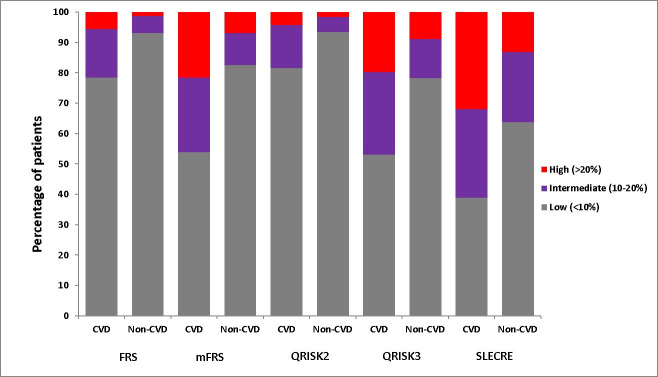
This is a single-centre analysis on 1887 patients with SLE followed prospectively according to a standard protocol. Tools' scores were evaluated against CVD development at/within 10 years for patients with CVD and without CVD. For patients with CVD, the index date for risk score calculation was chosen as close to 10 years prior to CVD event. For patients without CVD, risk scores were calculated as close to 10 years prior to the most recent clinic appointment. Proportions of low-risk (<10%), intermediate-risk (10%-20%) and high-risk (>20%) patients for developing CVD according to each tool were determined, allowing sensitivity, specificity, positive/negative predictive value and concordance (c) statistics analysis.
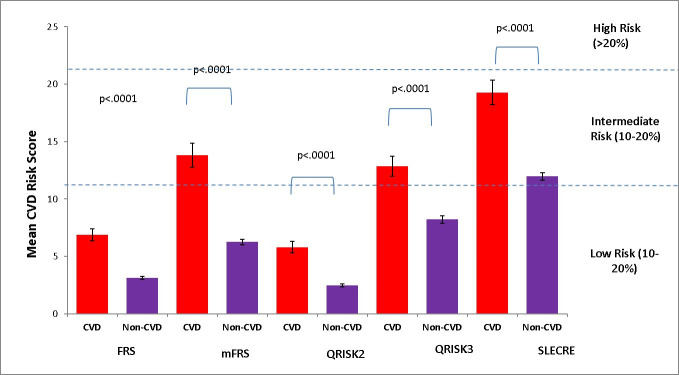
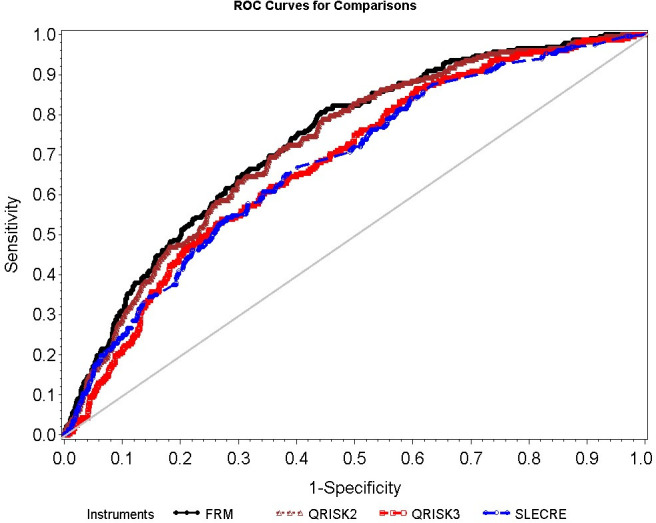
Among 1887 patients, 232 CVD events occurred. QRISK2 and FRS, and QRISK3 and mFRS, performed similarly. SLECRE classified the highest number of patients as intermediate and high risk. Sensitivities and specificities were 19% and 93% for QRISK2, 22% and 93% for FRS, 46% and 83% for mFRS, 47% and 78% for QRISK3, and 61% and 64% for SLECRE. Tools were similar in negative predictive value, ranging from 89% (QRISK2) to 92% (SLECRE). FRS and mFRS had the greatest c-statistics (0.73), while QRISK3 and SLECRE had the lowest (0. 67).
mFRS was superior to FRS and was not outperformed by the QRISK tools. SLECRE had the highest sensitivity but the lowest specificity. mFRS is an SLE-adjusted practical tool with a simple, intuitive scoring system reasonably appropriate for ambulatory settings, with more research needed to develop more accurate CVD risk prediction tools in this population.
SLE 是心血管疾病(CVD)的独立危险因素。本研究旨在确定 QRISK2、QRISK3、Framingham 风险评分(FRS)、改良Framingham 风险评分(mFRS)和 SLE 心血管风险方程(SLECRE)中哪一个最能预测 CVD。
这是一项对 1887 例接受前瞻性标准方案治疗的 SLE 患者进行的单中心分析。对有 CVD 和无 CVD 的患者进行 CVD 发病/10 年内工具评分评估。对于有 CVD 的患者,风险评分的计算日期选择为 CVD 事件前 10 年左右。对于无 CVD 的患者,风险评分计算为最近一次就诊前 10 年左右。根据每个工具确定发生 CVD 的低危(<10%)、中危(10%-20%)和高危(>20%)患者的比例,允许进行敏感性、特异性、阳性/阴性预测值和一致性(c)统计分析。
在 1887 例患者中,发生 232 例 CVD 事件。QRISK2 和 FRS 以及 QRISK3 和 mFRS 的表现相似。SLECRE 将最高比例的患者归类为中危和高危。QRISK2 的敏感性和特异性分别为 19%和 93%,FRS 为 22%和 93%,mFRS 为 46%和 83%,QRISK3 为 47%和 78%,SLECRE 为 61%和 64%。阴性预测值相似,范围为 89%(QRISK2)至 92%(SLECRE)。FRS 和 mFRS 的 c 统计量最大(0.73),而 QRISK3 和 SLECRE 最小(0.67)。
mFRS 优于 FRS,且不逊于 QRISK 工具。SLECRE 的敏感性最高,但特异性最低。mFRS 是一种 SLE 调整后的实用工具,具有简单直观的评分系统,在门诊环境中相当合理,需要更多研究来开发更适合该人群的 CVD 风险预测工具。