Cavieres-Lepe Javier, Ewer John
Centro Interdisciplinario de Neurociencia de Valparaíso, Instituto de Neurociencias, Universidad de Valparaíso, Valparaíso, Chile.
Programa de Doctorado en Ciencias, Mención Neurociencia, Universidad de Valparaíso, Valparaíso, Chile.
Front Mol Neurosci. 2021 May 11;14:666673. doi: 10.3389/fnmol.2021.666673. eCollection 2021.
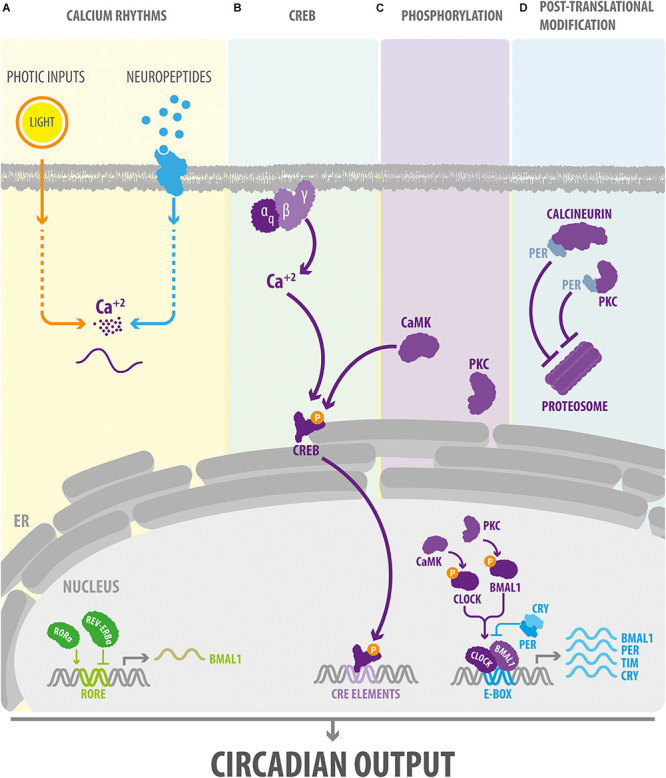
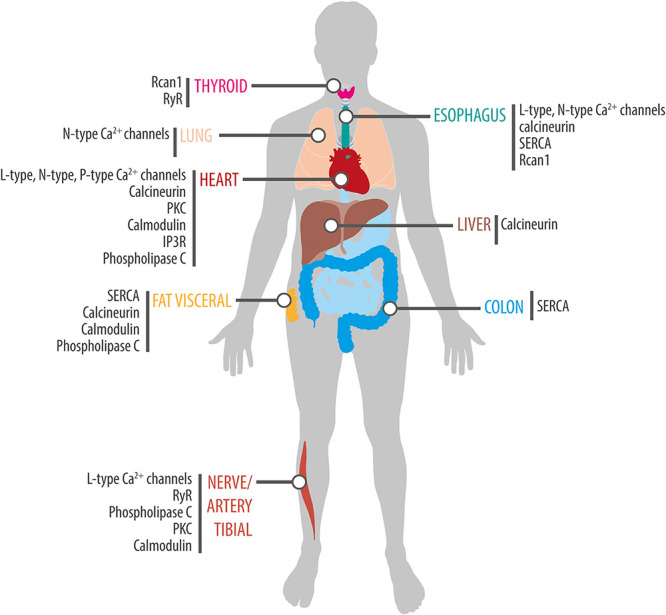
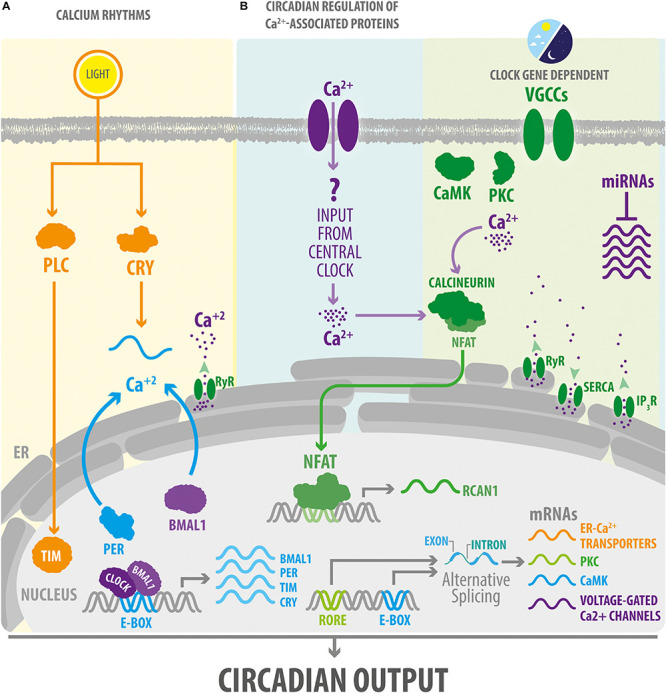
In animals, circadian clocks impose a daily rhythmicity to many behaviors and physiological processes. At the molecular level, circadian rhythms are driven by intracellular transcriptional/translational feedback loops (TTFL). Interestingly, emerging evidence indicates that they can also be modulated by multiple signaling pathways. Among these, Ca signaling plays a key role in regulating the molecular rhythms of clock genes and of the resulting circadian behavior. In addition, the application of imaging approaches has revealed that Ca is fundamental to the synchronization of the neuronal networks that make up circadian pacemakers. Conversely, the activity of circadian clocks may influence Ca signaling. For instance, several genes that encode Ca channels and Ca-binding proteins display a rhythmic expression, and a disruption of this cycling affects circadian function, underscoring their reciprocal relationship. Here, we review recent advances in our understanding of how Ca signaling both modulates and is modulated by circadian clocks, focusing on the regulatory mechanisms described in and mice. In particular, we examine findings related to the oscillations in intracellular Ca levels in circadian pacemakers and how they are regulated by canonical clock genes, neuropeptides, and light stimuli. In addition, we discuss how Ca rhythms and their associated signaling pathways modulate clock gene expression at the transcriptional and post-translational levels. We also review evidence based on transcriptomic analyzes that suggests that mammalian Ca channels and transporters (e.g., and -type Ca channels) as well as Ca-binding proteins (e.g., , and ) show rhythmic expression in the central brain clock and in peripheral tissues such as the heart and skeletal muscles. Finally, we discuss how the discovery that Ca signaling is regulated by the circadian clock could influence the efficacy of pharmacotherapy and the outcomes of clinical interventions.
在动物中,生物钟赋予许多行为和生理过程每日节律性。在分子水平上,昼夜节律由细胞内转录/翻译反馈环(TTFL)驱动。有趣的是,新出现的证据表明,它们也可被多种信号通路调节。其中,钙信号在调节生物钟基因的分子节律及由此产生的昼夜行为中起关键作用。此外,成像方法的应用表明,钙对于构成昼夜节律起搏器的神经网络同步至关重要。相反,生物钟的活动可能影响钙信号。例如,几个编码钙通道和钙结合蛋白的基因呈现节律性表达,这种循环的破坏会影响昼夜节律功能,突出了它们的相互关系。在这里,我们综述了我们对钙信号如何被生物钟调节以及如何调节生物钟的最新理解进展,重点关注在大鼠和小鼠中描述的调节机制。特别是,我们研究了与昼夜节律起搏器细胞内钙水平振荡相关的发现,以及它们如何被经典生物钟基因、神经肽和光刺激调节。此外,我们讨论了钙节律及其相关信号通路如何在转录和翻译后水平调节生物钟基因表达。我们还综述了基于转录组分析的证据,这些证据表明哺乳动物的钙通道和转运体(如L型和T型钙通道)以及钙结合蛋白(如钙调蛋白、钙结合蛋白D28K和恢复蛋白)在中枢脑生物钟以及心脏和骨骼肌等外周组织中呈现节律性表达。最后,我们讨论了钙信号受生物钟调节这一发现如何可能影响药物治疗的疗效和临床干预的结果。