Department of Community Medicine & School of Public Health, PGIMER, Chandigarh, India.
Cancer Prevention and Control Program, Georgetown University School of Medicine, Georgetown University, Washington DC, USA.
Asian Pac J Cancer Prev. 2021 May 1;22(5):1333-1349. doi: 10.31557/APJCP.2021.22.5.1333.
The evidence has shown that SARS CoV-2 infected patients with comorbidities are more likely to have severe disease sequel and mortality. In SARS-CoV-2 infected cancer patients risks associated with other underlying comorbidities might vary from those in non-cancer SARS CoV-2 infected patients. The relative impact of different underlying health conditions among patients with cancer and SARS CoV-2 infection remains yet to be explored. This systematic review aims to explore the prevalence of comorbidities among cancer patients with SARS CoV-2 infection and their impact on mortality.
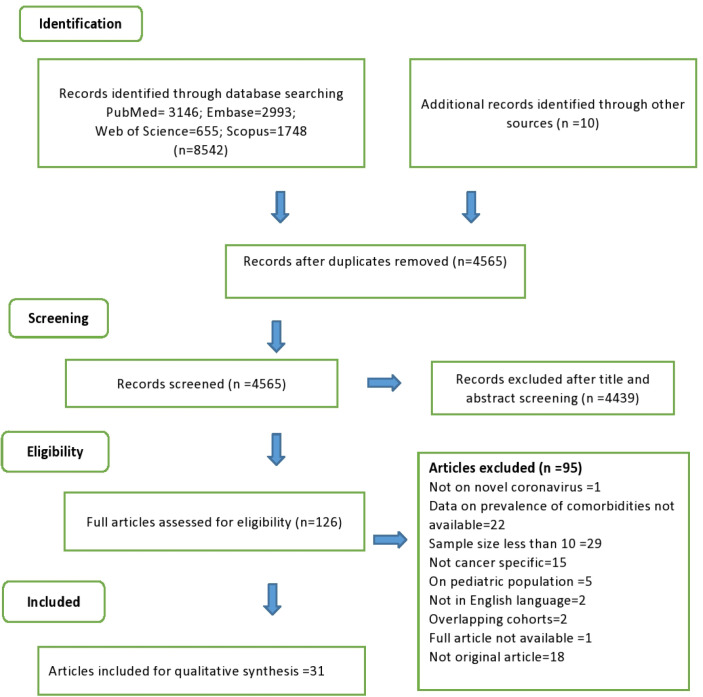
Online databases PubMed, Embase, Scopus and Web of science were searched for articles published between 9th July 2019 to July 8th 2020.Studies of cancer patients (>18 years) with diagnosis of SARS CoV-2 infection, published in English were included. A random-effects modelling for the meta-analyses was applied to assess the pooled prevalence and odds ratio for mortality due to comorbidities in SARS CoV-2 infected cancer patients.
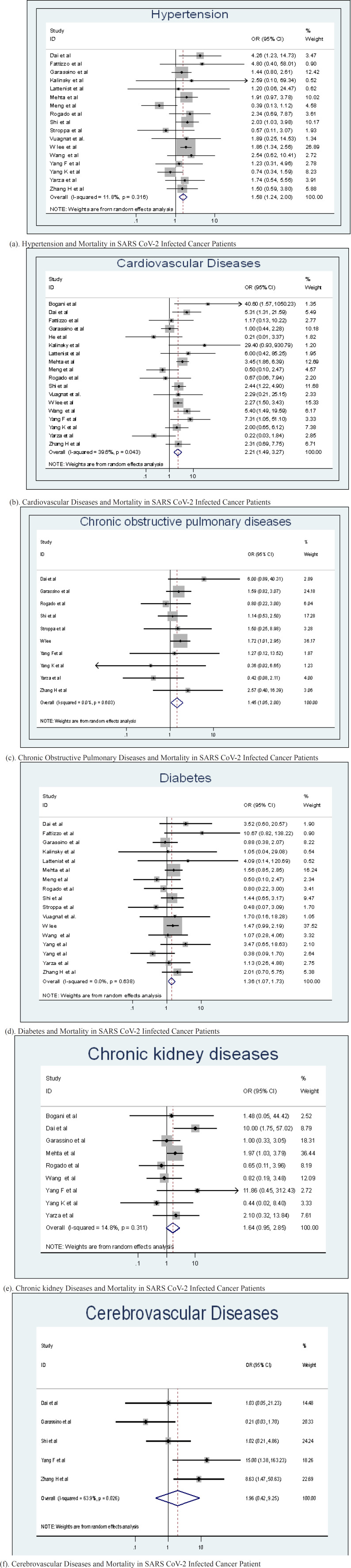
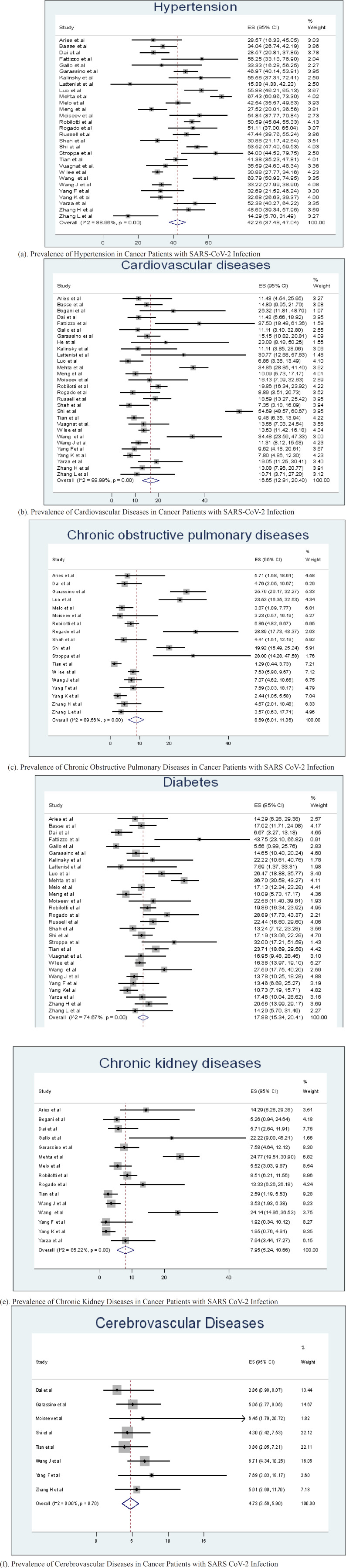
Total 31studies with 4086 SARS-CoV-2 infectedcancer patientsmet the inclusion criteria. Most prevalent co-morbidities in cancer patients with SARS CoV-2 infection were hypertension [42.3% (95%CI:37.5- 47.0)], diabetes [17.8% (95% CI: 15.3-20.4)] and cardiovascular diseases [16.7% (95%CI:12.9-20.4)].The risk of mortality (pOR) was significantly higher in individuals with hypertension[1.6(95%CI 1.24-2.00)], cardiovascular diseases [2.2 (95%CI 1.49- 3.27)], chronic obstructive pulmonary diseases [1.4(95% CI 1.05-2.00)] and diabetes [1.35(95%CI 1.06-1.73)].
Our results indicates that the mortality in SARS-CoV-2 infected cancer patients is affected by preexisting non-cancer comorbidities. By identifying the comorbidities predictive for mortality, clinicians can better stratify the risk of cancer patients presenting with SARS-COV-2, on their initial contact with health services.
.
有证据表明,合并症的 SARS-CoV-2 感染患者更有可能出现严重疾病后遗症和死亡率。在 SARS-CoV-2 感染的癌症患者中,与其他潜在合并症相关的风险可能与非癌症 SARS CoV-2 感染患者不同。癌症患者和 SARS-CoV-2 感染患者之间不同潜在健康状况的相对影响仍有待探讨。本系统评价旨在探讨 SARS-CoV-2 感染癌症患者合并症的患病率及其对死亡率的影响。
方法:在线数据库 PubMed、Embase、Scopus 和 Web of science 检索了 2019 年 7 月 9 日至 2020 年 7 月 8 日期间发表的文章。纳入了癌症患者(>18 岁)诊断为 SARS-CoV-2 感染的研究,以英文发表。应用随机效应模型对荟萃分析进行评估,以评估 SARS-CoV-2 感染癌症患者因合并症导致死亡率的汇总患病率和比值比。
结果:共有 31 项研究纳入了 4086 名 SARS-CoV-2 感染的癌症患者。SARS-CoV-2 感染癌症患者最常见的合并症为高血压[42.3%(95%CI:37.5-47.0)]、糖尿病[17.8%(95%CI:15.3-20.4)]和心血管疾病[16.7%(95%CI:12.9-20.4)]。高血压[1.6(95%CI 1.24-2.00)]、心血管疾病[2.2(95%CI 1.49-3.27)]、慢性阻塞性肺疾病[1.4(95%CI 1.05-2.00)]和糖尿病[1.35(95%CI 1.06-1.73)]的个体死亡风险(pOR)显著更高。
结论:我们的研究结果表明,SARS-CoV-2 感染癌症患者的死亡率受非癌症合并症的影响。通过确定预测死亡率的合并症,临床医生可以更好地对出现 SARS-CoV-2 的癌症患者进行风险分层,在他们首次接触卫生服务时。