da Costa João Cordeiro, Manso Maria Conceição, Gregório Susana, Leite Márcia, Pinto João Moreira
Hospital-Escola da Universidade Fernando Pessoa, Gondomar, Portugal.
Center for Innovative Care and Health Technology (ciTechCare), Polytechnic Institute of Leiria, Leiria, Portugal.
Tuberc Respir Dis (Seoul). 2022 Oct;85(4):349-357. doi: 10.4046/trd.2022.0006. Epub 2022 Jun 23.
The most consistently identified mortality determinants for the new coronavirus 2019 (COVID-19) infection are aging, male sex, cardiovascular/respiratory diseases, and cancer. They were determined from heterogeneous cohorts that included patients with different disease severity and previous conditions. The main goal of this study was to determine if activities of daily living (ADL) dependence measured by Barthel's index could be a predictor for COVID-19 mortality.
A prospective cohort study was performed with a consecutive sample of 340 COVID-19 patients representing patients from all over the northern region of Portugal from October 2020 to March 2021. Mortality risk factors were determined after controlling for demographics, ADL dependence, admission time, comorbidities, clinical manifestations, and delay-time for diagnosis. Central tendency measures were used to analyze continuous variables and absolute numbers (proportions) for categorical variables. For univariable analysis, we used t test, chi-square test, or Fisher exact test as appropriate (α=0.05). Multivariable analysis was performed using logistic regression. IBM SPSS version 27 statistical software was used for data analysis.
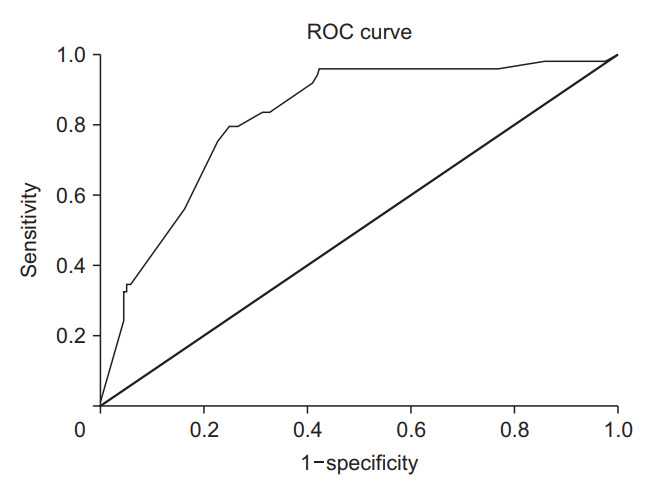
The cohort included 340 patients (55.3% females) with a mean age of 80.6±11.0 years. The mortality rate was 19.7%. Univariate analysis revealed that aging, ADL dependence, pneumonia, and dementia were associated with mortality and that dyslipidemia and obesity were associated with survival. In multivariable analysis, dyslipidemia (odds ratio [OR], 0.35; 95% confidence interval [CI], 0.17-0.71) was independently associated with survival. Age ≥86 years (pooled OR, 2.239; 95% CI, 1.100-4.559), pneumonia (pooled OR, 3.00; 95% CI, 1.362-6.606), and ADL dependence (pooled OR, 6.296; 95% CI, 1.795-22.088) were significantly related to mortality (receiver operating characteristic area under the curve, 82.1%; p<0.001).
ADL dependence, aging, and pneumonia are three main predictors for COVID-19 mortality in an elderly population.
2019年新型冠状病毒(COVID-19)感染最一致确定的死亡决定因素是老龄化、男性、心血管/呼吸系统疾病和癌症。这些因素是从包括不同疾病严重程度和既往病情患者的异质性队列中确定的。本研究的主要目的是确定用巴氏指数衡量的日常生活活动(ADL)依赖是否可作为COVID-19死亡率的预测指标。
进行了一项前瞻性队列研究,连续纳入了340例COVID-19患者,这些患者代表了2020年10月至2021年3月来自葡萄牙北部地区各地的患者。在控制了人口统计学、ADL依赖、入院时间、合并症、临床表现和诊断延迟时间后确定死亡风险因素。使用集中趋势测量方法分析连续变量,使用绝对数(比例)分析分类变量。单变量分析时,根据情况使用t检验、卡方检验或Fisher精确检验(α=0.05)。使用逻辑回归进行多变量分析。使用IBM SPSS 27版统计软件进行数据分析。
该队列包括340例患者(55.3%为女性),平均年龄为80.6±11.0岁。死亡率为19.7%。单变量分析显示,老龄化、ADL依赖、肺炎和痴呆与死亡率相关,血脂异常和肥胖与生存相关。在多变量分析中,血脂异常(比值比[OR],0.35;95%置信区间[CI],0.17 - 0.71)与生存独立相关。年龄≥86岁(合并OR,2.239;95% CI,1.100 - 4.559)、肺炎(合并OR,3.00;95% CI,1.362 - 6.606)和ADL依赖(合并OR,6.296;95% CI,1.795 - 22.088)与死亡率显著相关(曲线下受试者工作特征面积,82.1%;p<0.001)。
ADL依赖、老龄化和肺炎是老年人群中COVID-19死亡率的三个主要预测指标。