Department of Endocrinology and Metabolism, Fujian Medical University Union Hospital, 29 Xinquan Road, Fujian, 350001, Fuzhou, China.
Department of Clinical Pharmacy and Pharmacy Administration, School of Pharmacy, Fujian Medical University, 350122, Fuzhou, Fujian, China.
BMC Endocr Disord. 2021 May 28;21(1):112. doi: 10.1186/s12902-021-00772-z.
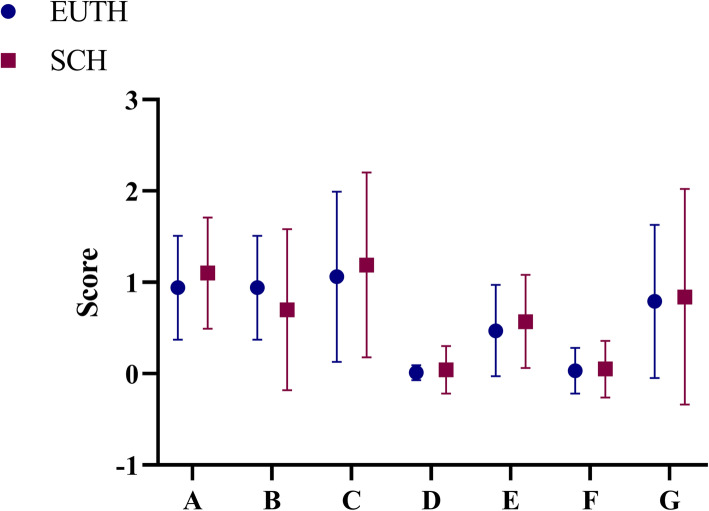
Few studies have focused on the association between lifestyle and subclinical hypothyroidism (SCH). The purpose of this study was to investigate the association between lifestyle and thyroid function in SCH.
This study was a part of a community-based and cross-sectional study, the Epidemiological Survey of Thyroid Diseases in Fujian Province, China. A total of 159 participants with SCH (81 males and 78 females) and 159 euthyroid (87 males and 72 females) participants without any missing data were included in the analysis. General information and lifestyle information including sleep, exercise, diet and smoking habits of the participants was collected by questionnaire and Pittsburgh sleep quality index scale (PSQI) was collected. Thyroid stimulating hormone (TSH), free thyroxine (FT4), thyroid peroxidase antibody (TPOAb), thyroid globulin antibody (TgAb) and urine iodine concentration (UIC) were tested. Thyroid homeostasis parameter thyroid' s secretory capacity (SPINA-GT), Jostel's TSH index (TSHI), thyrotroph T4 sensitivity index (TTSI) were calculated. Logistic regression and multiple linear regression were performed to assess associations.
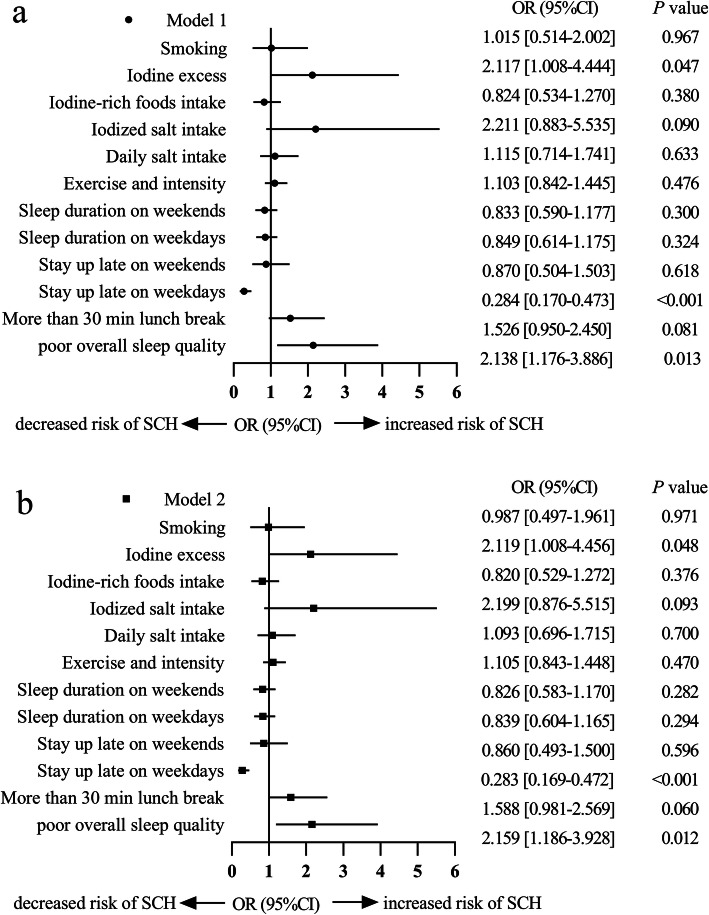
Compared with euthyroid subjects, patients with SCH were more likely to have poor overall sleep quality (15.1 vs.25.8 %, P = 0.018) and l less likely to stay up late on weekdays (54.7 vs. 23.9 % P < 0.001). In SCH group, exercise was the influencing factor of TSH (β= -0.224, P = 0.004), thyroid secretory capacity (β = 0.244, P = 0.006) and thyrotropin resistance (β = 0.206, P = 0.009). Iodine excess was the influencing factor of thyroid secretory capacity (β = 0.209, P = 0.001) and pituitary thyroid stimulating function (β = 0.167, P = 0.034). Smoking was the influencing factor of pituitary thyroid stimulating function (β = 0.161, P = 0.040). Staying up late on weekends was the influencing factor of thyroid secretory capacity (β = 0.151, P = 0.047). After adjusting for possible confounders, logistic regression showed that those with poor overall sleep quality assessed by PSQI and iodine excess had an increased risk of SCH (OR 2.159, 95 %CI 1.186-3.928, P = 0.012 and OR 2.119, 95 %CI 1.008-4.456, P = 0.048, respectively).
Lifestyle including sleep, smoking, diet and exercise was closely related to thyroid function especially thyroid homeostasis in SCH.
很少有研究关注生活方式与亚临床甲状腺功能减退症(SCH)之间的关联。本研究旨在探讨 SCH 患者生活方式与甲状腺功能之间的关系。
本研究是一项基于社区的横断面研究,即中国福建省甲状腺疾病流行病学调查。共纳入 159 名 SCH 患者(81 名男性和 78 名女性)和 159 名甲状腺功能正常(87 名男性和 72 名女性)且无任何缺失数据的参与者纳入分析。通过问卷和匹兹堡睡眠质量指数(PSQI)收集参与者的一般信息和生活方式信息,包括睡眠、运动、饮食和吸烟习惯。检测甲状腺刺激激素(TSH)、游离甲状腺素(FT4)、甲状腺过氧化物酶抗体(TPOAb)、甲状腺球蛋白抗体(TgAb)和尿碘浓度(UIC)。计算甲状腺稳态参数甲状腺分泌能力(SPINA-GT)、Jostel's TSH 指数(TSHI)、促甲状腺素 T4 敏感性指数(TTSI)。采用逻辑回归和多元线性回归分析评估关联。
与甲状腺功能正常的受试者相比,SCH 患者总体睡眠质量较差的可能性更大(15.1%比 25.8%,P=0.018),工作日熬夜的可能性更小(54.7%比 23.9%,P<0.001)。在 SCH 组中,运动是 TSH(β=-0.224,P=0.004)、甲状腺分泌能力(β=0.244,P=0.006)和促甲状腺素抵抗(β=0.206,P=0.009)的影响因素。碘过量是甲状腺分泌能力(β=0.209,P=0.001)和垂体甲状腺刺激功能(β=0.167,P=0.034)的影响因素。吸烟是垂体甲状腺刺激功能(β=0.161,P=0.040)的影响因素。周末熬夜是甲状腺分泌能力(β=0.151,P=0.047)的影响因素。在校正了可能的混杂因素后,逻辑回归显示,PSQI 评估的整体睡眠质量差和碘过量的患者患 SCH 的风险增加(OR 2.159,95%CI 1.186-3.928,P=0.012 和 OR 2.119,95%CI 1.008-4.456,P=0.048)。
包括睡眠、吸烟、饮食和运动在内的生活方式与 SCH 患者的甲状腺功能,特别是甲状腺稳态密切相关。