Ryu Jisu, Park Samuel D, Baranov Dmitry, Rreza Iva, Owen Jonathan S, Jonas David M
Department of Chemistry, University of Colorado, Boulder, CO 80309-0215, USA.
General Atomics Electromagnetic Systems Group (GA-EMS), 6685 Gunpark Dr. #230, Boulder, CO 80301, USA.
Sci Adv. 2021 May 28;7(22). doi: 10.1126/sciadv.abf4741. Print 2021 May.
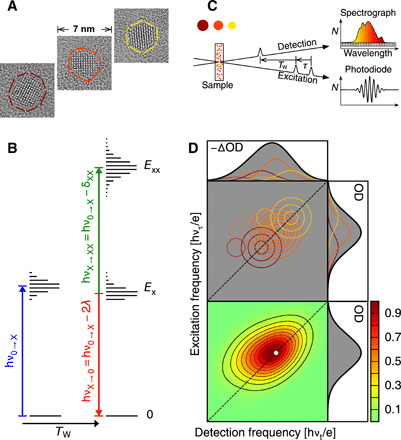
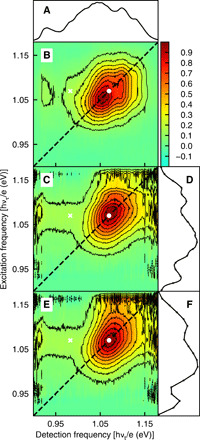
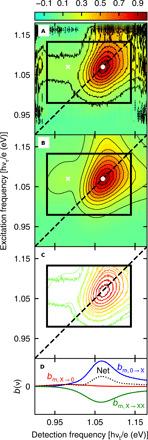
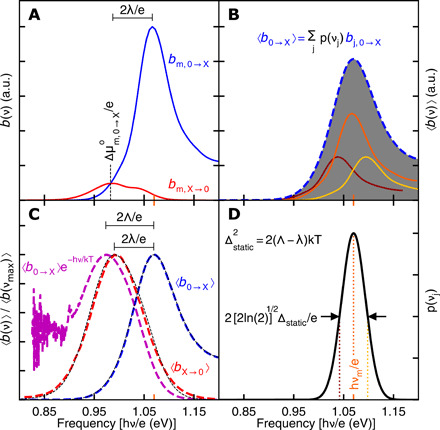
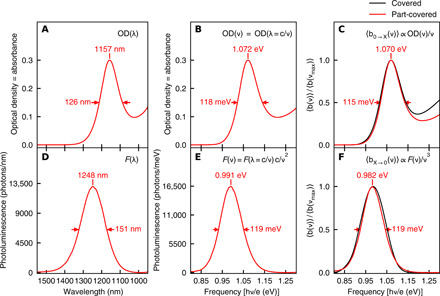
For quantum-confined nanomaterials, size dispersion causes a static broadening of spectra that has been difficult to measure and invalidates all-optical methods for determining the maximum photovoltage that an excited state can generate. Using femtosecond two-dimensional (2D) spectroscopy to separate size dispersion broadening of absorption and emission spectra allows a test of single-molecule generalized Einstein relations between such spectra for colloidal PbS quantum dots. We show that 2D spectra and these relations determine the thermodynamic standard chemical potential difference between the lowest excited and ground electronic states, which gives the maximum photovoltage. Further, we find that the static line broadening from many slightly different quantum dot structures allows single-molecule generalized Einstein relations to determine the average single-molecule linewidth from Stokes' frequency shift between ensemble absorption and emission spectra.
对于量子限域纳米材料,尺寸分散会导致光谱的静态展宽,这种展宽很难测量,并且会使用于确定激发态所能产生的最大光电压的全光学方法失效。利用飞秒二维(2D)光谱来分离吸收光谱和发射光谱的尺寸分散展宽,能够对胶体硫化铅量子点此类光谱之间的单分子广义爱因斯坦关系进行检验。我们表明,二维光谱和这些关系决定了最低激发电子态与基态电子态之间的热力学标准化学势差,而该化学势差给出了最大光电压。此外,我们发现,来自许多略有不同的量子点结构的静态谱线展宽使得单分子广义爱因斯坦关系能够根据系综吸收光谱和发射光谱之间的斯托克斯频移来确定平均单分子线宽。