School of Psychology and Neuroscience, University of St Andrews, St. Andrews, Fife KY16 9JP, UK; Department of Developmental and Comparative Psychology, Max Planck Institute for Evolutionary Anthropology, Deutscher Platz 6, Leipzig D-04103, Germany.
School of Psychology and Neuroscience, University of St Andrews, St. Andrews, Fife KY16 9JP, UK; Department of Developmental and Comparative Psychology, Max Planck Institute for Evolutionary Anthropology, Deutscher Platz 6, Leipzig D-04103, Germany.
Cognition. 2021 Sep;214:104766. doi: 10.1016/j.cognition.2021.104766. Epub 2021 May 26.
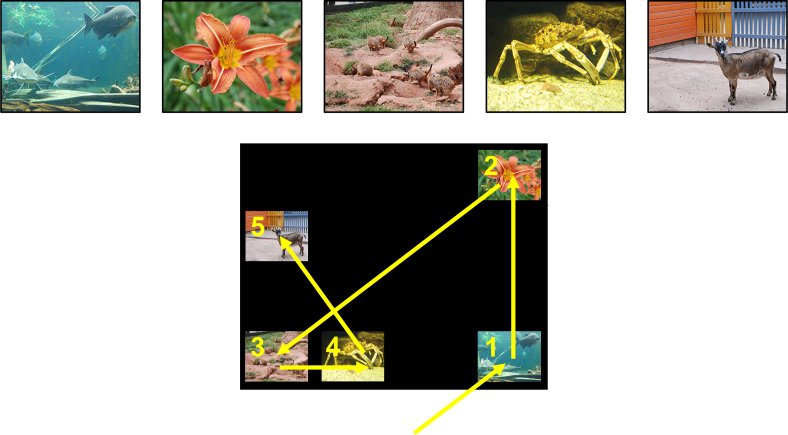
Humans can tell when they find a task difficult. Subtle uncertainty behaviors like changes in motor speed and muscle tension precede and affect these experiences. Theories of animal metacognition likewise stress the importance of endogenous signals of uncertainty as cues that motivate metacognitive behaviors. However, while researchers have investigated second-order behaviors like information seeking and declining difficult trials in nonhuman animals, they have devoted little attention to the behaviors that express the cognitive conflict that gives rise to such behaviors in the first place. Here we explored whether three chimpanzees would, like humans, show hand wavering more when faced with more difficult choices in a touch screen transitive inference task. While accuracy was very high across all conditions, all chimpanzees wavered more frequently in trials that were objectively more difficult, demonstrating a signature behavior which accompanies experiences of difficulty in humans. This lends plausibility to the idea that feelings of uncertainty, like other emotions, can be studied in nonhuman animals. We propose to routinely assess uncertainty behaviors to inform models of procedural metacognition in nonhuman animals.
人类能够察觉到任务的难度。微妙的不确定性行为,如运动速度和肌肉张力的变化,先于这些体验出现,并对其产生影响。动物元认知理论同样强调不确定性的内源性信号作为促使元认知行为的线索的重要性。然而,尽管研究人员已经调查了非人类动物的信息寻求和拒绝困难试验等二阶行为,但他们很少关注表达认知冲突的行为,而这种认知冲突首先导致了这些行为。在这里,我们探索了三只黑猩猩是否会像人类一样,在触摸屏传递性推理任务中面对更困难的选择时,手会更频繁地摆动。虽然在所有条件下准确性都非常高,但所有黑猩猩在客观上更困难的试验中摆动得更频繁,表现出一种与人类困难体验相伴的标志性行为。这使得不确定性的感觉(如其他情绪)可以在非人类动物中进行研究的观点变得合理。我们建议定期评估不确定性行为,以为非人类动物的程序元认知模型提供信息。