Programs in Psychology and Biology, The Graduate Center of the City University of New York, New York, NY, USA.
Department of Psychology, The University of Cambridge, Cambridge, UK.
Sci Rep. 2020 Feb 27;10(1):3632. doi: 10.1038/s41598-020-60382-y.
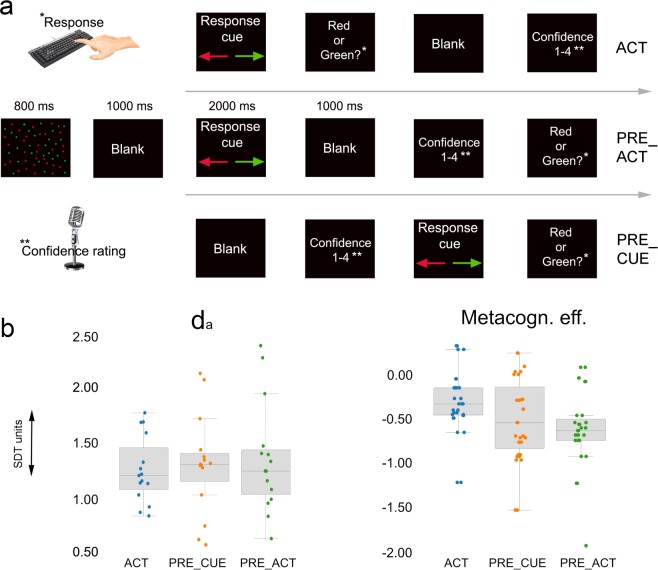
Metacognitive abilities allow us to adjust ongoing behavior and modify future decisions in the absence of external feedback. Although metacognition is critical in many daily life settings, it remains unclear what information is actually being monitored and what kind of information is being used for metacognitive decisions. In the present study, we investigated whether response information connected to perceptual events contribute to metacognitive decision-making. Therefore, we recorded EEG signals during a perceptual color discrimination task while participants were asked to provide an estimate about the quality of their decision on each trial. Critically, the moment participants provided their confidence judgments varied across conditions, thereby changing the amount of action information (e.g., response competition or response fluency) available for metacognitive decisions. Results from three experiments demonstrate that metacognitive performance improved when first-order action information was available at the moment metacognitive decisions about the perceptual task had to be provided. This behavioral effect was accompanied by enhanced functional connectivity (beta phase synchrony) between motor areas and prefrontal regions, exclusively observed during metacognitive decision-making. Our findings demonstrate that action information contributes to metacognitive decision-making, thereby painting a picture of metacognition as a process that integrates sensory evidence and information about our interactions with the world.
元认知能力使我们能够在没有外部反馈的情况下调整正在进行的行为并修改未来的决策。尽管元认知在许多日常生活环境中都很关键,但仍不清楚实际监测到的信息是什么,以及用于元认知决策的信息是什么。在本研究中,我们研究了与感知事件相关的反应信息是否有助于元认知决策。因此,我们在参与者被要求对每次试验的决策质量进行估计时记录了 EEG 信号。至关重要的是,参与者提供置信度判断的时刻因条件而异,从而改变了可用于元认知决策的动作信息(例如,反应竞争或反应流畅性)的数量。三个实验的结果表明,当必须提供有关感知任务的元认知决策时,可获得一阶动作信息时,元认知表现得到了提高。这种行为效应伴随着运动区域和前额叶区域之间功能连接(β 阶段同步)的增强,仅在元认知决策期间观察到。我们的研究结果表明,动作信息有助于元认知决策,从而描绘了元认知作为一个整合感官证据和我们与世界相互作用的信息的过程。