Immunoallergy Department, Hospital de Dona Estefânia, Centro Hospitalar Universitário de Lisboa Central, EPE, Lisbon, Portugal; NOVA Medical School/Comprehensive Health Research Center (CHRC) Campo dos Mártires da Pátria, 130, 1169-056 Lisbon, Portugal.
Pulmonology Department, Centro Hospitalar Universitário de São João, Porto, Portugal; Faculty of Medicine of the University of Porto, Portugal.
Pulmonology. 2022 Jan-Feb;28(1):34-43. doi: 10.1016/j.pulmoe.2021.04.001. Epub 2021 Apr 30.
Severe asthma management during the coronavirus disease 2019 (COVID-19) pandemic is a challenge and will continue to be, at least in the next few months, as herd immunity is still a mirage. A lot has to be learned about how COVID-19 affects underlying diseases, and severe asthma is no exception.
Narrative review of papers available until February 2021 in PubMed and Google Scholar, relating severe asthma and COVID-19. Four main research topics were reviewed: SARS-CoV-2 infection: immunology and respiratory pathology; interrelationship of severe asthma endotypes and COVID-19 disease mechanisms; severe asthma epidemiology and COVID-19; and biologics for severe asthma in the context of COVID-19.
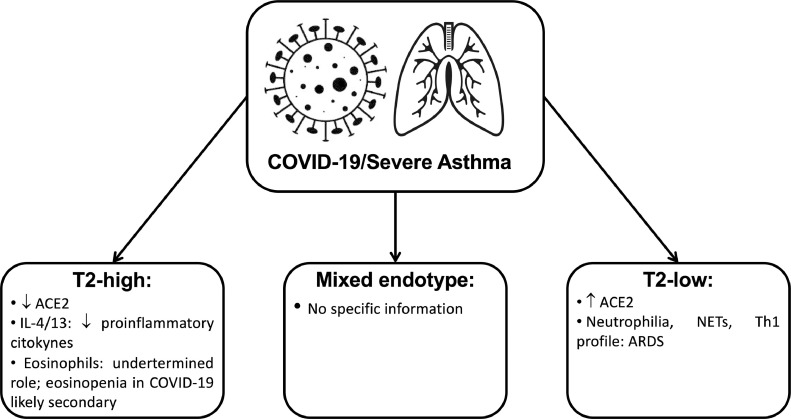
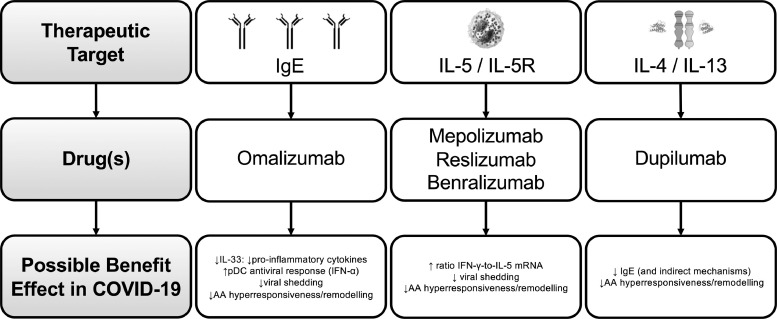
COVID-19 disease mechanisms start with upper respiratory cell infection, and afterwards several immunological facets are activated, contributing to disease severity, namely cell-mediated immunity and antibody production. Although infrequent in the COVID-19 course some patients develop a cytokine storm that causes organ damage and may lead to acute respiratory distress syndrome or multiorgan failure. Regarding severe asthma endotypes, type2-high might have a protective role both in infection risk and disease course. There is conflicting data regarding the epidemiological relationship between COVID-19 among severe asthma patients, with some studies reporting increased risk of infection and disease course, whereas others the other way round. Biologics for severe asthma do not seem to increase the risk of infection and severe COVID-19, although further evidence is needed.
Globally, in the era of COVID-19, major respiratory societies recommend continuing the biologic treatment, preferably in a self-home administration program.
在 2019 年冠状病毒病(COVID-19)大流行期间,严重哮喘的管理是一项挑战,并且至少在未来几个月内仍将如此,因为群体免疫仍然是一个幻想。我们需要了解很多关于 COVID-19 如何影响潜在疾病的知识,严重哮喘也不例外。
对截至 2021 年 2 月在 PubMed 和 Google Scholar 上可用的有关严重哮喘和 COVID-19 的论文进行叙述性综述。综述了四个主要研究主题:SARS-CoV-2 感染:免疫学和呼吸道病理学;严重哮喘表型和 COVID-19 疾病机制的相互关系;严重哮喘流行病学和 COVID-19;以及 COVID-19 背景下严重哮喘的生物制剂。
COVID-19 疾病机制始于上呼吸道细胞感染,随后激活了几种免疫方面,导致疾病严重程度增加,即细胞介导的免疫和抗体产生。尽管在 COVID-19 病程中并不常见,但有些患者会发生细胞因子风暴,导致器官损伤,并可能导致急性呼吸窘迫综合征或多器官衰竭。关于严重哮喘表型,2 型高表型在感染风险和疾病病程中可能具有保护作用。关于 COVID-19 在严重哮喘患者中的流行病学关系存在相互矛盾的数据,一些研究报告感染和疾病病程的风险增加,而另一些研究则相反。严重哮喘的生物制剂似乎不会增加感染和严重 COVID-19 的风险,但需要进一步的证据。
在 COVID-19 时代,全球各大呼吸学会建议继续进行生物治疗,最好采用自我家庭管理方案。