Xiong Peng, Liang Xiaohua, Chen Haiyan, Chen Li, Zuo Lei, Jing Chunxia, Hao Guang
Division of Medical Psychology and Behavioral Sciences, Department of Public Health and Preventive Medicine, School of Medicine, Jinan University, Guangzhou, China.
Clinical Epidemiology and Biostatistics Department, Children's Hospital of Chongqing Medical University, Ministry of Education Key Laboratory of Child Development and Disorders, National Clinical Research Center for Child Health and Disorders, Key Laboratory of Pediatrics in Chongqing, International Science and Technology Cooperation Center of Child Development and Critical Disorders, Chongqing, China.
Front Aging Neurosci. 2021 May 13;13:645189. doi: 10.3389/fnagi.2021.645189. eCollection 2021.
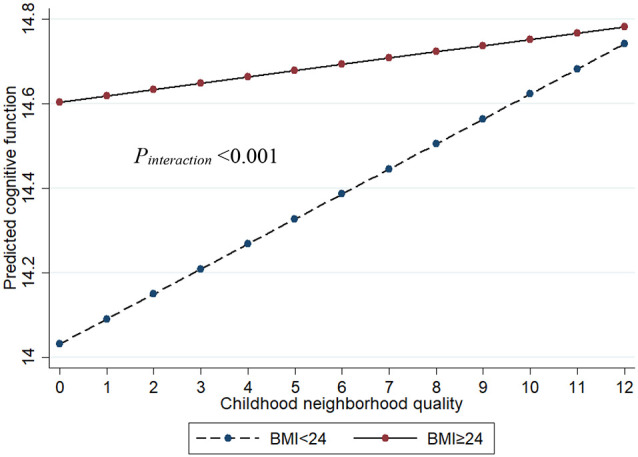
: Identification of early modifiable factors is crucial to delay or prevent the development of cognitive impairment and reduce the social and economic burden. : This study aimed to examine the longitudinal associations of childhood neighborhood quality (CNQ) with the risk of later-life cognitive dysfunction and the role of body mass index (BMI) in this association. : A total of 8,289 community-dwelling middle-aged and elderly population from wave 2011, wave 2013, and wave 2015 of the China Health and Retirement Longitudinal Study (CHARLS) were included. Cognitive function and CNQ were measured by standardized questionnaires. Multilevel linear regression models were used to estimate the associations of CNQ and cognitive function. The interactions of BMI with CNQ in the progress of cognitive function were also estimated. : The participants with higher CNQ had a significantly low risk of cognitive impairment than those with lower CNQ score ( = 0.067, 95% CI: 0.031, 0.103), and the results remained similar ( = 0.039, 95% CI: 0.004, 0.075) after controlling other confounding variables. Furthermore, there was an interaction between BMI with CNQ score ( < 0.001) for the risk of cognitive impairment. In BMI-stratified analysis, we found that the association of CNQ and cognitive function was not statistically significant in overweight or obese population ( = 0.019, 95% CI: -0.032, 0.070), but was statistically significant in people with lower BMI ( = 0.059, 95% CI: 0.010, 0.107). : Higher CNQ score is significantly associated with the lower risk of cognitive dysfunction in adulthood. BMI may moderate the associations of CNQ with the risk of cognitive function.
识别早期可改变因素对于延缓或预防认知障碍的发展以及减轻社会和经济负担至关重要。本研究旨在探讨童年邻里质量(CNQ)与晚年认知功能障碍风险的纵向关联,以及体重指数(BMI)在此关联中的作用。纳入了中国健康与养老追踪调查(CHARLS)2011年、2013年和2015年波次的8289名社区居住的中老年人。认知功能和CNQ通过标准化问卷进行测量。采用多水平线性回归模型估计CNQ与认知功能的关联。还估计了BMI与CNQ在认知功能进展中的相互作用。CNQ较高的参与者认知障碍风险显著低于CNQ得分较低的参与者(β = 0.067,95%CI:0.031,0.103),在控制其他混杂变量后结果仍然相似(β = 0.039,95%CI:0.004,0.075)。此外,BMI与CNQ得分之间存在认知障碍风险的相互作用(P < 0.001)。在按BMI分层分析中,我们发现CNQ与认知功能的关联在超重或肥胖人群中无统计学意义(β = 0.019,95%CI:-0.032,0.070),但在BMI较低的人群中具有统计学意义(β = 0.059,95%CI:0.010,0.107)。较高的CNQ得分与成年期较低的认知功能障碍风险显著相关。BMI可能会调节CNQ与认知功能风险的关联。