Jacobs Benedikt, Gebel Veronika, Heger Lukas, Grèze Victoria, Schild Hansjörg, Dudziak Diana, Ullrich Evelyn
Department of Internal Medicine 5, Haematology and Oncology, Friedrich Alexander University Erlangen-Nuremberg (FAU), University Hospital Erlangen, Erlangen, Germany.
Children's Hospital, Goethe-University Frankfurt, Frankfurt, Germany.
Front Immunol. 2021 May 14;12:670540. doi: 10.3389/fimmu.2021.670540. eCollection 2021.
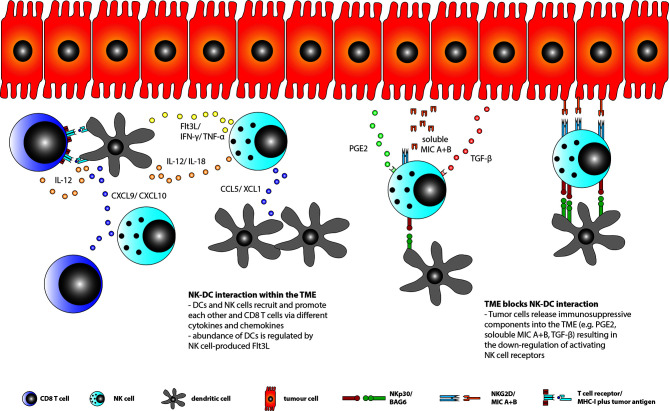
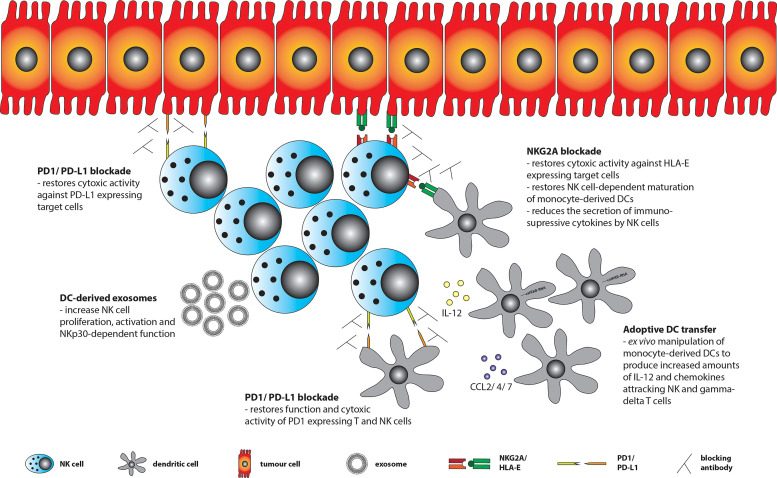
Cellular therapy has entered the daily clinical life with the approval of CAR T cell therapeutics and dendritic cell (DCs) vaccines in the US and the EU. In addition, numerous other adoptive cellular products, including natural killer (NK) cells, are currently evaluated in early phase I/ II clinical trials for the treatment of cancer patients. Despite these promising accomplishments, various challenges remain to be mastered in order to ensure sustained therapeutic success. These include the identification of strategies by which tumor cells escape the immune system or establish an immunosuppressive tumor microenvironment (TME). As part of the innate immune system, DCs and NK cells are both present within the TME of various tumor entities. While NK cells are well known for their intrinsic anti-tumor activity by their cytotoxicity capacities and the secretion of pro-inflammatory cytokines, the role of DCs within the TME is a double-edged sword as different DC subsets have been described with either tumor-promoting or -inhibiting characteristics. In this review, we will discuss recent findings on the interaction of DCs and NK cells under physiological conditions and within the TME. One focus is the crosstalk of various DC subsets with NK cells and their impact on the progression or inhibition of tumor growth. In addition, we will provide suggestions to overcome the immunosuppressive outcome of the interaction of DCs and NK cells within the TME.
随着嵌合抗原受体(CAR)T细胞疗法和树突状细胞(DC)疫苗在美国和欧盟获批,细胞疗法已进入日常临床应用。此外,包括自然杀伤(NK)细胞在内的许多其他过继性细胞产品目前正在进行I/II期早期临床试验,用于治疗癌症患者。尽管取得了这些令人鼓舞的成果,但为确保持续的治疗成功,仍有各种挑战有待克服。这些挑战包括确定肿瘤细胞逃避免疫系统或建立免疫抑制性肿瘤微环境(TME)的策略。作为先天免疫系统的一部分,DC和NK细胞都存在于各种肿瘤实体的TME中。虽然NK细胞因其细胞毒性能力和促炎细胞因子的分泌而具有内在的抗肿瘤活性而广为人知,但DC在TME中的作用是一把双刃剑,因为已描述了具有肿瘤促进或抑制特征的不同DC亚群。在本综述中,我们将讨论在生理条件下以及在TME中DC和NK细胞相互作用的最新发现。一个重点是各种DC亚群与NK细胞的相互作用及其对肿瘤生长进展或抑制的影响。此外,我们将提供建议,以克服TME中DC和NK细胞相互作用产生的免疫抑制结果。