Laboratory of Ultrastructure, Aggeu Magalhães Institute (IAM), Recife, Brazil.
Postgraduate Program in Biosciences and Biotechnology for Health (PPGBBS), Oswaldo Cruz Foundation (FIOCRUZ-PE)/Aggeu Magalhães Institute (IAM), Recife, Brazil.
Front Immunol. 2021 May 13;12:671511. doi: 10.3389/fimmu.2021.671511. eCollection 2021.
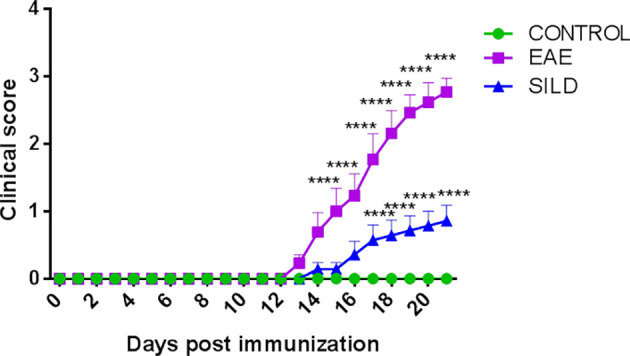
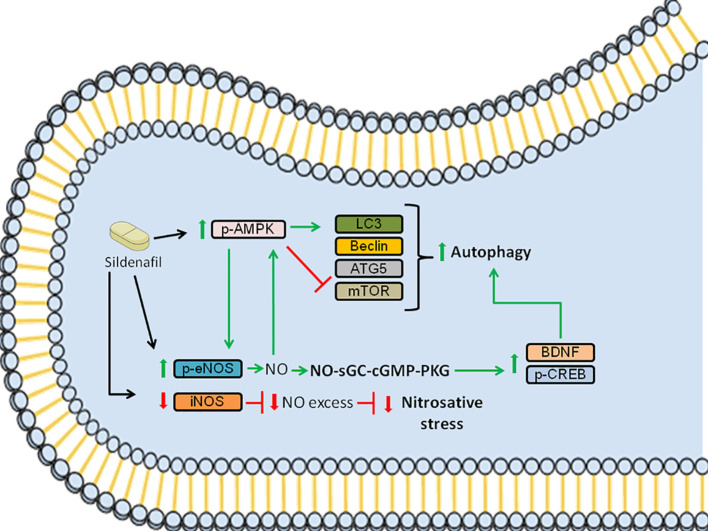
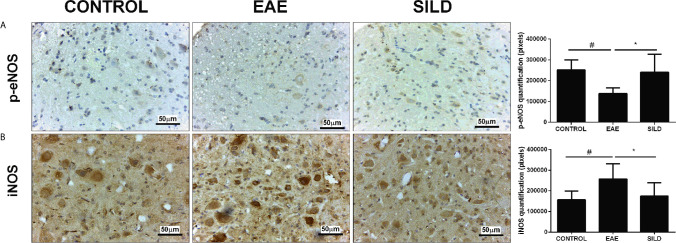
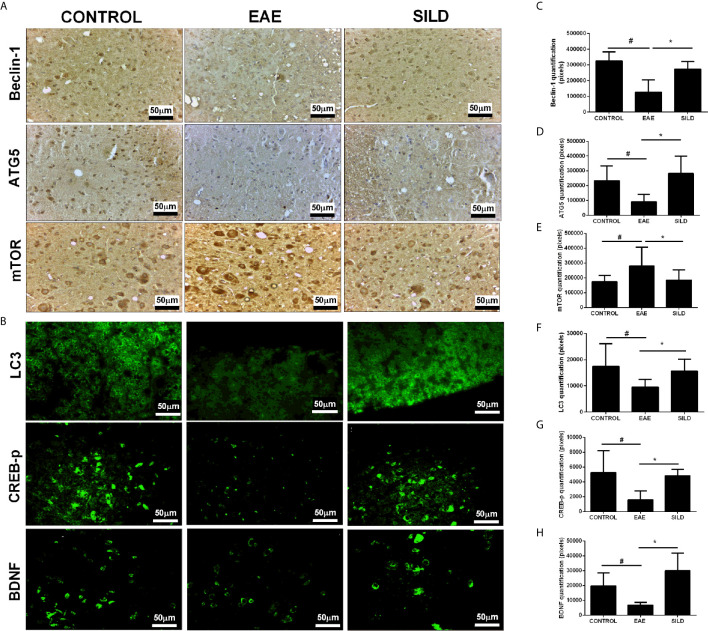
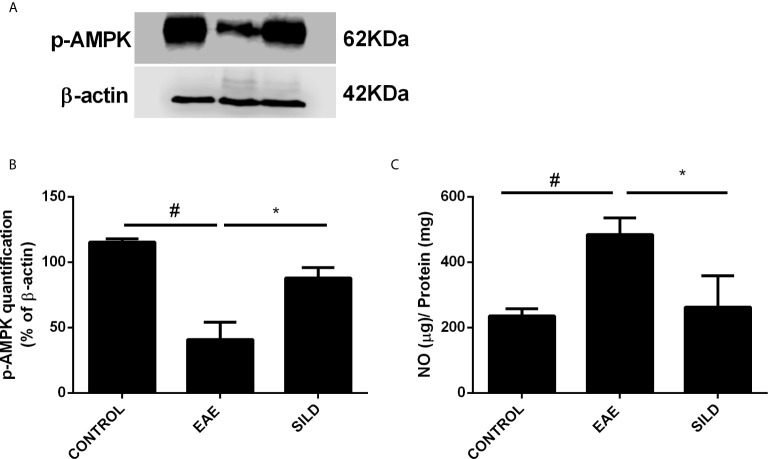
Multiple Sclerosis (MS) is a neuroinflammatory and chronic Central Nervous System (CNS) disease that affects millions of people worldwide. The search for more promising drugs for the treatment of MS has led to studies on Sildenafil, a phosphodiesterase type 5 Inhibitor (PDE5I) that has been shown to possess neuroprotective effects in the Experimental Autoimmune Encephalomyelitis (EAE), an animal model of MS. We have previously shown that Sildenafil improves the clinical score of EAE mice modulation of apoptotic pathways, but other signaling pathways were not previously covered. Therefore, the aim of the present study was to further investigate the effects of Sildenafil treatment on autophagy and nitrosative stress signaling pathways in EAE. 24 female C57BL/6 mice were divided into the following groups: (A) Control - received only water; (B) EAE - EAE untreated mice; (C) SILD - EAE mice treated with 25mg/kg of Sildenafil s.c. The results showed that EAE mice presented a pro-nitrosative profile characterized by high tissue nitrite levels, lowered levels of p-eNOS and high levels of iNOS. Furthermore, decreased levels of LC3, beclin-1 and ATG5, suggests impaired autophagy, and decreased levels of AMPK in the spinal cord were also detected in EAE mice. Surprisingly, treatment with Sildenafil inhibited nitrosative stress and augmented the levels of LC3, beclin-1, ATG5, p-CREB and BDNF and decreased mTOR levels, as well as augmented p-AMPK. In conclusion, we propose that Sildenafil alleviates EAE by activating autophagy the eNOS-NO-AMPK-mTOR-LC3-beclin1-ATG5 and eNOS-NO-AMPK-mTOR-CREB-BDNF pathways in the spinal cord.
多发性硬化症(MS)是一种神经炎症性和慢性中枢神经系统(CNS)疾病,影响着全球数以百万计的人。为了寻找更有前途的治疗多发性硬化症的药物,人们对西地那非进行了研究,西地那非是一种磷酸二酯酶 5 抑制剂(PDE5I),已被证明在实验性自身免疫性脑脊髓炎(EAE)中具有神经保护作用,EAE 是多发性硬化症的动物模型。我们之前已经表明,西地那非可以改善 EAE 小鼠的临床评分——通过调节细胞凋亡途径,但之前没有涵盖其他信号通路。因此,本研究的目的是进一步研究西地那非治疗对 EAE 中自噬和硝化应激信号通路的影响。24 只雌性 C57BL/6 小鼠被分为以下几组:(A)对照组-仅接受水;(B)EAE 组-未治疗的 EAE 小鼠;(C)SILD 组-接受 25mg/kg 西地那非皮下注射的 EAE 小鼠。结果表明,EAE 小鼠表现出促硝化状态,其特征是组织中亚硝酸盐水平升高,p-eNOS 水平降低,iNOS 水平升高。此外,EAE 小鼠的自噬受损,脊髓中 LC3、beclin-1 和 ATG5 的水平降低,AMPK 的水平降低。令人惊讶的是,西地那非治疗抑制了硝化应激,增加了 LC3、beclin-1、ATG5、p-CREB 和 BDNF 的水平,并降低了 mTOR 的水平,同时增加了 p-AMPK 的水平。总之,我们提出西地那非通过激活自噬来缓解 EAE,通过 eNOS-NO-AMPK-mTOR-LC3-beclin1-ATG5 和 eNOS-NO-AMPK-mTOR-CREB-BDNF 通路在脊髓中发挥作用。