
癌症患者中使用草药的患病率:一项系统评价和荟萃分析。
Prevalence of the Use of Herbal Medicines among Patients with Cancer: A Systematic Review and Meta-Analysis.
作者信息
Asiimwe John Baptist, Nagendrappa Prakash B, Atukunda Esther C, Kamatenesi Mauda M, Nambozi Grace, Tolo Casim U, Ogwang Patrick E, Sarki Ahmed M
机构信息
Department of Pharmacy, Faculty of Medicine, Mbarara University of Science and Technology, Mbarara, Uganda.
Faculty of Nursing and Health Sciences, Bishop Stuart University, Mbarara, Uganda.
出版信息
Evid Based Complement Alternat Med. 2021 May 17;2021:9963038. doi: 10.1155/2021/9963038. eCollection 2021.
BACKGROUND
Although herbal medicines are used by patients with cancer in multiple oncology care settings, the magnitude of herbal medicine use in this context remains unclear. The purpose of this review was to establish the prevalence of herbal medicine use among patients with cancer, across various geographical settings and patient characteristics (age and gender categories).
METHODS
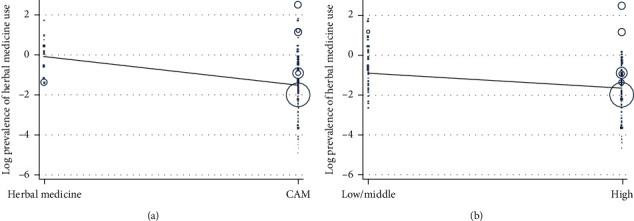
Electronic databases that were searched for data published, from January 2000 to January 2020, were Medline (PubMed), Google Scholar, Embase, and African Index Medicus. Eligible studies reporting prevalence estimates of herbal medicine use amongst cancer patients were pooled using random-effects meta-analyses. Studies were grouped by World Bank region and income groups. Subgroup and meta-regression analyses were performed to explore source of heterogeneity.
RESULTS
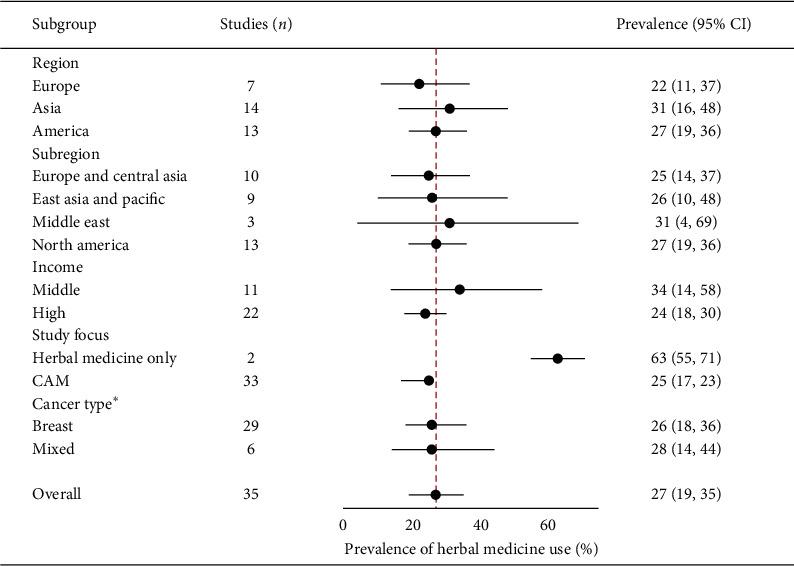
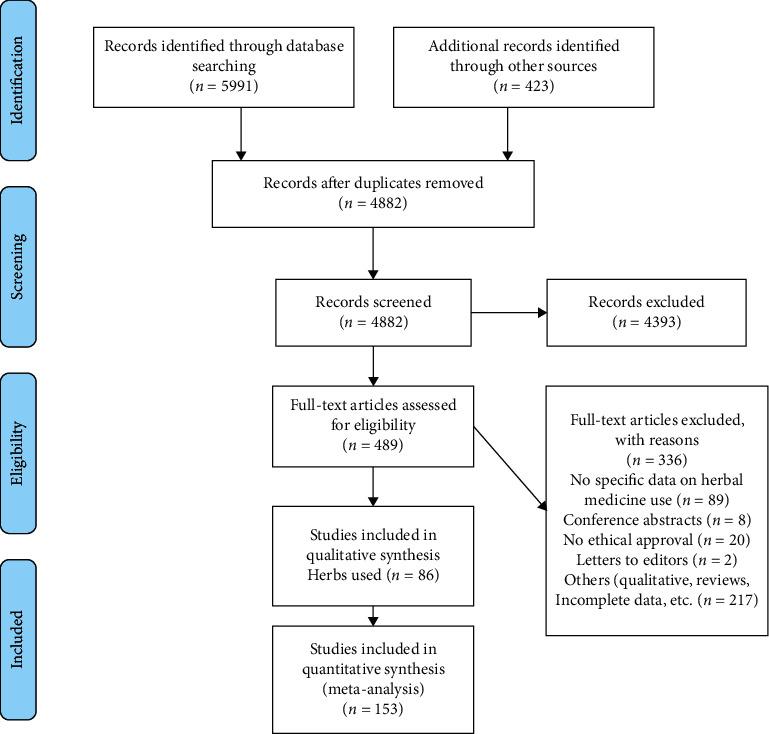
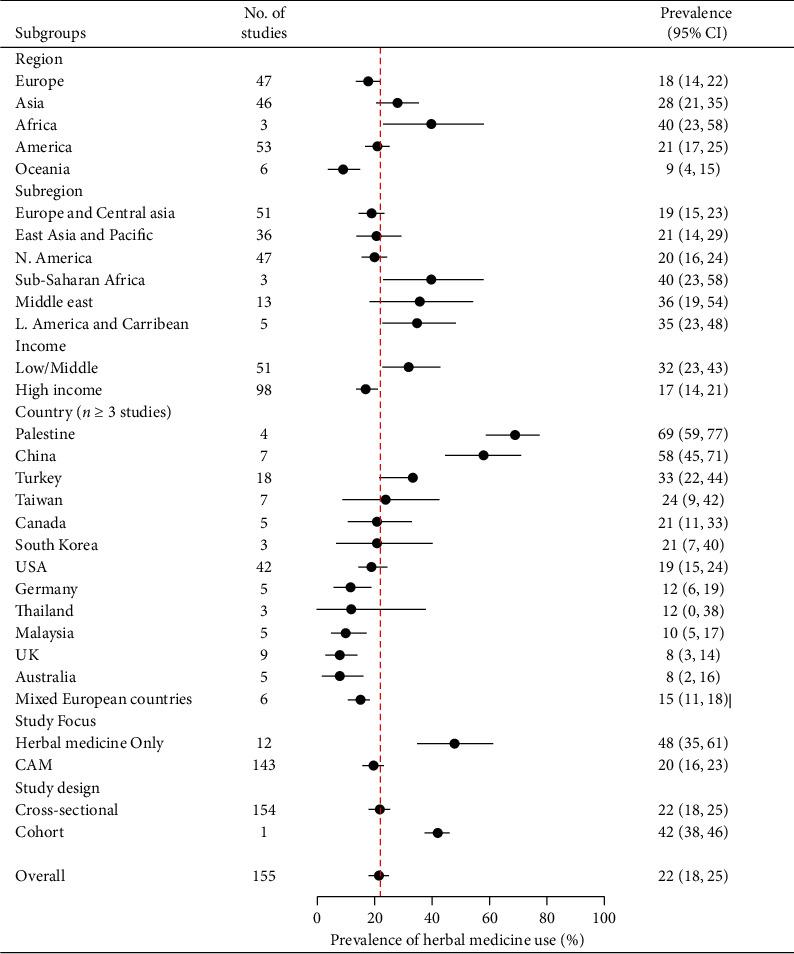
In total, 155 studies with data for 809,065 participants (53.95% female) met the inclusion criteria. Overall, the pooled prevalence of the use of herbal medicine among patients with cancer was 22% (95% confidence interval (CI): 18%-25%), with the highest prevalence estimates for Africa (40%, 95% CI: 23%-58%) and Asia (28%, 95% CI: 21%-35%). The pooled prevalence estimate was higher across low- and middle-income countries (32%, 95% CI: 23%-42%) and lower across high-income countries (17%, 95% CI: 14%-21%). Higher pooled prevalence estimates were found for adult patients with cancer (22%, 95% CI: 19%-26%) compared with children with cancer (18%, 95% CI: 11%-27%) and for female patients (27%, 95% CI: 19%-35%) compared with males (17%, 95% CI: 1%-47%).
CONCLUSION
Herbal medicine is used by a large percentage of patients with cancer use. The findings of this review highlight the need for herbal medicine to be integrated in cancer care.
背景
尽管癌症患者在多种肿瘤护理环境中使用草药,但在此背景下草药的使用规模仍不明确。本综述的目的是确定在不同地理环境和患者特征(年龄和性别类别)下癌症患者中使用草药的患病率。
方法
检索了2000年1月至2020年1月发表数据的电子数据库,包括Medline(PubMed)、谷歌学术、Embase和非洲医学索引。使用随机效应荟萃分析汇总报告癌症患者中草药使用患病率估计值的合格研究。研究按世界银行区域和收入组进行分组。进行亚组和荟萃回归分析以探索异质性来源。
结果
共有155项研究的数据涉及809,065名参与者(53.95%为女性)符合纳入标准。总体而言,癌症患者中使用草药的合并患病率为22%(95%置信区间(CI):18%-25%),非洲(40%,95%CI:23%-58%)和亚洲(28%,95%CI:21%-35%)的患病率估计最高。低收入和中等收入国家的合并患病率估计较高(32%,95%CI:23%-42%),高收入国家较低(17%,95%CI:14%-21%)。与癌症儿童患者(18%,95%CI:11%-27%)相比,成年癌症患者的合并患病率估计更高(22%,95%CI:19%-26%);与男性患者(17%,95%CI:1%-47%)相比,女性患者的合并患病率更高(27%,95%CI:19%-35%)。
结论
很大比例的癌症患者使用草药。本综述的结果凸显了将草药纳入癌症护理的必要性。
 Zotero 插件