Jia Liming, Hao Hongzhong, Wang Chunyu, Wei Jianfeng
Department of Anesthesiology, Shanxi Provincial People's Hospital, Taiyuan, Shanxi 030012, P.R. China.
Exp Ther Med. 2021 Jul;22(1):785. doi: 10.3892/etm.2021.10217. Epub 2021 May 19.
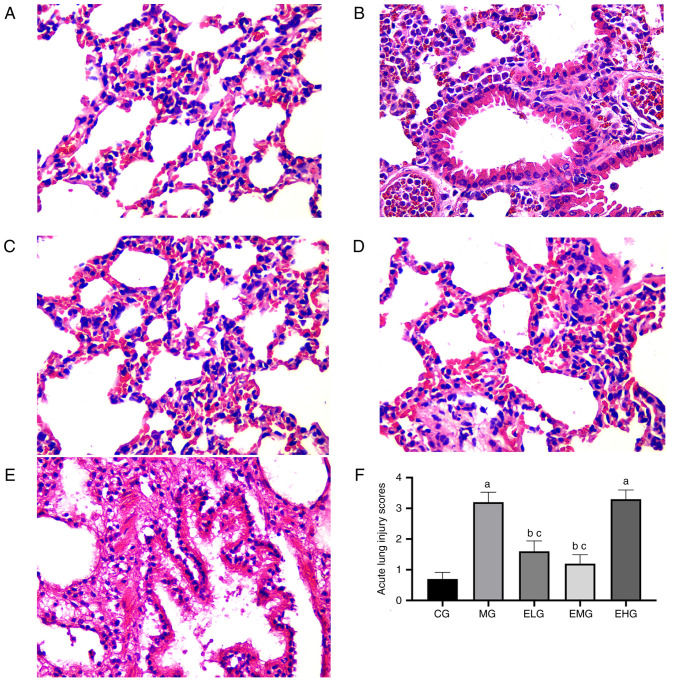
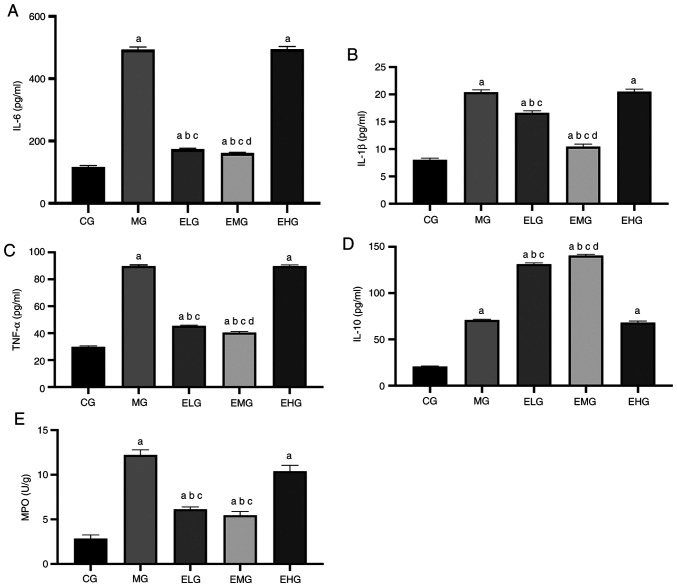
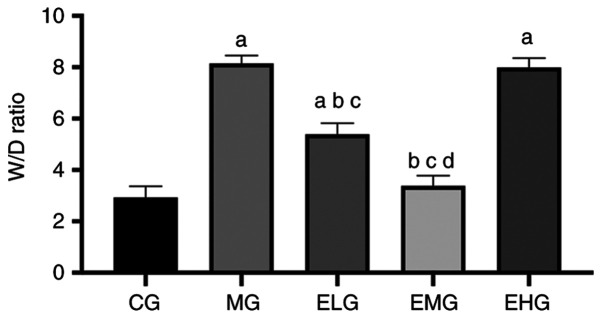
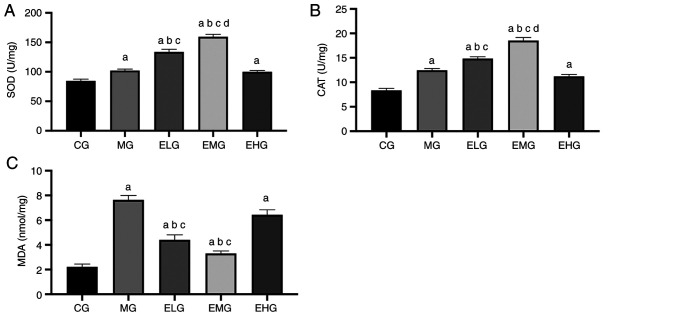
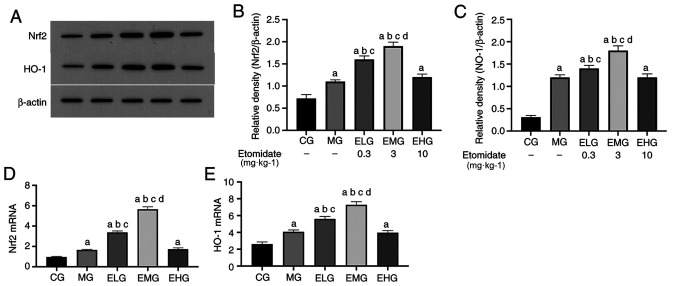
The present study aimed to investigate the protective effects of etomidate on hyperoxia-induced acute lung injury in mice, particularly on the nuclear factor-erythroid 2-related factor 2 (Nrf2)/heme oxygenase 1 (HO-1) pathway. Fifty specific pathogen-free mice were randomly divided into the blank control, model, high oxygen exposure + low etomidate dose (0.3 mg·kg), a high oxygen exposure + moderate etomidate dose (3 mg·kg), and a high oxygen exposure + high etomidate dose (10 mg·kg) groups, with ten mice allotted per group. After 72 h, the mice were sacrificed and the lung tissues were harvested, and the wet-to-dry (W/D) ratio of the tissues was calculated. Hematoxylin-eosin staining was performed to observe the pathological changes in the lung tissues, and the lung injury score (LIS) was calculated. The mRNA and protein expression levels of Nrf2 and HO-1 were measured. The malondialdehyde (MDA), myeloperoxidase (MPO), superoxide dismutase (SOD) and catalase (CAT) levels were also measured, and interleukin (IL)-1β, IL-6, tumor necrosis factor alpha (TNF-α) and IL-10 concentrations in the bronchoalveolar lavage fluid were determined. At low and moderate doses, etomidate decreased pathological damage in the lung tissue, decreased the LIS and W/D ratio, upregulated Nrf2 and HO-1 mRNA and protein expression, decreased IL-1β, IL-6, and TNF-α concentrations, increased MPO activity and IL-10 levels, suppressed the production of the oxidation product MDA, and enhanced the activities of the antioxidant enzymes CAT and SOD. Within a certain dose range, etomidate enhanced antioxidant and anti-inflammatory effects in mice, thereby decreasing lung injury induced by the chronic inhalation of oxygen at high concentrations. Furthermore, the underlying mechanism may be associate with the upregulation of the Nrf2/HO-1 signaling pathway.
本研究旨在探讨依托咪酯对小鼠高氧诱导的急性肺损伤的保护作用,特别是对核因子红细胞2相关因子2(Nrf2)/血红素加氧酶1(HO-1)通路的影响。将50只无特定病原体小鼠随机分为空白对照组、模型组、高氧暴露+低剂量依托咪酯(0.3 mg·kg)组、高氧暴露+中剂量依托咪酯(3 mg·kg)组和高氧暴露+高剂量依托咪酯(10 mg·kg)组,每组10只。72小时后,处死小鼠并采集肺组织,计算组织的湿干(W/D)比。进行苏木精-伊红染色以观察肺组织的病理变化,并计算肺损伤评分(LIS)。检测Nrf2和HO-1的mRNA和蛋白表达水平。还检测丙二醛(MDA)、髓过氧化物酶(MPO)、超氧化物歧化酶(SOD)和过氧化氢酶(CAT)水平,并测定支气管肺泡灌洗液中白细胞介素(IL)-1β、IL-6、肿瘤坏死因子α(TNF-α)和IL-10的浓度。在低剂量和中剂量时,依托咪酯可减轻肺组织的病理损伤,降低LIS和W/D比,上调Nrf2和HO-1的mRNA和蛋白表达,降低IL-1β、IL-6和TNF-α浓度,增加MPO活性和IL-10水平,抑制氧化产物MDA的产生,并增强抗氧化酶CAT和SOD的活性。在一定剂量范围内,依托咪酯可增强小鼠的抗氧化和抗炎作用,从而减轻高浓度慢性吸氧诱导的肺损伤。此外,其潜在机制可能与Nrf2/HO-1信号通路的上调有关。