Yoder Kristine E, Rabe Anthony J, Fishel Richard, Larue Ross C
Department of Cancer Biology and Genetics, College of Medicine, The Ohio State University, Columbus, OH, United States.
Front Mol Biosci. 2021 May 12;8:662331. doi: 10.3389/fmolb.2021.662331. eCollection 2021.
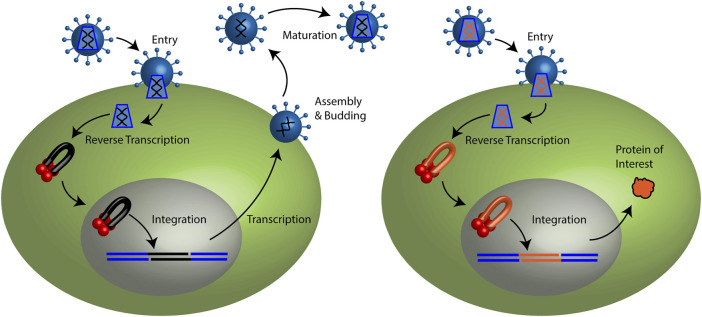
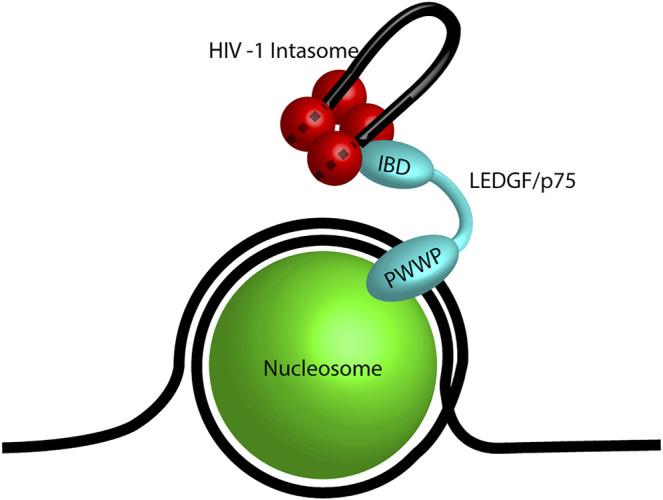
Retroviruses are obligate intracellular parasites that must integrate a copy of the viral genome into the host DNA. The integration reaction is performed by the viral enzyme integrase in complex with the two ends of the viral cDNA genome and yields an integrated provirus. Retroviral vector particles are attractive gene therapy delivery tools due to their stable integration. However, some retroviral integration events may dysregulate host oncogenes leading to cancer in gene therapy patients. Multiple strategies to target retroviral integration, particularly to genetic safe harbors, have been tested with limited success. Attempts to target integration may be limited by the multimerization of integrase or the presence of host co-factors for integration. Several retroviral integration complexes have evolved a mechanism of tethering to chromatin via a host protein. Integration host co-factors bind chromatin, anchoring the complex and allowing integration. The tethering factor allows for both close proximity to the target DNA and specificity of targeting. Each retrovirus appears to have distinct preferences for DNA sequence and chromatin features at the integration site. Tethering factors determine the preference for chromatin features, but do not affect the subtle sequence preference at the integration site. The sequence preference is likely intrinsic to the integrase protein. New developments may uncouple the requirement for a tethering factor and increase the ability to redirect retroviral integration.
逆转录病毒是专性细胞内寄生虫,必须将病毒基因组的一个拷贝整合到宿主DNA中。整合反应由病毒酶整合酶与病毒cDNA基因组的两端形成复合物来进行,产生一个整合的前病毒。逆转录病毒载体颗粒因其稳定整合而成为有吸引力的基因治疗递送工具。然而,一些逆转录病毒整合事件可能会使宿主癌基因失调,从而在基因治疗患者中导致癌症。针对逆转录病毒整合,特别是针对基因安全港的多种策略已经进行了测试,但取得的成功有限。靶向整合的尝试可能会受到整合酶多聚化或整合所需宿主辅助因子的存在的限制。几种逆转录病毒整合复合物已经进化出一种通过宿主蛋白与染色质连接的机制。整合宿主辅助因子结合染色质,锚定复合物并允许整合。连接因子既允许与靶DNA紧密接近,又允许靶向特异性。每种逆转录病毒似乎对整合位点的DNA序列和染色质特征都有不同的偏好。连接因子决定了对染色质特征的偏好,但不影响整合位点处微妙的序列偏好。序列偏好可能是整合酶蛋白固有的。新的进展可能会解除对连接因子的需求,并提高重新定向逆转录病毒整合的能力。