Forny Patrick, Footitt Emma, Davison James E, Lam Amanda, Woodward Cathy E, Batzios Spyros, Bhate Sanjay, Chakrapani Anupam, Cleary Maureen, Gissen Paul, Grunewald Stephanie, Hurst Jane A, Scott Richard, Heales Simon, Jacques Thomas S, Cullup Thomas, Rahman Shamima
Mitochondrial Research Group (P.F., S.R.), UCL Great Ormond Street Institute of Child Health; Metabolic Medicine Department (P.F., E.F., J.E.D., S. Batzios, A.C., M.C., P.G., S.G., S.R.), Great Ormond Street Hospital for Children NHS Foundation Trust; Neurometabolic Unit (A.L., S.H.), National Hospital for Neurology and Neurosurgery; Department of Chemical Pathology (A.L., S.H.), Great Ormond Street Hospital for Children NHS Foundation Trust; Neurogenetics Unit (C.E.W.), National Hospital for Neurology and Neurosurgery; Department of Neurology (S. Bhate), Department of Clinical Genetics (J.A.H., R.S.), North East Thames Regional Genetics Service, DBC Programme (T.S.J.), UCL Great Ormond Street Institute of Child Health and Department of Histopathology, and London North Genomic Laboratory Hub (T.C.), Great Ormond Street Hospital for Children NHS Foundation Trust, United Kingdom.
Neurol Genet. 2021 May 25;7(3):e597. doi: 10.1212/NXG.0000000000000597. eCollection 2021 Jun.
We hypothesized that novel investigative pathways are needed to decrease diagnostic odysseys in pediatric mitochondrial disease and sought to determine the utility of clinical exome sequencing in a large cohort with suspected mitochondrial disease and to explore whether any of the traditional indicators of mitochondrial disease predict a confirmed genetic diagnosis.
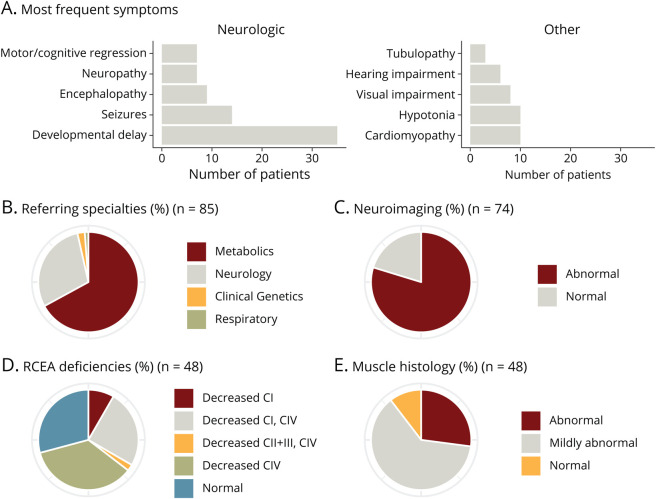
We investigated a cohort of 85 pediatric patients using clinical exome sequencing and compared the results with the outcome of traditional diagnostic tests, including biochemical testing of routine parameters (lactate, alanine, and proline), neuroimaging, and muscle biopsy with histology and respiratory chain enzyme activity studies.
We established a genetic diagnosis in 36.5% of the cohort and report 20 novel disease-causing variants (1 mitochondrial DNA). Counterintuitively, routine biochemical markers were more predictive of mitochondrial disease than more invasive and elaborate muscle studies.
We propose using biochemical markers to support the clinical suspicion of mitochondrial disease and then apply first-line clinical exome sequencing to identify a definite diagnosis. Muscle biopsy studies should only be used in clinically urgent situations or to confirm an inconclusive genetic result.
This is a Class II diagnostic accuracy study showing that the combination of CSF and plasma biochemical tests plus neuroimaging could predict the presence or absence of exome sequencing confirmed mitochondrial disorders.
我们推测需要新的研究途径来减少儿科线粒体疾病的诊断弯路,并试图确定临床外显子组测序在一大群疑似线粒体疾病患者中的效用,同时探究线粒体疾病的任何传统指标是否能预测确诊的基因诊断结果。
我们使用临床外显子组测序对85名儿科患者进行了研究,并将结果与传统诊断测试的结果进行了比较,传统诊断测试包括常规参数(乳酸、丙氨酸和脯氨酸)的生化检测、神经影像学检查以及肌肉活检(包括组织学检查和呼吸链酶活性研究)。
我们在36.5%的队列中确立了基因诊断,并报告了20种新的致病变异(1种线粒体DNA变异)。与直觉相反的是,常规生化标志物比更具侵入性且复杂的肌肉研究更能预测线粒体疾病。
我们建议使用生化标志物来支持线粒体疾病的临床怀疑,然后应用一线临床外显子组测序来确定明确的诊断。肌肉活检研究仅应用于临床紧急情况或用于确认不确定的基因检测结果。
这是一项II类诊断准确性研究,表明脑脊液和血浆生化检测联合神经影像学检查可以预测外显子组测序确诊的线粒体疾病的存在与否。