Kim Yong-Kyoung, Sathasivam Ramaraj, Kim Yeon Bok, Kim Jae Kwang, Park Sang Un
Division of Safety Analysis, Experiment and Research Institute, National Agricultural Products Quality Management Service, Gimcheon 39660, Republic of Korea.
Department of Crop Science, Chungnam National University, 99 Daehak-ro, Yuseong-gu, Daejeon 34134, Republic of Korea.
ACS Omega. 2021 May 4;6(19):12820-12830. doi: 10.1021/acsomega.1c01202. eCollection 2021 May 18.
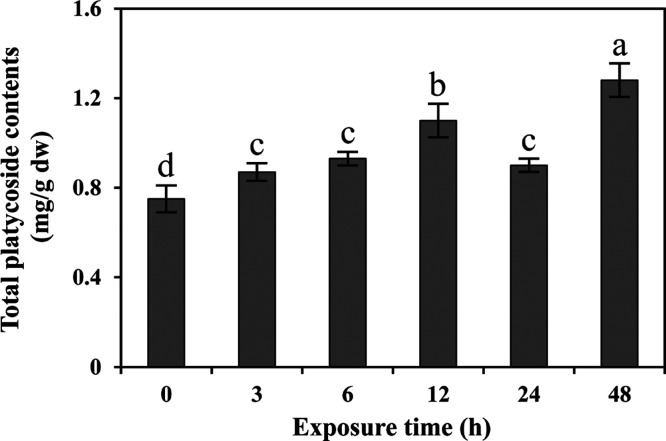
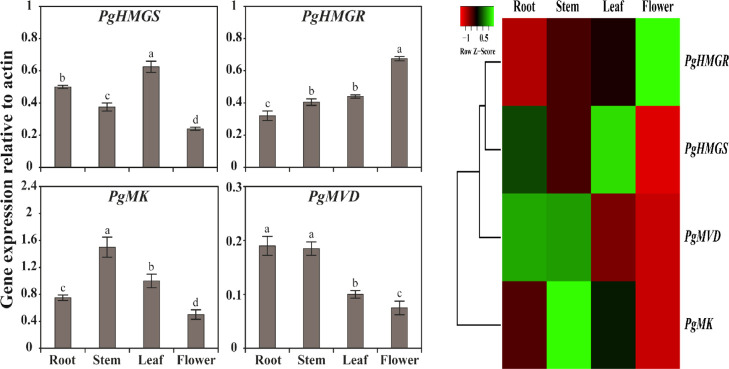
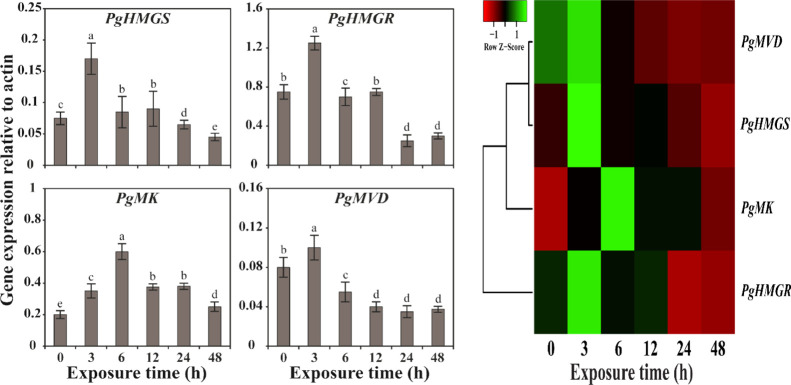
is a perennial plant that has been used for medicinal purposes. Specifically, it is widely used in Northern China and Korea for the treatment of various diseases. Terpenoids belong to a group called secondary metabolites and have attracted a wide range of interest. Here, we determined the expressed sequence tag (EST) library of the methyl jasmonate (MeJA)-treated hairy root of . In total, 5760 ESTs were obtained, but after deleting the vector sequences and removing poor-quality sequences, a total of 2536 ESTs were attained. Of these, 811 contigs and 1725 singletons were annotated. The data were further analyzed with a focus on the gene families of the terpenoid biosynthetic pathway (TBP). We identified and characterized four TBP genes; among these were three full-length cDNAs encoding , , and , whereas had a partial sequence based on the EST library database. Phylogenetic analysis and a pairwise identity matrix showed that these identified genes were closely related to those of other higher plants. Moreover, the tertiary structure and multiple alignment analysis showed that several distinct conserved motifs were present. Quantitative reverse transcription-polymerase chain reaction results revealed that TBP genes were constitutively expressed in all organs of , while the expression of transcript levels of these genes varied distinctly among the organs. Additionally, the total amount of platycosides was highly detected in the root, accumulating in concentrations 7.8 and 2.6 times higher than in the hairy root and stem, respectively, and 1.4 times higher than in the leaf and flower. The highest amount of total phytosterols was found to accumulate in the leaves at 9.3, 9.1, 1.8, and 1.6 times higher than that of the stem, root, hairy root, and flower, respectively. After the hairy root was exposed to the MeJA treatment, the transcript levels of , , , and had significantly increased. The highest level of transcript accumulation occurred at 3 h after initial exposure for most of the genes. Meanwhile, triterpene saponin accumulation increased with the increase in the time of exposure, and at 48 h after initial exposure, the total saponin content was the highest recorded.
是一种多年生植物,一直被用于药用目的。具体而言,它在中国北方和韩国被广泛用于治疗各种疾病。萜类化合物属于一类称为次生代谢物的物质,已引起广泛关注。在此,我们测定了茉莉酸甲酯(MeJA)处理的[植物名称]毛状根的表达序列标签(EST)文库。总共获得了5760个EST,但在删除载体序列并去除质量较差的序列后,共获得了2536个EST。其中,811个重叠群和1725个单拷贝序列得到注释。数据进一步聚焦于萜类生物合成途径(TBP)的基因家族进行分析。我们鉴定并表征了四个TBP基因;其中三个是全长cDNA,分别编码[具体蛋白名称1]、[具体蛋白名称2]和[具体蛋白名称3],而[基因名称4]基于EST文库数据库只有部分序列。系统发育分析和成对同一性矩阵表明,这些鉴定出的基因与其他高等植物的基因密切相关。此外,三级结构和多序列比对分析表明存在几个不同的保守基序。定量逆转录-聚合酶链反应结果显示,TBP基因在[植物名称]的所有器官中组成性表达,而这些基因转录本水平的表达在不同器官中差异明显。此外,桔梗皂苷总量在根中检测到的含量很高,其积累浓度分别比毛状根和茎高7.8倍和2.6倍,比叶和花高1.4倍。发现总植物甾醇含量最高积累在叶中,分别比茎、根、毛状根和花高9.3倍、9.倍、1.8倍和1.6倍。毛状根经MeJA处理后,[基因名称1]、[基因名称2]、[基因名称3]和[基因名称4]的转录本水平显著增加。大多数基因在初次暴露后3小时转录本积累水平最高。同时,三萜皂苷积累随着暴露时间的增加而增加,在初次暴露后48小时总皂苷含量达到记录的最高值。